
Phoenix already hitting annual average for number of 110-degree days
It's only July 14, but Phoenix is already approaching the annual average for days with temperatures of 110 degrees or higher.

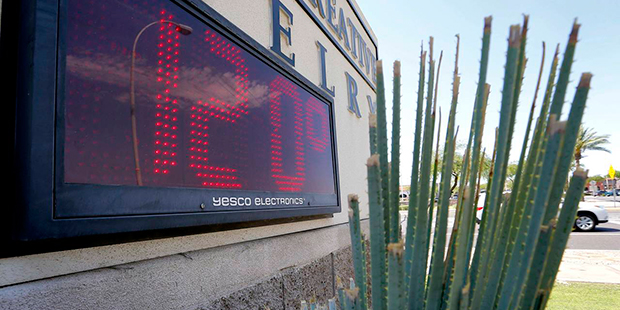
A sign, in direct sunlight, indicates 120 degrees, Monday, June 20, 2016, in Phoenix. The National Weather Service is expecting another day of triple-digit temperatures in Phoenix and across much of the Southwest. On Sunday, the mercury climbed to 118, breaking a record of 115 set nearly 50 years ago. The heat played a role in the deaths of mountain biker in Phoenix and a hiker in Pinal County over the weekend. (AP Photo/Matt York)
(AP Photo/Matt York)
PHOENIX — It’s only July 14, but Phoenix is already approaching the annual average for days with temperatures of 110 degrees or higher.
Thus far in 2016, the National Weather Service has recorded a high of at least 110 degrees a total of 18 times.
The annual average for days with such extreme highs — 19.
440pm: Phoenix just hit 110 degrees for a high temp. That's 18 days of 110 or higher this year. Official annual avg is only 19. #azwx
— NWS Phoenix (@NWSPhoenix) July 12, 2016
Jessica Nolte said the Phoenix area will likely hit the average mark or surpass it, especially given this weekend’s forecast.
“At least through Sunday, we’re hovering around the 110, 111 mark,” she said.
Phoenix will see 110+ heat thru the weekend with Friday the hottest day. Expect moderate heat risks daily. #azwx pic.twitter.com/okAb3TVH5j
— NWS Phoenix (@NWSPhoenix) July 13, 2016
Phoenix opened summer by tying the record for the hottest average June temperature.
The average high temperature for Phoenix was 107.4 degrees, which tied for the fifth warmest June in city history.
In all of June, there were five daily records broken, with the highest temperature at one point reaching 118 degrees on June 19. That was the fifth-hottest day ever recorded in the city.
However, relief could be around the corner. The Arizona monsoon season could be poised to send storms rolling back through the Phoenix area as early as next week after a lull.
“Even though the moisture has disappeared for a short while, it’s bound to come back,” Nolte said. “It’s bound to bring all of the associated hazards — blowing dust, dust storms, lightning, downburst winds.”
KTAR’s Jim Cross contributed to this report.
Related
 Cornell president admits he never followed up on gang rape allegation ahead of no-confidence debate
 Scottsdale Unified would have to cut $14.9M in non-classroom spending if Prop 320 passes
 WATCH: President Donald Trump headlines rally in Bullhead City
 Blockbuster-era law governing privacy of video rentals gets a fresh look from the Supreme Court
 A gang rape allegation at Cornell highlights how Title IX guides campus sex assault cases
 Lawyers for Federal Reserve’s Lisa Cook says White House hearing set up by Trump is ‘biased’

Comments
0 Comments