
After 4 years of construction and $832M, I-10 Broadway Curve Improvement Project is complete
After four years of construction – and countless traffic detours -- the I-10 Broadway Curve Improvement Project is officially finished.


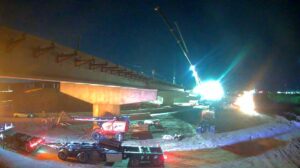
The I-10 Broadway Curve Improvement Project is complete after four years of construction. (KTAR News/Colton Krolak)
(KTAR News/Colton Krolak)
PHOENIX – Officials and motorists alike are celebrating the completion of the largest freeway reconstruction project in Arizona history.
After about four years of construction – and countless traffic detours — the I-10 Broadway Curve Improvement Project is officially finished.


State and local officials — including Gov. Katie Hobbs and Phoenix Mayor Kate Gallego — joined project partners and stakeholders to commemorate the achievement during a media event Tuesday at Tempe Diablo Stadium.
“We’ve crossed that finish line and we can take a moment to enjoy the fact that we did what we set out to do,” said Jennifer Toth, director of the Arizona Department of Transportation (ADOT). “So, in this case, we took on a major effort to reduce traffic congestion and improve travel time on I-10 through this very busy Broadway curve area.”
Construction, which began in summer 2021, ended Saturday, ADOT said.
How much did the Broadway Curve Improvement Project cost?
All told, the project, which was carried out as a public-private partnership, cost approximately $832 million.
It was funded, in part, by a half-cent Maricopa County sales tax dedicated to transportation improvements known as Proposition 400.
Hobbs said the investment will pay off economically for the state.
“A major thoroughfare for freight, commerce, and commuters, the Broadway Curve has solidified its place as a key driver of Arizona’s economy,” she said. “These critical infrastructure investments will help grow and attract businesses and make Arizona the best place to live, work and raise a family.”
How was I-10 transformed by Broadway Curve Improvement Project?
The Broadway Curve Improvement Project spans an 11-mile stretch of Interstate 10 between the Loop 202 interchange in the Chandler/Ahwatukee area and I-17 near Phoenix Sky Harbor International Airport. Related work was completed on US 60 and State Route 143.
The project was designed to improve freeway safety by reducing the need for lane changes and weaving through the area while improving access to 4,600-plus businesses along the Broadway Curve corridor.
The I-10 mainline through the area was transformed into a 16-lane behemoth, with six general purpose lanes (up from four) and two HOV lanes in each direction between US 60 and I-17.
City and state leaders are celebrating the completion of the I-10 Broadway Curve Improvement Project, which was built to improve safety and reduce congestion.@KTAR923 pic.twitter.com/zJ6f1ohVOq
— Colton Krolak (@ColtonKrolak) June 3, 2025
In addition, collector-distributor roads were built parallel to I-10 between Baseline Road and 40th Street, separating through-traffic from the exits and entries along that stretch.
Furthermore, a fourth general purpose lane in each direction was added to I-10 between US 60 and Ray Road.
The work included the following upgrades, too:
- The I-10/SR 143 interchange was rebuilt to improve traffic flow and connect SR 143 directly to the I-10 HOV lanes.
- The Broadway Road and 48th Street bridges over I-10 were replaced.
- The I-10 bridges over the Salt River were widened.
- Multi-use bridges for pedestrians and bicyclists were built over I-10 at Alameda Drive and the Western Canal, between Baseline and Broadway roads.
- The Sun Circle Trail I-10 crossing at Guadalupe Road was improved.
- Sound and retaining walls were added where needed, and additional overhead messages signs were installed.
The Maricopa Association of Governments (MAG), a regional planning and policy council, programmed funding for the Broadway Curve Improvement Project as a way to reduce I-10 travel times during peak hours, improve airport access and prepare for the projected Valley population growth.
A 2020 MAG economic evaluation determined that the project would save motorists a cumulative total of 2.5 million hours in traffic each year, which translates to $130 million in time savings.
More than 300,000 vehicles pass through the Broadway Curve on an average weekday, and officials expect the traffic to increase by 25% by 2040.
Tempe Mayor Corey Woods applauded the multi-entity collaborative effort.
“I can’t express it enough how wonderful it’s been working with the cities of Phoenix and the city of Chandler and groups like ADOT and MAG and all these groups, frankly, that really always kept their eye on the ball when and frankly understood the importance of getting this project done,” he said.
KTAR News 92.3 FM’s Colton Krolak contributed to this report.
Get the latest KTAR News 92.3 FM traffic alerts sent straight to your phone by texting “TRAFFIC” to 620620.
Related
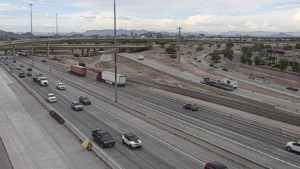 Drivers should think of new CD road alongside I-10 Broadway Curve as extended exit ramp
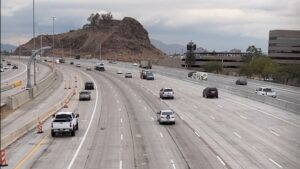 New lanes open to motorists as part of I-10 Broadway Curve Improvement Project
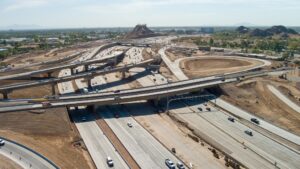 Here are the major freeway projects scheduled for metro Phoenix in 2025
 Valley Metro sets opening date for Phoenix's long-awaited South Central Extension
 Detours, Devils and dirndls: How to navigate Tempe closures this weekend
 Phoenix freeway closures: How to steer clear of roadwork this weekend

Comments
9 Comments
Arizona is awesome. And no bs toll roads.
That’s a W. Pretty quick when you consider the scope.
I was caught off guard also. I figured at least another year. Great work. I love the HOV lane to the 143. No need to efff around with the US 60 interchange traffic to go from NB(West) I10 to the 143. Just stay in the HOV far left lane.