
10-to-1 spending gap in SRP election defines battle for Phoenix utility control
On April 7, eligible voters across metro Phoenix will decide who controls the Salt River Project (SRP), one of the nation's largest public utilities. Whoever wins will decide fundamental questions about Arizona's energy and water future.


An SRP canal carries water through metropolitan Phoenix. The Salt River Project's 1,265-mile network of canals, laterals and channels delivers nearly 1 million acre-feet of water annually to a 240,000-acre service area, making the utility's elected leadership crucial to the region's water future. (Photo courtesy of Salt River Project)
(Photo courtesy of Salt River Project)
The Salt River Project election is Tuesday, April 7. Visit the SRP website for information about how to vote on Election Day. Below is a story about the election originally published on March 23, 2026.
PHOENIX — On April 7, eligible voters across metro Phoenix will decide who controls the Salt River Project (SRP), one of the nation’s largest public utilities.
Whoever wins will decide fundamental questions about Arizona’s energy and water future.
In this often-overlooked race, the winners will oversee electricity and water delivery to more than 2 million residents, set utility rates, determine the pace of renewable energy adoption and help allocate Arizona’s share of the dwindling Colorado River.
They’ll also help decide whether data centers pay full infrastructure costs or shift expenses to residential customers.
What’s typically been a sleepy affair with roughly 1% turnout has exploded into a multimillion-dollar clash between competing visions for Arizona’s energy future.
Two slates of candidates with competing visions
The race features two distinct slates of candidates with sharply different priorities.
The Clean Energy Slate, led by Sandra Kennedy running for President, and including current board members Randy Miller, Casey Clowes, Krista O’Brien and Kathy Mohr-Almeida, emphasizes renewable energy expansion and consumer protection.
Kennedy, a former Arizona Corporation Commissioner, positions herself as “a consumer advocate” who has “always been outspoken for the rate payers of this state.”
The slate’s central message: clean energy and affordability go hand-in-hand.
“Solar and wind are some of the cheapest energy sources right now and investing in them will give families more control over their bills,” Clean Energy campaign manager Josie Mitz said.
Their platform prioritizes making “data centers pay their fair share” and protecting Arizona’s limited water resources.
The Affordable Reliable Rate Team, backed by Turning Point Action, includes Chris Dobson and Barry Paceley, running for president and vice president, respectively.
With 20 years of SRP experience, Dobson emphasizes what he calls a “balanced approach” to energy that maintains affordability while transitioning away from coal.
“We’re not against renewables, but we’re just a balanced approach to make sure that we incorporate it properly where we can maintain our reliability,” Dobson explained.
The team argues that natural gas serves as a crucial “bridge” fuel until nuclear power becomes viable around 2040.
“Every 1 megawatt of natural gas that we add supports 4 megawatts of renewables,” Dobson said, describing how quick-firing gas plants balance solar intermittency during cloudy conditions.
Paceley, an SRP Council member for 14 years, frames the choice starkly.
“The No. 1 objective … is just keep our power bills down. And that helps everybody in the community,” he said.
Unprecedented outside involvement
What sets this election apart from previous ones is the involvement of Turning Point Action, the Phoenix-based conservative activist organization cofounded by the late Charlie Kirk.
Tyler Bowyer, Turning Point Action’s chief operating officer, confirmed the group has deployed “hundreds and hundreds of full-time staff” and substantial financial resources to support the Affordable Reliable Rate slate.
“We haven’t committed a dollar amount,” Bowyer told KTAR News 92.3 FM. “(The SRP election) stops radical policies and really bad ideas that stem from progressivism.”
Turning Point’s involvement serves dual purposes.
“We look at this as a ballot chase,” Bowyer explained, describing efforts to register voters and ensure turnout. More strategically, “this is laying the groundwork for voter interaction that needs to happen in order to get out the vote for 2026 (midterm elections).”
The Clean Energy slate expects to be “outspent 10 to 1, maybe more,” according to Mitz.
Their campaign relies mostly on grassroots organizing, said Mitz.
They have volunteers making phone calls, knocking on doors and educating voters about an election many don’t know exists. Environmental groups including the Sierra Club’s Grand Canyon chapter support their efforts.
The heavy outside involvement reflects the high stakes.
Beyond campaign rhetoric about “clean energy” versus “affordable rates,” the winning slate will make concrete decisions affecting millions of Arizonans.
What the new SRP board will decide
The incoming board will determine whether expanding data centers, which require enormous amounts of power and water, pay full infrastructure costs upfront or shift expenses to residential ratepayers.
Dobson noted that SRP already implemented an E-67 rate requiring large users to “pay 100% of their mitigation costs” including easements, transmission equipment, transformers and substations.
“It’s protecting the ratepayers and making sure if these guys want to come in and do it, … this is what it’s going to cost,” Paceley said.
SRP’s Association delivers nearly 1 million acre-feet of water annually to a 240,000-acre service area in metropolitan Phoenix.
The elected officials will help determine water allocation as Colorado River supplies dwindle and the Supreme Court weighs in on water rights disputes.
Dobson highlighted plans to expand Bartlett Dam on the Verde River, potentially storing an additional 400,000 acre-feet, or roughly equivalent to one year’s water supply, for the entire SRP territory.
“It’s the forward thinking, trying to conserve water when we got it, as opposed to just letting it go down the salt and then into the Gila,” he said.
The Clean Energy slate wants faster adoption of solar and wind power, while the Affordable Reliable Rate team emphasizes maintaining fossil fuel capacity until nuclear comes online.
Kennedy argues solar and wind economics make rapid expansion sensible.
“As demand keeps increasing, clean energy is an affordable option with unlimited supply, making it a smart choice for now and for the future,” she said.
Dobson counters that reliability requires diverse sources.
“Solar’s fairly cheap during the time (of day), but then once it becomes 4 p.m. when the sun starts setting … you have these things called intermittences. You balance that out with natural gas,” he said.
The board executives and members elected on April 7 will serve four-year terms. Eligible voters must be U.S. citizens, at least 18 years old, registered to vote in Arizona and own property within SRP boundaries.
The final pitch to voters
Both sides view the election as consequential beyond Phoenix.
Bowyer warned about the implications if the Clean Energy slate prevails.
“If we are not successful, I think that there’s a good chance that (radical environmentalists) will want to spend more time in the state,” he said.
Kennedy, however, accused Turning Point of spreading misinformation. She also pointed to parallels to past utility controversies, such as a situation involving Arizona Public Service in 2014.
“APS went out and bought their utility commissioners. And what happened to their rates? Their rates went up, almost eightfold,” she said. “That is history in the making and we’re looking at the same thing coming right around again.”
For many voters, the choice comes down to fundamental questions about Arizona’s future in a warming, water-scarce West and who should make those decisions.
Bowyer rejected characterizing the race in partisan terms.
“This is not really even a political issue as much as it’s been politicized by the left,” he said. “This is a lifestyle, civilization issue and we’re happy to participate to make sure that we defend the civilization we’re trying to protect.”
Kennedy offered a different framing focused on economics.
“Arizona families are frustrated by unpredictable bills and feel they have no control over the cost,” she said. “And clean energy is cheaper and more stable and offers peace of mind that they deserve.”
“In the end, this isn’t partisan,” offered Dobson, looking at the decisions soon coming before SRP. “We’re talking water and power here. And what are we going to do to carry us to the next 100 years?”
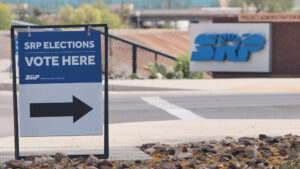
Early voting continues through April 6 at SRP’s Administration Building in Tempe. Election Day voting and ballot drop-off runs from 6 a.m. to 7 p.m. on April 7 at the same location.
Related
 Salt River Project election sees surge of attention as electricity bills rise
 SRP board approves 3% cut in electricity rates for hottest months of 2026
 Donald Trump plans Oct. 14 rally in Bullhead City as Arizona votes early
 Sen. Ruben Gallego says ASU should have fired hockey coach after workout injured player
 Can Maricopa County change — or completely dump — third-party election vendors?
 Maricopa County official says recorder’s mail ballot claims reflect ‘pattern’ of failing to tell truth

Comments
3 Comments
TPA is going to throw $'s at this? Heaven help the SRP customers.
Only one reason TPA spent money on this election, there is more money to be grifted for TPA.
Sounds like some of these people escaped from "F'tardistan" (WA,OR,CA). This tired broken record....“Solar and wind are some of the cheapest energy sources right now and investing in them will give families more control over their bills,”