
Phoenix settles into triple-digit territory as monsoon season grows near
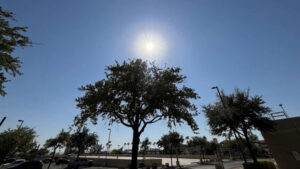
As the calendar turns to a new month and the monsoon season approaches, Phoenix is settling into triple-digit territory.


Phoenix is settling into triple-digit territory. (KTAR News file photo)
(KTAR News file photo)
As the calendar turns to a new month and the monsoon season approaches, Phoenix is settling into triple-digit territory.
“The first week of June, we’re going to see high temperatures in Phoenix hitting those low 100s, maybe pushing right around the 105 mark for the middle of the week,” meteorologist Sean Benedict of the National Weather Service told KTAR News 92.3 FM on Monday.
Highs are expected to peak Wednesday and Thursday and then dip a few degrees — but remain in the 100s — as moisture pushes into the region.
But don’t expect any pre-monsoon rainfall in the Valley just yet after only trace amounts fell in April and May. March 29 was the last time Phoenix received measurable precipitation.
“We’re only looking at showers and storms developing toward far eastern Arizona over some of the mountains. So, you might be able to see that from Phoenix, but overall our chances of seeing anything in Phoenix are very low,” Benedict said.
Temperatures typically peak in the low 100s this time of year, so the early-June forecast shouldn’t be a surprise. Additionally, prognosticators are expecting a hotter-than-normal summer, Benedict said.
What’s Phoenix’s monsoon season rainfall outlook?
The odds also are in favor of more rain than usual during the monsoon season, which runs from June 15 to Sept. 30. Benedict explained that monsoon conditions could develop in Arizona earlier than usual after a winter with low snowpack in the high country.
“With less snowpack, we’re anticipating a potentially earlier development of the monsoon high pressure system. Due to those warmer grounds you can develop that circulation, and then that could draw in moisture sooner,” he said.
The prevailing El Niño climate pattern in the Pacific Ocean could also contribute to Phoenix’s storm activity, particularly later in the summer.
“Having those warmer waters in the eastern Pacific may lead to a little bit more activity in terms of, like, tropical cyclone development, and then that may push moisture up here into the desert Southwest and then drive our showers and thunderstorms,” Benedict said.
KTAR News 92.3 FM’s Shira Tanzer contributed to this report.
Related
 KTAR Weather Center: Forecast, radar maps, latest news
 Arizona's monsoon season projected to be wetter than usual, but not enough to end the drought
 Is Arizona’s water supply getting boost from recent storms, El Niño?
 Parts of metro Phoenix see showers before evening lull, overnight ramp up
 Ground stop issued for Phoenix Sky Harbor due to thunderstorms
 Possibility of showers remains in Phoenix-area forecast after wet weekend

Comments
0 Comments