
Water expected to be restored to Grand Canyon’s South Rim in weeks following flash flood
The National Park Service said crews will be constructing a temporary water intake at Bright Angel Creek to replace the one that was destroyed by the flood.

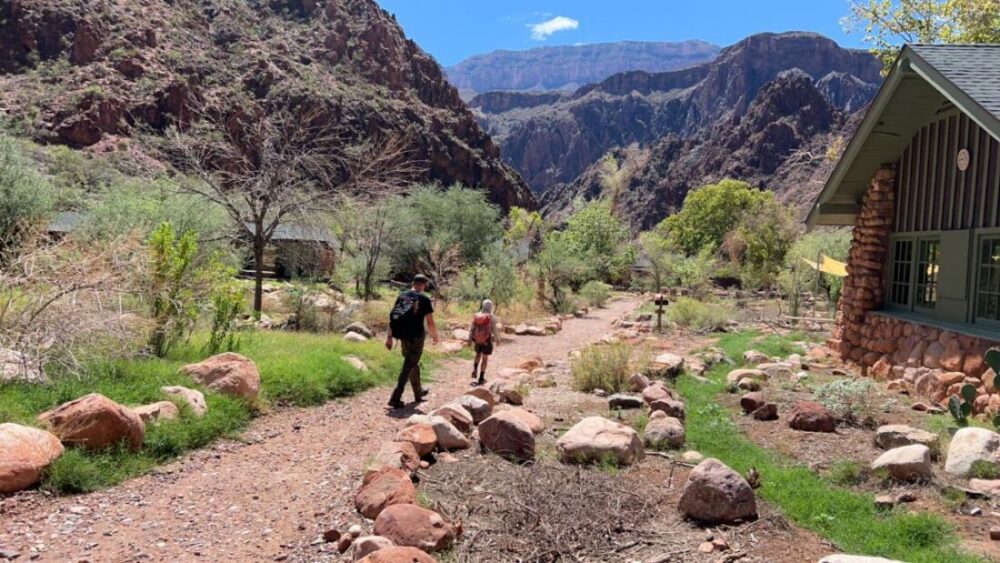
Work to restore water service to the Grand Canyon's South Rim following a destructive Aug. 29 flash food is expected to take weeks instead of months, officials announced. (Photo via National Park Service)
(Photo via National Park Service)
Work to restore water service to the Grand Canyon’s South Rim following a destructive Aug. 29 flash food tearing through Bright Angel Canyon and the Phantom Ranch area is expected to take weeks instead of months, officials announced.
The National Park Service said crews will be constructing a temporary water intake at Bright Angel Creek to replace the one that was destroyed by the flood. It added that construction is expected to start this week as engineers are currently in the canyon designing the temporary intake.
“There is still significant work ahead and that timeline depends on conditions in the canyon and our continued ability to conserve the water we have,” Fire Chief and Deputy Incident Commander Dave Black said during a community meeting Tuesday. “But now we have a path forward and work is underway.”
Even though the intake is temporary it is still expected to pump 500 gallons per minute, which is the same capacity that was available before the flood.
Once the intake is operational, it will move water through the new Transcanyon Waterline system to replenish South Rim storage while a permanent intake is being built.
While the legacy Transcanyon Waterline was damaged during the flood, including 40% of the old pipeline that runs between the Phantom Ranch area and the North Rim, the new pipeline infrastructure on the canyon’s south side was not impacted.
Work to make the pipeline infrastructure and South Rim water treatment plan, which prior to the flood was weeks away from being brought online, operational has now been accelerated.
Electricity needed to build the temporary intake has been restored and crews are preparing the site for construction, including removing debris.
“There is still uncertainty. There will undoubtedly be challenges along the way. But we have made substantial progress in a short period of time and we have a clear path forward,” Black said.
It was emphasized that water conservation will be critical while the repairs are being done, as the South Rim is relying on stored water. Every gallon saved provides crews with more time and flexibility.
To support the effort, Stage 4 water restrictions took effect in the South Rim on Aug. 31. The park also shut off potable water in multiple areas of the South Rim over the weekend.
Five 2,500-gallon potable-water tanks have already been placed throughout the community, and more are planned. Additionally, more than 13,500 gallons of potable drinking water has been positioned across the South Rim.
The park has also worked with partners, including Xanterra and Delaware North, on conservation efforts.
“Xanterra has offset 42,500 gallons daily from their lodges, dining operations, housing and pack operation. They’ve also provided a train car with 52,000 gallons for fire suppression if we need it,” Nathan Souder, a liaison officer with the Western Incident Management Team, said. “Delaware North has offset over 40,000 gallons daily from their lodging, dining and camping operations.”
Potable-water tanks, bottled drinking water, handwashing stations, portable showers, laundry facilities and portable toilets will also be deployed to reduce demand on the water system.
The park is evaluating other ways to supplement the water supply as well. It is collaborating with the Arizona Department of Environmental Quality, contractors and potential suppliers on those options.
Search efforts, Grand Canyon closures continue
Search teams are still looking for the last missing person following the flood. There are people looking in the delta area near Phantom Ranch and river patrol crews searching downstream along the Colorado River as well as adjacent areas where debris may have been carried.
While the national park is open on both the South and North Rims, there are inner-canyon areas that are closed.
The South Kaibab Trail below the Tip-Off and the Bright Angel Trail below its intersection with the Tonto Trail are closed to visitors.
Additionally, the North Kaibab Trail, Cottonwood Campground, Phantom Ranch, Bright Angel Campground and the Black and Silver bridge are all closed, effectively cutting off hiker access to the canyon’s popular rim-to-river corridor.
Overnight accommodations at El Tovar, Bright Angel Lodge, Maswik Lodge, Yavapai Lodge and Trailer Village were also shut down.
KTAR News 92.3 FM’s David Iversen contributed to this report.
Related
 SRP pulls back curtain on Mormon Flat Dam maintenance work at Canyon Lake
 Democrat says ‘Arizona got screwed’ in Colorado River water agreement
 Arizona joins lawsuit over Colorado River plan, warns of deep water cuts
 Is Arizona’s water supply getting boost from recent storms, El Niño?
 Arizona Cotton Growers Association honors lawmaker for service to agriculture industry
 Scottsdale considers new restrictions for large water users as demand rises

Comments
0 Comments