
Arizona, other Colorado River basin states miss latest deadline on water use deal
A Feb. 14 deadline came and went without Arizona and the other Colorado River basin states coming to terms on a new operating agreement.

Watch: Arizona, other Colorado River basin states miss latest deadline on water use deal | 1 min
PHOENIX – A Feb. 14 deadline came and went without Arizona and the other Colorado River basin states coming to terms on a new operating agreement amid historic drought conditions.
One day before the missed deadline, Central Arizona Project (CAP) President Terry Goddard told KTAR News 92.3 FM’s Arizona’s Morning News the ongoing dry spell represents “the longest continuous reduction in precipitation” on the Colorado River watershed in roughly 1,000 years.
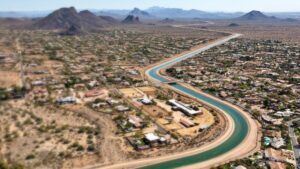
CAP delivers Colorado River water to about 80% of Arizona’s population through a canal system that stretches more than 300 miles. It begins at the Colorado River near Lake Havasu and ends south of Tucson.
“This is bad. And it is worse this year than we’ve seen it for a long time,” Goddard said of the drought.
Colorado River reservoirs approach ‘dead pool’ levels
Lakes Powell and Mead, the largest Colorado River reservoirs, are dangerously close to “dead pool” levels, where the water can no longer flow through the dam and generate electricity.
“You’ve seen, I’m sure, the pictures of what they call the bathtub ring effect in Lake Mead, where you’ve got this huge section of the lake where you can see where the water used to be and you can see where it is today, and it’s way down,” Goddard said.
Lake Powell is less than 25% full right now at 3,533 feet of elevation. If it drops below 3,370 feet, another 163 feet, Glen Canyon Dam will stop producing electricity.
“At times of low flow, we get dangerously close to not being able to turn the electric generating turbines, which is supplying a lot of inexpensive energy for the West,” Goddard said.
If the water goes below the turbines, dam operators must use the bypass chutes. The chutes are not as big as the gates going into the turbines, meaning they can’t let as much water out and it won’t generate electricity.
The U.S. Bureau of Reclamation wants to keep Lake Powell at a level much higher than what is needed to generate electricity.
However, Lake Powell still has a lot of water at 25% capacity, leading the lower basin states of California, Nevada and Arizona to wonder if there is an engineering fix.
“Is there any way that you can take less water because at so-called dead pool there is still 4 million acre-feet in Lake Powell,” Goddard said.
Colorado River disagreement likely to be settled in court
The seven Colorado River basin states have until the end of the year to finalize a new operating agreement into state and federal law.
But Goddard said the states are no closer to an agreement today than they were two years ago despite the latest missed deadline, so the matter will likely end up being resolved in the courts.
The lower basin states have already taken cuts, recognizing there is less water in the river.
“Our only condition was that the upper basin, the four states that are above us on the river, that would be Colorado, Utah, Wyoming and New Mexico, that they would share equally in any shortage,” Goddard said.
If the 1.5 million acre-feet of water the upper basin has already put on the table isn’t enough to balance the books, Goddard believes both basins should equally agree to water cuts.
Related
 Gov. Hobbs on Colorado River negotiations: Agreement is not likely by Feb. 14 deadline
 Why the basin states' fight over Colorado River water is a big deal for Arizona
 Rep. Andy Biggs says ‘water’s No. 1’ as he hears from Arizonans during run for governor
 Amazon launches collaborative initiative to fund Colorado River Basin water projects
 Election-year backlash clogs Scottsdale’s water recycling plan
 With Colorado River cuts looming, Peoria commits $104 million to bolster water supply

Comments
0 Comments