
Why the basin states’ fight over Colorado River water is a big deal for Arizona
Central Arizona Project could be severely impacted by future cuts to the state's Colorado River water allocation.

Watch: CAP President talks impact of Colorado River operating guidelines negotiations | 1 min
PHOENIX — Central Arizona Project (CAP) delivers water to about 90% of the state’s population.
CAP is a 336-mile system of aqueducts, tunnels, pumping plants and pipelines that carries Colorado River water to Arizona’s most-populated regions.
Terry Goddard, president of CAP, is worried about how operations will have to be restructured if Arizona gets shorted in when new Colorado River operating guidelines are finalized next year.
The basin states first agreed to Colorado River operating guidelines in 2007 when they anticipated future water shortages. When the U.S. Bureau of Reclamation made the original allocations, they believed the river could be relied on 18-20 million acre-feet of water. But now, the figure is around half that amount, at 10-11 million-acre feet, resulting in ongoing allocation cuts to some states that use Colorado River water, including Arizona.
The current operating guidelines expire at the end of 2026, and the Colorado River Basin states, along with Congress, must reach a new agreement by then.
Goddard, a former Phoenix mayor and state attorney general, told KTAR News’ AZ Political Podcast with Jim Sharpe last week that the basin states have not been able to come to an agreement over the last two years of discussions.
Arizona bears brunt of current Colorado River cuts
Under the current operating guidelines, the Bureau of Reclamation mandated that the lower basin states cut 720,000 acre-feet of their Colorado River water allocation this year and next.
Arizona had to absorb most of the cuts, 512,000 acre-feet, mainly impacting farmers in Pinal County.
“There basically is no more CAP service to Pinal County agriculture. Those farms either are on the pump or they’re going dry,” Goddard explained.
Goddard said there is this myth that Arizona is wasteful with water because of its fountains, lakes and golf courses. While some of that is true, he acknowledged, the Grand Canyon State also has done an incredibly good job at conserving water.
“In the ’50s, Phoenix used more water than they use today, and we have almost double the population,” Goddard said.
Most excess water usage in Arizona is from outdoor landscaping. There’s been push in much in the Phoenix metro area to incentivize homeowners and businesses to swap out their grass lawns for turf or opt for desert landscaping.
Trickle-down effect of water shortages
Goddard said the state’s economy is tied to its water security.
“If the CAP is significantly reduced beyond the one-third that’s already been taken, that we’re giving up now, it will come right out of our future development possibilities,” Goddard said.
State officials placed a moratorium on building in a part of the West Valley that relies solely on groundwater after it came to light it was short of the required 100-year water supply. Goddard said no other state has a 100-year water requirement for development.
Lower basin vs. upper basin
The lower Colorado River Basin states — Arizona, California and Nevada — are negotiating together against the upper basin states of New Mexico, Colorado, Utah and Wyoming.
“Colorado and the upper basin have taken the position that, ‘Hell no, we’re not giving you a drop of water, even in the most dire drought,’” Goddard said.
There are alternative ways the state could mitigate future cuts, but no simple solutions.
“We’ve got options, but none of those options are easy, and some of them are really expensive,” Goddard said.
What happens if states can’t agree?
If the basin states can’t come to an agreement on Colorado River water usage, Goddard said the federal officials are prepared to impose a settlement.
“The Bureau of Reclamation … is working on an Environmental Impact Statement, which will have at least six different alternatives. Presumably, at least one of those will be … less offensive to each side,” Goddard said.
Goddard called such a settlement a penalty and said he hopes it doesn’t have to come to that.
Related
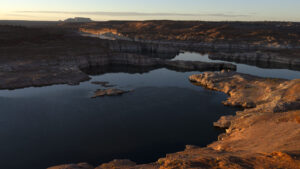 Arizona faces continued Colorado River water cuts, uncertainty about future access
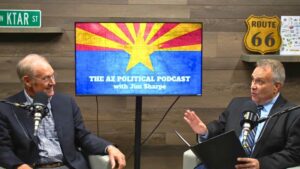 AZ Political Podcast: Former Arizona attorney general discusses state's water future
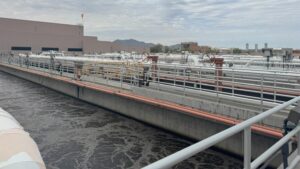 Phoenix planning 3 plants where treated wastewater will be purified enough to drink
 Lawsuit questions if Arizona city has enough groundwater for large housing development
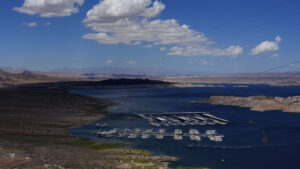 Arizona, Nevada and Mexico will again get less Colorado River water in 2026
 Scottsdale considers new restrictions for large water users as demand rises

Comments
0 Comments