
Arizona keeps legal options on the table after feds order historic Colorado River cuts
ADWR director says the state is keeping all legal options on the table after feds ordered Arizona to cut 760,000 acre-feet of river water per year.

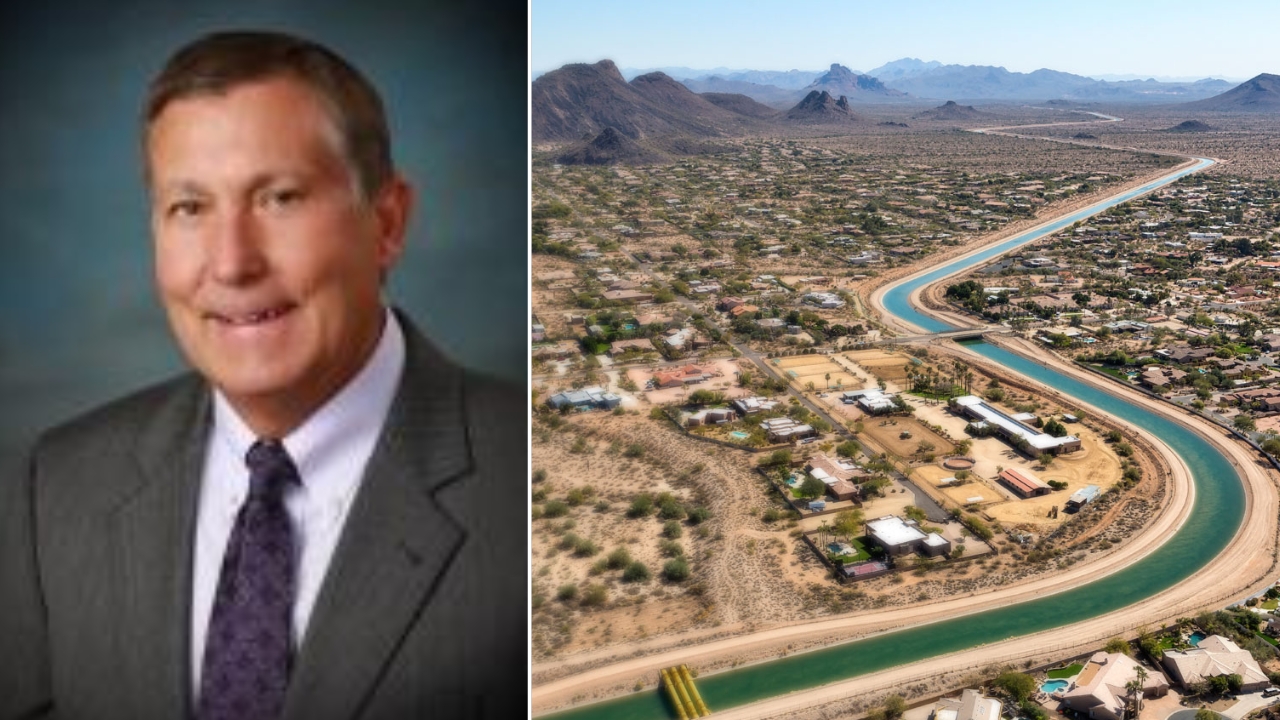
ADWR Director Tom Buschatzky speaks to reporters Friday after the federal government ordered the largest mandatory cuts in Colorado River history. The Central Arizona Project canal delivers river water to Phoenix, Tucson and tribal communities across the state. (ADWR)
(ADWR)
Arizona’s top water official said Friday the state won’t hesitate to go to court to protect its share of the Colorado River.
Tom Buschatzky, director of the Arizona Department of Water Resources, called the deal a short-term win to reporters Friday afternoon. He made the comments after the federal government ordered Arizona to give up 760,000 acre-feet of river water per year in 2027 and 2028.
That’s more than any other state.
It’s a win, Buschatzky said, because it avoided even deeper cuts the federal government had considered earlier this year. He said Arizona is keeping all legal options on the table.
“We reserve the right to launch it even within the 2027 -28 timeframe, depending on what the issue is,” he told reporters Friday, hours after the Interior Department released the agreement.
The Colorado River cuts won’t hit just one source
While the Central Arizona Project canal that supplies Phoenix and Tucson will take the biggest hit, Buschatzky said cities and farms along the river share the same priority as CAP and will absorb some of the reductions as well.
To make up the difference, the state plans to tap water it has been storing underground for decades through the Arizona Water Banking Authority. Cities, tribes and business leaders are also in discussions about programs to move backup supplies where they’re needed most.
When asked whether Arizona can keep growing under these conditions, Buschatzky was direct.
“Yes, we can continue to responsibly grow,” he added.
He pointed to state rules that require developers to prove 100 years of water supply before building new homes, along with backup supplies cities have built up since the 1980 Groundwater Management Act.
Buschatzky pushed back hard on the Upper Basin states – Colorado, Utah, Wyoming and New Mexico – for refusing to cut any of their own water use. He said Arizona had proposed the Upper Basin reduce consumption by just 100,000 acre-feet per year for five years during negotiations, but they rejected it.
“The Colorado River is a system and we need to address everything within the system, not just Lake Powell and Lake Mead.”
No timeline has been set for negotiating longer-term rules beyond 2028.
Buschatzky said the Lower Basin states first need to finalize their own agreement before returning to the table with all seven states.
Related
 SRP pulls back curtain on Mormon Flat Dam maintenance work at Canyon Lake
 Democrat says ‘Arizona got screwed’ in Colorado River water agreement
 Arizona joins lawsuit over Colorado River plan, warns of deep water cuts
 Is Arizona’s water supply getting boost from recent storms, El Niño?
 Arizona Cotton Growers Association honors lawmaker for service to agriculture industry
 Scottsdale considers new restrictions for large water users as demand rises

Comments
2 Comments
When legislation to build the CAP passed in the late 60's, part of the deal was that AZ would agree take a junior position to the other states when it came to future Colorado River allocation cuts. Well, that chicken has come home to roost it seems.
That should do wonders for your real estate prices. Time to get out while you can.