
Phoenix studies future of controversial reversible lanes
Phoenix is studying midtown traffic, including the fate of the controversial reversible lanes on Seventh Street and Seventh Avenue. Public input starts Thursday.


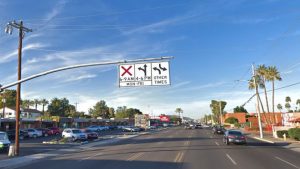
Phoenix is asking for public input on whether to update or change the city's "reversible" lanes. (Photo by David Iversen)
(Photo by David Iversen)
City officials are taking a fresh look at how traffic flows through midtown Phoenix, including the fate of the much-debated reversible lanes on Seventh Street and Seventh Avenue.
The Midtown Core Transportation Study will examine streets between 19th Avenue and 16th Street, from McDowell Road north to Dunlap Avenue. City officials announced the effort Wednesday, ahead of the first public meeting set for 6 p.m. Thursday.
Matt Wilson, assistant director of the Phoenix Street Transportation Department, said the study was prompted by residents who want changes to the reversible lanes, which switch direction during rush hour.
“There was a petition submitted to our city council asking for a change in the reversible lanes,” Wilson told a conference room full of reporters Wednesday. “There was a discussion at council that resulted in a request for street transportation to conduct a comprehensive study.”
What the city will study
Scott Beck, with consulting firm WSP, is leading the study. Crews are gathering traffic data at about 60 intersections and 30 to 40 speed-monitoring points across the study area over a two-week period.
Researchers will also dig into the city’s historical traffic records, crash patterns, congestion and queuing, lane usage and even anonymized cellphone data to understand how people actually move through midtown.
“That’s going to build the foundation for the analysis,” Beck said.
The goal is to predict future demand on midtown roads and spot bottlenecks for drivers, transit riders, cyclists and pedestrians alike.
Possible fixes could include new signal technology, street redesigns within existing rights-of-way, better traffic distribution across the network or changes to the reversible lanes themselves.
“We’ll also evaluate options for the reversible lanes, including modifications, improvements or the potential removal,” Beck said.
But any traffic changes will come with trade-offs.
“This task will be about balancing safety, mobility, access and the community needs to develop practical, well-rounded solutions for the future,” Beck said.
What is so controversial about reversible lanes?
Reversible lanes are center lanes that change direction depending on the time of day. Critics say they create confusion and a dangerous mess for drivers, pedestrians and local businesses alike.
The number of crashes in these center lanes have spurred documentary films and petitions. Residents complain that the lanes are unnecessarily stressful, while business owners report lost traffic as would-be customers avoid the chaos.
“Our streets should be for people, not just for cars,” Urban Phoenix Project board member Jamie Trufin said in a 2024 editorial for the Arizona Republic. “That’s what highways are for.”
The study comes as the area becomes more densely populated.
“People are definitely asking for some traffic improvements, how things will function as growth continues,” Wilson said.
What happens next?
The study will roll out in four phases: corridor analysis, scenario development, identifying a preferred plan and a final report. That final report will be sent to the Phoenix City Council in the fall.
The public now has the opportunity to provide input.
The city is hosting a virtual town hall on Thursday night to understand more about resident’s concerns. You can sign up to attend on city’s website.
“Tomorrow night is just the start of the public engagement period,” Wilson said. “We encourage feedback over that next month.”
A 2021 city study found the reversible lanes were essential to traffic flow and warned that removing them could slow travel times by more than 40%.
Related
 Study finds reverse traffic lanes north of downtown Phoenix are essential
 Detours, Devils and dirndls: How to navigate Tempe closures this weekend
 Phoenix freeway closures: How to steer clear of roadwork this weekend
 Northbound Loop 101 Pima Freeway reopens near Tempe-Scottsdale border after crash
 Next phase of I-10 widening between Phoenix and Casa Grande begins
 Child killed in multivehicle crash on I-10 in Phoenix

Comments
0 Comments