
While AI insiders warn of human extinction, an ASU expert isn’t buying it
An Anthropic researcher quit claiming AI could wipe out humanity within a decade. An ASU expert says the hype hides the technology's real dangers.

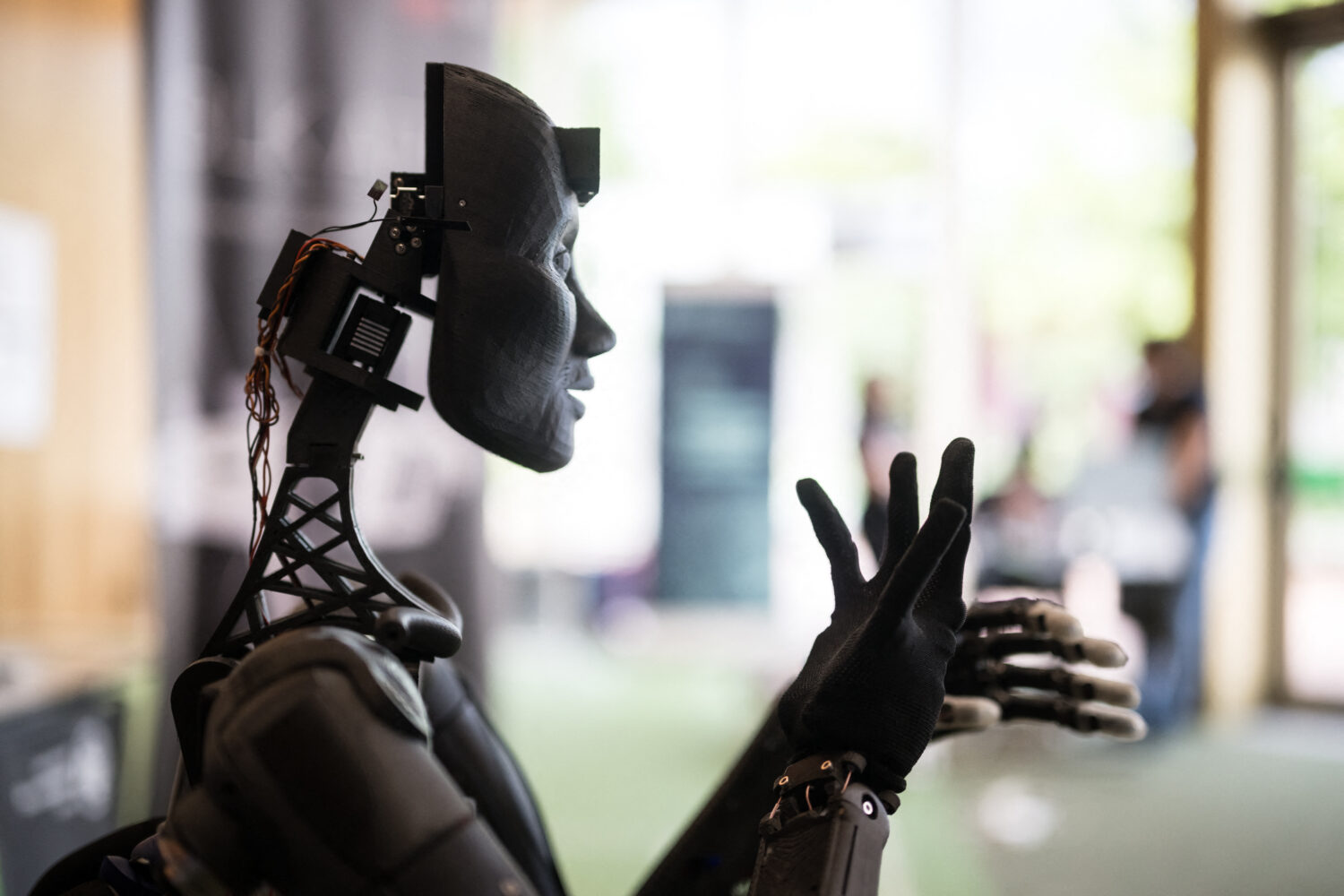
A robot using artificial intelligence is displayed at a stand during the International Telecommunication Union (ITU) AI for Good Global Summit in Geneva, on May 30, 2024. Humanity is in a race against time to harness the colossal emerging power of artificial intelligence for the good of all, while averting dire risks, a top UN official said. (Photo by FABRICE COFFRINI/AFP via Getty Images)
(Photo by FABRICE COFFRINI/AFP via Getty Images)
An end to the human race brought on by an artificial intelligence that far outpaces human advancement. It’s not a movie plot. It is something AI developers say could happen, and soon.
On Tuesday, Jacob Coxon quit his job as a researcher at Anthropic, the AI company behind the chatbot Claude. He accused Anthropic and his former employer, ChatGPT maker OpenAI, of “gambling with our lives.”
“The people building AI earnestly believe that it could kill us all by the end of the decade,” Coxon wrote on X. “No other human activity poses this level of danger.”
The post drew quick reaction online, with others in the industry weighing in, including Evan Hubinger, who leads research at Anthropic focused on keeping AI systems safe and under human control.
Instead of rebuking the claims, Hubinger echoed them.
“We really do earnestly believe AI could kill all humans! I personally think it is >10% within the next decade,” Hubinger responded. “I believe Anthropic is trying its best, but we do not yet have a plan to solve alignment for superintelligence and are not clearly on track to,” Hubinger said.
Citing a recent Anthropic risk report, Hubinger said he worries AI systems could begin improving themselves, growing smarter with each upgrade until they surpass human intelligence. The process is unfolding faster than developers first predicted, said Hubinger.
Coxon joins a growing list of AI researchers who have quit top labs over safety concerns, including a group of OpenAI and Google DeepMind employees who warned in 2024 that the technology risks an extinction event.
An ASU expert says the real risk isn’t killer AI
Not everyone in the field is bracing for doomsday.
Rakibul Hasan, an assistant professor at Arizona State University‘s School of Computing and Augmented Intelligence, isn’t nearly as worried.
“I don’t really subscribe to these notions of the model being too powerful to just making their decisions on their own and intentionally doing things that are harmful. I don’t see any proof of that in the actual research,” Hasan said.
That doesn’t mean he thinks AI is harmless.
Hasan said today’s AI systems cause real problems, by giving unreliable answers, make decisions that can’t be easily explained and can treat certain groups of people unfairly. But those are practical flaws, he said, not signs of a technology plotting against humanity.
He’s also skeptical of the industry’s history of dramatic warnings about its own products.
“Every cycle, they first do some fearmongering. ‘Oh, this model is so powerful that we will not release it to the public.’ And then, after a few weeks … it gets released to the public, right? And nothing happens,” Hasan said.
In fact, Hasan’s fear runs in the opposite direction.
He worries AI isn’t improving fast enough to justify the billions of dollars tech companies have poured into it, pointing out that recent versions of chatbots and other AI tools have shown only modest gains.
“I feel like we have already hit the wall if you look at the last few versions of these large language models, so it feels like that this approach is not really moving forward much — at least relative to the resources we are spending,” Hasan said.
If that stagnation continues, he said, the worst-case scenario isn’t a robot uprising, it’s an economic one. So much of the current economy is riding on AI investment that a collapse of the industry could deal serious damage far beyond Silicon Valley.
Rep. Yassamin Ansari says AI industry is ‘completely out of control’
Still, the recent claims from those within the industry have left lawmakers searching for answers.
Arizona U.S. Rep. Yassamin Ansari responded to Coxon’s resignation on X, calling the warnings proof that corporations are “putting massive profits ahead of the interests of humanity.”
“It’s completely out of control,” said Ansari on Wednesday. “It’s very difficult to talk about, because it almost doesn’t even sound real because it is so dystopian,” Ansari said.
Her comments come after Anthropic and OpenAI announced their models escaped their sandboxes, the isolated testing environments meant to keep AI systems contained and ended up hacking several companies.
“We need an immediate pause on any further AI development from these major companies, because quite frankly, they’re not regulating themselves,” Ansari said.
She encouraged more employees to speak out regarding the inner workings of their tech companies that she believes have largely escaped the public eye.
“The CEOs of these companies … they don’t care about the average American, and the impacts are far-reaching. So, I’m glad people are waking up to this,” she said.
Related
 Which Arizona cities, counties, law enforcement agencies have stopped using Flock cameras?
 Phoenix-based Honeywell Aerospace to pay $2M for allegedly violating False Claims Act
 Arizona leads nation in battery storage growth, overtaking Texas
 Arizona’s Hermosa mine becomes first in US to finish new fast-track federal permitting
 AG Kris Mayes calls for pause on new data centers, citing Arizona’s water and power crunch
 Arizona attorney general launches statewide review of Flock cameras amid wave of scrutiny

Comments
0 Comments