
2025 Maricopa County point-in-time homeless count another chance to help those in need
City officials gathered on Tuesday for the 2025 Maricopa County point-in-time homeless count to acquire data for federal funding.


PHOENIX — On a cold Tuesday morning, volunteers, city officials and police officers gathered at the Glendale Main Library as they prepared to begin the 2025 point-in-time count.
It’s a one-day count of unhoused people in the city and across Maricopa County, a requirement for federal funding used for homeless solutions. Information such as names and factors related to a person’s state of homelessness are gathered during the count.
It’s also used as a chance to hand out food, water and ways to access other resources.
Point-in-time homeless count starts in Glendale
“Oftentimes they don’t want to be found, and so they’ll be working in parks, parking lots, washes and various places homeless folk might be,” Glendale interim director of community services Matthew Hess said before the count began.
Soon after, the counters headed out in groups, each assigned to a specific “grid” of the city to make sure the whole community is covered.
In Glendale, police officers serve as support to other counters, an extension of everyday work from the Misdemeanor Repeat Offender Program (MROP) in the Glendale Police Department.
The program is an effort to divert people who face county jail time due to repeated offenses, which can often be associated with homelessness.
“After your fourth arrest [in a year] you’re looking at significant jail time or diversion,” said Greg Mills, who co-founded the program because he felt like something needed to be done in response to homelessness.
Glendale’s diversion into services to get work and eventually housing is done through nonprofit Phoenix Rescue Mission.
“I can’t grab you by the arm and drag you through the door. But if you’re willing to walk through the door, we’re willing to drop everything and help you,” Mills said.
When the count began in Glendale, Officer Mills took me to an empty desert area near Westgate. Mills is familiar with the local homeless population and says it’s an area people often camp in.
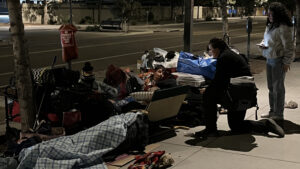
While the area was littered with trash, tents and strewn-out belongings, initially it seemed totally empty.
Mills shone his light on a pickup truck that he says was recently set ablaze over a possible dispute between two of the people who stay in the area.
Soon after, Mills approached another tent in the area and talked with a man sleeping inside. He declined an interview from the PIT counters, so a city official and Glendale Councilwoman Dianna Guzman (who volunteered for the count) wrote down visual information about him.
Before long, we headed to several other areas where Mills says he typically finds unhoused people. But the early morning hours were quiet with very few encounters.
Later in the day, Officer Mills introduced me to a man living on the streets who goes by “Redhawk,” who was waiting outside a Phoenix Rescue Mission food bank, standing by a cart filled with belongings.
He says his previous housing was through a Phoenix voucher program meant for single adults, but an accommodation had been made so Redhawk could live with his son.
His son eventually earned a scholarship to university and went to live in dorms. But that also led to Redhawk going back on the streets.
“‘Cause he’s living on campus now, it changed the situation, and I lost the apartment. And I’m back on the streets,” he said.
Despite that, Redhawk tells me he is “very, very proud” of his son. He says the one thing people need on the streets is compassion. It’s not just to be nice, he explains, as he’s only been able to improve his situation because of the help he’s received from others.
He says, “You can’t really put your feet on solid ground because you have no resources until somebody is willing to help.”
Officer Mills says he’ll be checking on Redhawk again.
“I’ll be out there tomorrow. If I see him, I’ll talk to him and try to get him to go with me again. That’s just what we do.”
Throughout the morning Officer Mills took me to other areas in Glendale, where encampments or groups of unhoused people had gathered in the past, including railroad tracks near 51st Avenue and Camelback Road and an empty dirt lot along 83rd Avenue. As of the day of the count, Jan. 28, those areas remained empty.
For Glendale Councilwoman Dianna Guzman, this shows signs of progress.
“Overall there were a lot less homeless people out that they were able to talk to. It’s a good thing, to me that shows me MROP is working in the City of Glendale.”
In PHX, I followed MAG (Maricopa Assoc. of Governments) workers around as they did their count.
While cities do their own count, MAG organizes the PIT throughout the region.
One man they spoke with was "Billy," near University Park. pic.twitter.com/IsxMrQ7q2D
— Balin Overstolz (@balin_om) January 28, 2025
To Phoenix and Beyond
While individual cities such as Glendale do their own count, the whole process for the Valley region is overseen by the Maricopa Association of Governments (MAG).
After talking with officials in Glendale and seeing the process there, I met with counters from MAG at University Park in the downtown area.
In Phoenix, the density of unhoused people compared to Glendale was immediate. Speaking to the unhoused at the park, MAG workers heard a range of stories.
One woman says she’s staying at a Central Arizona Shelter Services shelter and is trying to get clean from fentanyl, which she was only several days into doing. Another man says he’s been homeless in Phoenix since his youth and had previously been at the downtown homeless encampment known as “The Zone.”
A woman named Mara Butterfield tells counters she’s been homeless for about 6 months. After they collected her information, she told me more about her situation.
Mara says it started with a relationship she wanted to flee from, so she came to Phoenix but found no support here.
“I’m really just trying to figure it all out,” Butterfield said.
She had previously stayed at Phoenix’s “safe outdoor space,” or “SOS.” It’s an outdoor area that allows people to urban camp within its premises. There were many people at the park and the four MAG counters split into two teams to talk with everyone. Efforts are made to avoid duplication in the count by matching collected data.
Mag counter Dillon Belmont said there were no safety issues throughout the day, and he heard a wide range of reasons people became homeless. He also indicated recent laws and general crackdowns on homelessness in Arizona may be pushing unhoused people into the shadows without actually addressing them.
“This morning it did feel strangely low,” he said on what he called an informative day.
Deputy Director of the Phoenix Office of Homeless Solutions Scott Hall said the city count did not come with any major surprises.
He didn’t say if the city expects an increase or decrease in the PIT number once compiled, but he did say the number of people encountered “was pretty much the same” compared to what the city expected.
“People want to be talked to,” Hall said. “A lot of people took advantage of the opportunity. Hope more would, but we’ll continue to work on that.”
It was also used as a chance to connect unhoused people already being interviewed for the count to be offered shelter space.
For the day of the count, Hall says the city was able to get “some” veterans and youth into programs.
I also asked him about Glendale’s approach of using police efforts to its homeless response compared to the City of Phoenix.
He says Phoenix has the resources to create more specialized solutions that other cities may not but adds leaning on police is a good move.
“They’re our biggest outreach component throughout our society and do a wonderful job doing it,” Hall said. “They treat people with dignity and respect, luckily, we don’t have to leverage this resource for the count.”
Hall also thanks those who are homeless and participated in the count for answering questions.
Time to wait
Cities receiving federal funding related to homelessness must do the count at least every two years to keep getting it, meaning communities around the nation all participated this week. Breaking down, cleaning up and removing any duplicates from the finalized data will take time and the full 2025 PIT report will likely be available in May.
Until then, homelessness continues to be a massive issue in Phoenix. Officer Mills will continue his work, driving people toward help and away from jail as much as he can.
“I don’t condemn you for being a drug addict. I don’t condemn you for being homeless. We just want to figure out a way to help you,” Mills said.
For people like Redhawk, that help will likely be eagerly received when the time is right. It often takes many repeated attempts to get someone on the streets to accept help, but Redhawk is thankful for the compassion he’s received so far.
“I feel so insecure, helpless, vulnerable. But the Glendale Works program helped me feel good about myself again,” he said.
Related
 City of Phoenix aims to extend outdoor shelter permit set to expire
 Maricopa County heat deaths surge past 2025’s pace as officials expand cooling resources
 Circle the City files lawsuit over Phoenix parks ordinance, alleges it directly targets homeless people
 Advocate calls for state of emergency to address family homelessness in Phoenix area
 New homeless data shows increase in shelter population as total remains flat
 In 6-3 vote, Phoenix City Council adopts regulations on food distribution in parks

Comments
5 Comments
Off Topic.
Another silly Gaydos poll asking about do we need regulatory changes over that midair collision when we don't even know how it happened yet. Let's get some answers first and take it one step at a time.
Help those in need? Give them rides to rehab centers. Most if not all are druggies.
Problem is most homeless want to live the homeless lifestyle. If they are not druggies they have mental issues. Most normal people do not usually end up homeless.