
2 of Arizona’s biggest water sources, CAP and SRP, to connect in massive $250M project
State leaders are working to expand Arizona’s water supply flexibility by connecting the Central Arizona Project with the Salt River Project.

Watch: Two of Arizona’s biggest water sources to link in massive $250 million project | 1 min
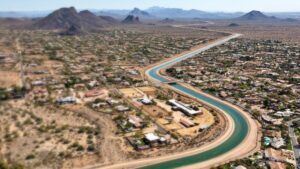
PHOENIX — The Central Arizona Project (CAP) delivers Colorado River water to about 80% of Arizona’s population through a canal system that stretches more than 300 miles. It begins at the Colorado River near Lake Havasu and ends south of Tucson.
Now, state leaders are working to expand Arizona’s water supply flexibility by connecting CAP, which delivers Colorado River water across the state, with the Salt River Project (SRP), which supplies water from the Salt and Verde rivers to the Phoenix metropolitan area.
The new SRP–CAP Interconnection Facility (SCIF) will allow water to flow both ways between the two systems.
How will connecting SRP and CAP strengthen Arizona’s water supply?
Right now, CAP can send water to SRP through an existing connection, but SRP cannot send water back. The CSIF uses gravity to move water from CAP’s higher canal system into SRP’s lower one.
The SCIF pump and pipe system near the Granite Reef Dam would be a game-changer, allowing two-way water transfers between SRP and CAP.


Making such a massive change isn’t cheap. The project is estimated at about $250 million.
“It would be another major connection of the two large renewable water sources in the state of Arizona, adding lots of operational flexibility for both of our groups,” CAP Assistant General Manager Darrin Francom told KTAR News 92.3 FM.
He added that the project will be especially helpful in years when CAP receives less water from the Colorado River, while reservoirs within the Salt and Verde River systems might be full.
The SCIF is still in the design and construction phase, with completion expected around 2028.
Combining both water sources comes brings new challenges
Because CAP and SRP draw from different sources, their water qualities can vary significantly.
“The Colorado River has a very stable water quality, and our customers have come to rely on that,” Francom said.
The Salt River has higher salinity, while Verde River has a higher amount of dissolved minerals. All water that goes into any of the canals must meet an introductory standard water quality.
“SRP is working on analyzing their water and making a determination of how they can blend their flows and timing of flows to comply with the introductory water quality standards,” Francom said.
New Colorado River guidelines may impact future of project
New Colorado River operating guidelines must be agreed upon by the seven basin states and the federal government next year.
“The guidelines… describe who will take a shortage, how much, and when,” Francom said.
The Colorado River is currently operating under a Tier 1 shortage and is forecast to remain in that classification through 2026. Under Tier 1, Arizona takes a reduction of more than 500,000 acre-feet. Normally, Arizona receives about 1.5 million acre-feet annually from the Colorado River, so CAP is operating with roughly two-thirds of its typical supply.
“If the cuts went deeper, it would start to impact both our municipal and industrial customers, as well as our tribal customers,” Francom said.
However, it’s unlikely that residential users will be affected, because municipalities have diverse water portfolios and are not entirely reliant on CAP. For example, the city of Phoenix has groundwater rights, long-term storage credits for water banked underground and access to the Salt River system through SRP, Francom said.
While CAP is not a utility itself, it serves utility companies like EPCOR, as well as 14 Native American tribes and municipalities such as Phoenix, Scottsdale and Mesa. This makes CAP the largest single provider of tribal water in the U.S.
If Arizona faces deeper Colorado River cuts next year, that doesn’t necessarily mean residents will feel the impact. According to Francom, that’s thanks to municipalities’ diversified water supplies and long-term planning.
Related
 Urgent action needed to save Arizona community sinking due to groundwater pumping, official says
 Scottsdale’s Veolia Hubgrade Center manages wastewater treatment plants across US
 Why the basin states' fight over Colorado River water is a big deal for Arizona
 Phoenix planning 3 plants where treated wastewater will be purified enough to drink
 SRP pulls back curtain on Mormon Flat Dam maintenance work at Canyon Lake
 Democrat says ‘Arizona got screwed’ in Colorado River water agreement

Comments
0 Comments