
Arizona tribes seek $5B in federal funding to implement landmark water rights agreement
Sen. Mark Kelly wants Congress to approve $5 billion in funding to implement a landmark water rights deal for three Native American tribes.

Watch: Northern Arizona Indian Water Rights Settlement Agreement needs $5 billion | 1 min
PHOENIX – Arizona U.S. Sen. Mark Kelly wants Congress to approve $5 billion in funding to implement a landmark water rights deal for three Native American tribes.
Kelly introduced a bill to fund a tribal plan called the Northern Arizona Indian Water Rights Settlement Agreement and pleaded for its passage during a Senate Committee on Indian Affairs hearing on March 11.
He was joined by leaders of Hopi Tribe, Navajo Nation and San Juan Southern Paiute Tribe, who completed the water rights settlement in 2024 but need Congress to approve the funding.
“This settlement is a major step forward securing the tribes’ water future, while providing long needed certainty for Arizona and the entire Colorado River Basin,” Kelly said.
Why water rights settlement is so important to Arizona tribes
About one-third of residents on the Navajo and Hopi reservations do not have running water and are forced to rely on hauled water.
Without federal funding for the Northern Arizona Indian Water Rights Settlement Agreement, uncertainty over tribal water claims will continue impacting communities across the region that need reliable water management to grow.


Under Kelly’s funding bill, which was cosponsored by fellow Arizona Democratic Sen. Ruben Gallego, the three tribes would waive their right to future litigation of water claims.
In exchange, the tribes would be guaranteed 56,000 acre-feet of Colorado River water split between the Upper and Lower basins.
Those rights would be protected even if not immediately used, as more infrastructure needs to be built for tribal members to access the water.
“It also establishes cooperative agreements between the Hopi Tribe and Navajo Nation to protect shared groundwater resources and manage them sustainably for generations to come,” Hopi Tribe Chairman Lamar Keevama said at the hearing.
Infrastructure needs are a big part of $5 billion request
Much of the requested $5 billion would be used on infrastructure, but some opponents have concerns about the price tag.
“This legislation will fund critical infrastructure projects such as wells, pipelines, treatment systems and storage facilities that are necessary to deliver safe and reliable water to our communities,” Keevama said. “Today, water infrastructure is either aging or nonexistent.”
The rights agreement requires Navajo Nation and the Hopi Tribe to leave significant amounts of water in Lake Powell, helping conservation for the Colorado River system.
And it would allow tribally led water leasing within Arizona before local demand is fully met. Navajo Nation President Buu Nygren said the agreement includes limits on how much water the tribes are permitted to lease.
“The tribes have agreed to create a water savings pool in Lake Powell by contributing 17,050 acre-feet a year for 20 years, which will benefit all Upper Basin states and the federal government by protecting critical infrastructure in Lake Powell,” Nygren said during the hearing.
Bill would also establish territory for San Juan Southern Paiute reservation
Furthermore, the bill would ratify a 26-year-old treaty that establishes a reservation for the San Juan Southern Paiute Tribe, Arizona’s only federally recognized tribe with no land base of its own.
The treaty sets aside 5,100 acres west of Tuba City, Arizona, and about 300 acres west of Paiute Mountain in Utah for a San Juan Southern Paiute reservation.
“Paiute rights to water in the southern area provide up to 350 acre-feet of water per year and create a trust fund so the tribe can build and maintain infrastructure we need,” San Juan Southern Paiute Tribe Vice President John Lehi Jr. said at the hearing.
The combination of land and water access will allow the tribe to build housing and community infrastructure.
Currently, there is no date set to vote on Kelly’s bill in either chamber.
Related
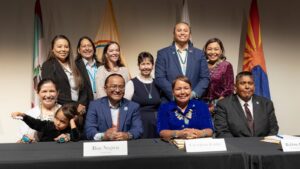 Leaders of 3 Arizona tribes sign water rights settlement agreement
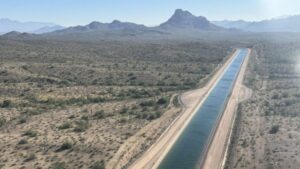 Arizona tribal leaders acknowledge personhood status for the Colorado River
 SRP pulls back curtain on Mormon Flat Dam maintenance work at Canyon Lake
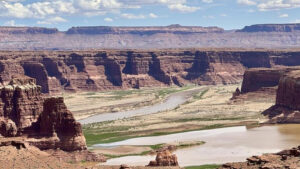 Democrat says ‘Arizona got screwed’ in Colorado River water agreement
 Arizona joins lawsuit over Colorado River plan, warns of deep water cuts
 Is Arizona’s water supply getting boost from recent storms, El Niño?

Comments
1 Comments
That's only $36,000 per person. For that you you could deliver bottled water to each one forever. Complete stupidity.
Surprised the "usual suspects" crowd haven't left their usual comments on this.