
New AI tool detects drought conditions at over 80% of Arizona’s rivers and streams
Over 80% of Arizona’s rivers and streams are experiencing drought conditions, and there’s no relief in sight, according to a new AI forecasting tool.

Watch: 80% of Arizona's river and streams in drought, according to new USGS AI tool | 1 min
PHOENIX – Over 80% of Arizona’s rivers and streams are experiencing drought conditions, and there’s no relief in sight, according to a new AI forecasting tool.
The U.S. Geological Survey’s River DroughtCast shows the current streamflow drought status across the U.S. and forecasts conditions in weekly intervals for the next three months.
“Measuring streamflow is really useful because it tells us how much water is available for all sorts of different uses,” USGS research hydrologist John Hammond told KTAR News 92.3 FM.
How does AI tool determine streamflow drought
Streamflow drought specifically refers to when a river or stream’s discharge drops to abnormally low levels for an extended period.
“So that’s when you start to see really low levels in your rivers and streams. You start to see lakes and ponds dry up. Your reservoirs draw down, as well,” Hammond said.
The River DroughtCast compiles information from weather forecasts as well as snowpack, soil moisture and streamflow gauges across U.S. The free public tool combines current and historical data to make its predictions.
“The U.S. Geological Survey has been measuring and storing data on streams, groundwater, lake levels, etc. for many decades. In some cases, there are sites out in Arizona and New Mexico that have been running for more than 100 years,” Hammond said.
What does streamflow drought model say about Arizona?
Through Monday, AI model showed 43% of the nation’s rivers and streams with moderate, severe or extreme drought conditions based on data from 2,817 sites.
At the same time, Arizona had streamflow drought conditions at 82% of the 50 sites where data was available.
Arizona’s weekly projections fluctuate up or down a few points until the last part of the 13-week window. The forecast dips to 80% for 12 weeks out before jumping to 90% for the furthest projection in mid-July.
The model is the most accurate for predictions up to four weeks out, Hammond said.
“Once you get past that, you start to see those uncertainty ranges — basically our confidence in the forecast — decrease,” he said.
Related
 Could startup company bolster Arizona water supply with undersea desalination system?
 Arizona's first wastewater-to-drinking-water plant reaches construction halfway mark
 Interior Sec. Doug Burgum on Colorado River talks: 'Everybody's got to make some sacrifices'
 Arizona joins lawsuit over Colorado River plan, warns of deep water cuts
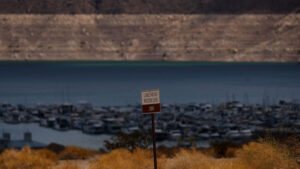 Is Arizona’s water supply getting boost from recent storms, El Niño?
 Arizona Cotton Growers Association honors lawmaker for service to agriculture industry

Comments
8 Comments
The data centers are using the water to run the AI that's telling us the water is disappearing.
You needed A1 to tell you the creek is dry?
It's a real Catch-22 LOL