
Colorado River Water Users Association conference pushes for 7-state solution
There is still no solution to Colorado River allocation, but a recent conference pushed for a seven-state solution before the February deadline arrives.

Watch: Colorado River Water Users Association conference pushes for 7-state solution | 55 seconds
PHOENIX — The annual Colorado River Water Users Association Conference in Las Vegas last week brought together water advocates from all seven basin states, as well as stakeholders from across the basin who rely on that water.
Haley Paul, Arizona policy director for the National Audubon Association who attended the conference, said its main theme was figuring out a seven-state solution for the new Colorado River operating agreement, as they’re now up against a Feb. 14 deadline.
There was a panel where a principal from each of the basin states appeared on stage together to give an update on the water negotiations. The conversation was positive and collegial, but realistic in that there is still no solution.
“They haven’t gotten past the sticking points that have kind of been bogging them down for 2.5 years,” Paul told KTAR News.
Arizona is already operating under an 18% reduction of its Colorado River water allocation, while the upper basin has maintained it will not agree to mandatory reductions under the new operating agreement.
It’s still unclear what litigation could look like if the basin states can’t come to an agreement.
“I do think it’s significant the lower basin has put 1.5 million acre-feet on the table, that remains,” Paul said. “I think the upper basin has their concerns about saving water when they haven’t grown into their full entitlement.”
Possible litigation on Colorado River users’ operation
The U.S. Department of the Interior and its Bureau of Reclamation could impose a settlement, and if a state felt like they were shorted, they could sue the federal government.
There is also a compact compliance issue, which was a part of conference discussions. Lower basin states could sue upper basin states if the upper basin states take more than their fair share of water and don’t send enough water down the river.
“If we see litigation, we’re just worried that people will go into their corners. We’re going to lose the opportunity for creativity, collaboration and flexibility and how we can solve these really tough problems,” Paul said.
She hopes states can get past their legal arguments and find a way to share a smaller river.
It’s been a dismal start to winter in the Southwest with record-breaking warm temperatures here in the Valley and low snowfall totals in the high country and the Rocky Mountains.
“If Mother Nature’s not going to help us and give us a reprieve, (it’s time) for us to figure out how to use less (water),” Paul said.
Basin states share individual water conservation efforts
States also made it a point to tout their voluntary conservation efforts, which Paul said is helping.
“All of the work each state has done to try to use less, to get tighter with their water efficiency, to use less in cities, to use less in agriculture,” Paul said.
She’d like to see long-term investments in the basin for sustained water conservation efforts.
Related
 Arizona faces continued Colorado River water cuts, uncertainty about future access
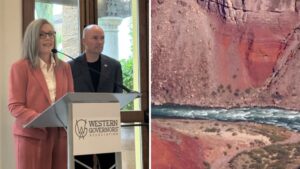 Western governors debate over Colorado River allocations ahead of winter deadline
 Rio Grande River at risk of water shortage due to overuse, NAU study finds
 SRP pulls back curtain on Mormon Flat Dam maintenance work at Canyon Lake
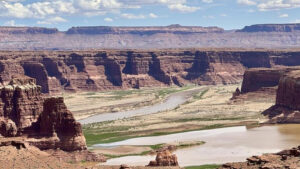 Democrat says ‘Arizona got screwed’ in Colorado River water agreement
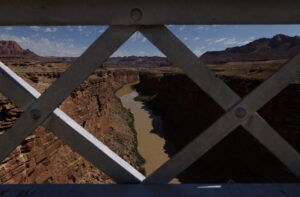 Arizona joins lawsuit over Colorado River plan, warns of deep water cuts

Comments
1 Comments
Arizona needs to address cities that give lower overall rates to the largest users of water. Gilbert is notoriously bad about this (see their flat rate sewer fee too). Get rid of the "base rate" and charge by total usage.
Grass and landscape irrigation needs to go; pools need to be a luxury item that actually costs the owner extra (use public pools). That will get you started.