
Thousands of sandhill cranes make their seasonal return to southeastern Arizona
The dancing, rambunctious birds provide several months of wildlife viewing experiences in their Cochise County wintering grounds.

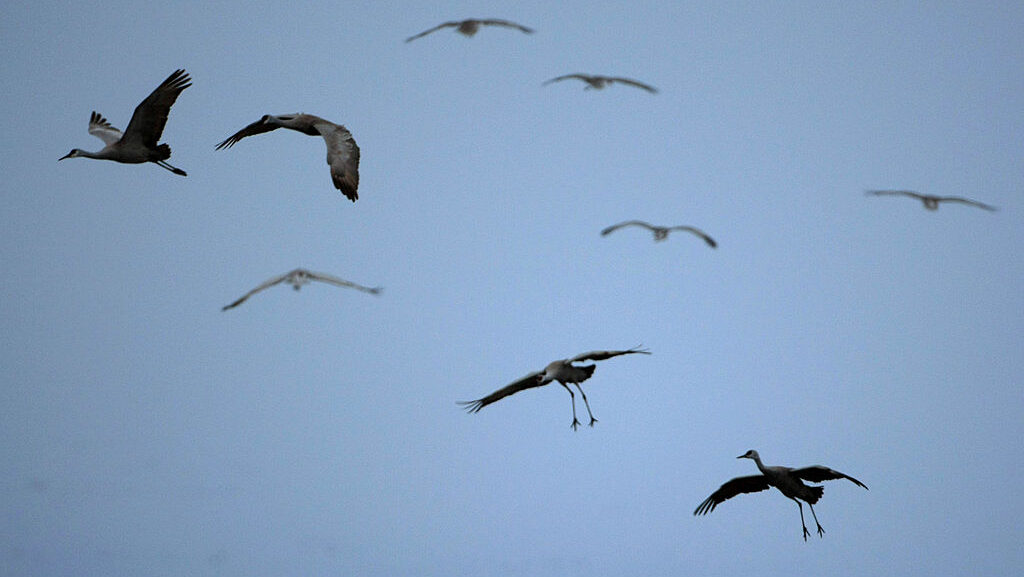
Sandhill Cranes fly in at sunset to roost for the night in the wetlands of the Monte Vista Wildlife Refuge on March 8, 2008, in Monte Vista, Colorado. (Photo by Doug Pensinger/Getty Images)
(Photo by Doug Pensinger/Getty Images)
Large, talkative and well-traveled sandhill cranes have made it back to Arizona by the thousands.
Sandhill cranes – one of two crane species in North America – descend on the Whitewater Draw Wildlife Area and other wetlands of southeastern Arizona for the winter, with some birds migrating from as far out as Siberia.
More than 20,000 cranes will roost in their Arizona wintering grounds before heading back north around mid-February to March, providing several months of seasonal wildlife viewing experiences of these dancing, rambunctious birds.
“In my opinion, there just isn’t a better wildlife-viewing opportunity in Arizona than Whitewater Draw,” Jeff Meyers, wildlife viewing program manager for the Arizona Game and Fish Department, said in a news release. “We’re really seeing AZGFD’s conservation efforts pay off in the form of healthy habitat and thriving wildlife.”
Bird lovers can check out sandhill cranes via AZGFD livestream
AZGFD runs a livestream of Whitewater Draw for bird lovers to tune in and see what the sandhill cranes are up to.
Sandhill cranes roost in shallow waters with short or no vegetation, such as playa lakes and sandbars, which allows them to spot predators from a distance. They head out to feed right around sunrise and return to their roosting areas before noon, giving bird-watchers plenty of chances to see (or hear) them. They stand at 3 to 4 feet with a wingspan of 6 to 7 feet.
The sandhill crane is one of the oldest bird species in the world, with fossils going back 2 million years.
The gray, long-legged and long-necked birds breed from the northeastern United States through Canada, into Alaska and eastern Siberia, migrating for the winter throughout the southern half of the U.S. and Cuba. They can fly up to 500 miles in a single day.
Environmental groups say SpaceX data center could threaten sandhill cranes
Even with such a long history and expansive range, the sandhill cranes have experienced challenges, and environmental groups warn of another in Arizona.
Elon Musk’s SpaceX has submitted plans to build Arizona’s largest data center in Cochise County, near the Willcox Playa, a wintering ground for sandhill cranes.
SpaceX addressed the sandhill cranes on its website by promising to conduct a biological assessment of the property and work with AZGFD and the U.S. Fish and Wildlife Service. The company called it a “wildlife-friendly design,” with no open-process water that would attract birds, a dry-cooling system and low metal buildings to limit impact on migration.
That has not quelled concerns that the data center could impact natural resources, which could in turn affect the future of sandhill cranes and other wildlife in the area.
“In southeast Arizona, near the Willcox Playa and world-famous gathering of sandhill cranes, an application tied to SpaceX has been submitted to build a data center with six times the energy load of Project Blue,” the Sky Island Alliance said in a social media post. “This is an awful idea, yet another drain on our region’s precious water supplies.”
The Cochise County Planning and Zoning Commission is scheduled to consider the SpaceX plan during a Dec. 9 meeting in Bisbee.
Arizona Attorney General Kris Mayes sent a letter to the Cochise County Planning and Zoning Commission asking to delay the vote due to the project’s scale and potential impacts on the electric grid, water resources, wildlife and national security. Mayes will host a public town hall meeting at the Cochise Elementary School gymnasium on Dec. 3.
Conservation efforts have helped sandhill cranes
Sandhill cranes are the most numerous species of cranes in the world, with increasing numbers since the 1960s due to conservation efforts. They are considered endangered in Mississippi and Cuba but are deemed “Least Concern” on the International Union for Conservation of Nature’s Red List.
Wetland habitat loss due to development is their greatest threat.
The cranes are celebrated locally, notably during the Wings Over Willcox Birding & Nature Festival that is scheduled for Jan. 14-17, 2027.
Related
 WB Loop 101 Pima Freeway reopens after multivehicle collision in north Phoenix
 Arizona missing 10,000 workers with bachelor’s degrees to fill workforce
 ‘Destination landmark’ with resort and golf course eyed for Gilbert park
 Pomo Restaurant Group opening Salta Argentine live-fire steakhouse in downtown Phoenix
 Eastbound I-10 reopens in southeast Valley after crash
 Arizona gaming department expands self-exclusion program with shorter 6-month option

Comments
0 Comments