
Rare Ocelot traverses more than 100 miles in southern Arizona
A male ocelot trekked over 100 miles in southern Arizona, according to trap camera footage collected between April 2024 and October 2025.


An Ocelot, Leopardus pardalis, in the Belize Zoo. (Photo by: Jon G. Fuller/VW Pics/Universal Images Group via Getty Images)
(Photo by: Jon G. Fuller/VW Pics/Universal Images Group via Getty Images)
PHOENIX — A male ocelot, a wild cat endangered in the United States that looks like a cross between a jaguar and a house cat, trekked over 100 miles in southern Arizona, according to trap camera footage collected between April 2024 and October 2025.
The cat traversed multiple highways and was spotted in four different mountain ranges over 388 days, identified by the unique patterns on his fur, according to a study published by the Phoenix Zoo and the Sky Island Alliance nonprofit.
The ocelot was located in the following locations:
- In the Atascosa Highlands by the Phoenix Zoo (June 2024)
- In the Patagonia Mountains by the Sky Island Alliance (July 2024)
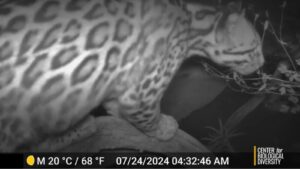
- In the Whetstone Mountains by the Center for Biological Diversity (July 2025)
- In the Santa Rita Mountains by the University of Arizona Wild Cat Center (July 2025)
The Whetstone Mountains sighting was particularly fortunate, as a black bear actually knocked the camera out of a tree, which incidentally pointed the lens toward a small water patch that the ocelot was caught drinking from, according to the Sky Island Alliance.
Students from the San Xavier District Voices of Our Youth program named the ocelot “Himdam,” or “traveler” in the O’odham language.
Meet Himdam.
He was just bestowed the name, which means “traveler” in the O’odham language, by Tohono O’odham Youth from the San Xavier District Voices of Our Youth program.
It’s a fitting name for a cat who has been spotted roaming Arizona’s Sky Islands since 2024. More details: biodiv.us/4tnkfJr
— Center for Biological Diversity (@biologicaldiversity.org) April 20, 2026 at 3:42 PM
“The return of an ocelot to the Santa Rita Mountains is a powerful reminder that these mountains are critical refuges for wildlife,” Austin Nunez, chairman of the Tohono O’odham Nation’s San Xavier District, said in a press release. “Our youth took the time to learn, reflect and name this animal in our language, honoring both its journey and our responsibility to protect it.”
Ocelots range from northern Argentina and southern Brazil up to southern Arizona and Texas. The northernmost breeding population is in Sonora, Mexico.
No ocelots were detected in Arizona from 1980 to 2009, but seven have been spotted in Arizona since 2009, each of which have been males.
Himdam’s trek has told researchers a new story about the feasibility of ocelots finding refuge in Arizona.
“This individual’s movement is extraordinary and expands what we understand about how far ocelots can travel across fragmented landscapes. These observations highlight the importance of protecting habitat and connectivity between mountain ranges, because even species we think of as habitat specialists are capable of remarkable dispersal when given the opportunity,” Eamon J. Harrity, wildlife program manager at Sky Island Alliance and co-author of the study, said.
Exciting news in the world of rare Sky Island kitties. Recently, SIA and Phoenix Zoo published a study describing the remarkable journey of a male ocelot across four mountain ranges in the Sky Islands of Arizona, the longest-known trek by the species: https://t.co/mvEemGZz7E pic.twitter.com/NlzijpWigJ
— Sky Island Alliance (@Sky_Islands) April 20, 2026
Himdam’s sightings were each at night. There were non-baited camera-traps at 89 locations in the Madrean Sky Islands of southern Arizona used to track him.
His minimum travel distance between sites was 178 kilometers, and the study presumes he dispersed from Rancho El Aribabi, Sonora. Himdam likely crossed Interstate-19 and State Route 82 or 83.
Ocelots are elusive, nocturnal hunters that prey on rabbits, rodents, young deer, birds, snakes, lizards and fish.
They weigh between 24 to 35 pounds, which is slightly smaller than a bobcat. Their fur is patterned differently than a jaguar, as ocelots have stripes on their heads and more elongated spots.
More well known as a jungle cat throughout many Latin American countries, the ocelot has been listed as endangered in the United States since 1982. The Association of Zoos and Aquariums called ocelots America’s most endangered wild cat.
The species is not considered threatened in Central or South America.
Habitat loss and fragmentation are critical reasons why the ocelot has not been able to maintain a population north of the southern border, with the border wall creating another more recent barrier.
Vehicle collisions are the top killer of ocelots in Texas, where fewer than 100 are thought to survive. There are two populations in southern Texas, one on private ranchlands and the other in Laguna Atascosa National Wildlife Refuge, according to National Geographic, although populations that small have genetic diversity concerns. Conservation efforts, including introduction and education, are underway.
The study from the Phoenix Zoo and Sky Island Alliance concluded that additional wildlife crossing structures and the protection of critical habitat in southern Arizona would aid the conservation of ocelots in the U.S., as the Sky Islands provide a biologically rich habitat.
“Himdam is a reminder of the resilience of these native Arizona species and our commitment to share a future with them,” the Phoenix Zoo’s field research program manager Kinley Ragan, a co-author of the study, said.
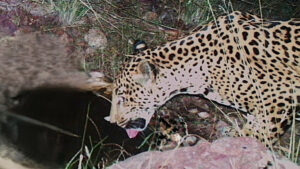
Jaguar sightings have also trickled in over the past 15 years, as the biggest cat in the Americas also has been historically found in Arizona.
Related
 New endangered ocelot 1st spotted in Arizona in June makes 2nd appearance
 Jaguar spotting in southern Arizona indicates progress in endangered species' recovery
 Phoenix Police responding critical incident at south Phoenix apartment complex
 Wall of dust, rain moving through Valley causing ground stop at Phoenix Sky Harbor
 All pet adoptions free at Arizona Humane Society for 1 day
 Scattered showers, thunderstorms expected to hit metro Phoenix

Comments
0 Comments