
Pima County sheriff speaks out against Gov. Hobbs’ latest border task force
One Arizona sheriff spoke out against a joint border security task force initiative formed by Arizona Gov. Katie Hobbs since border security isn't the state's responsibility.
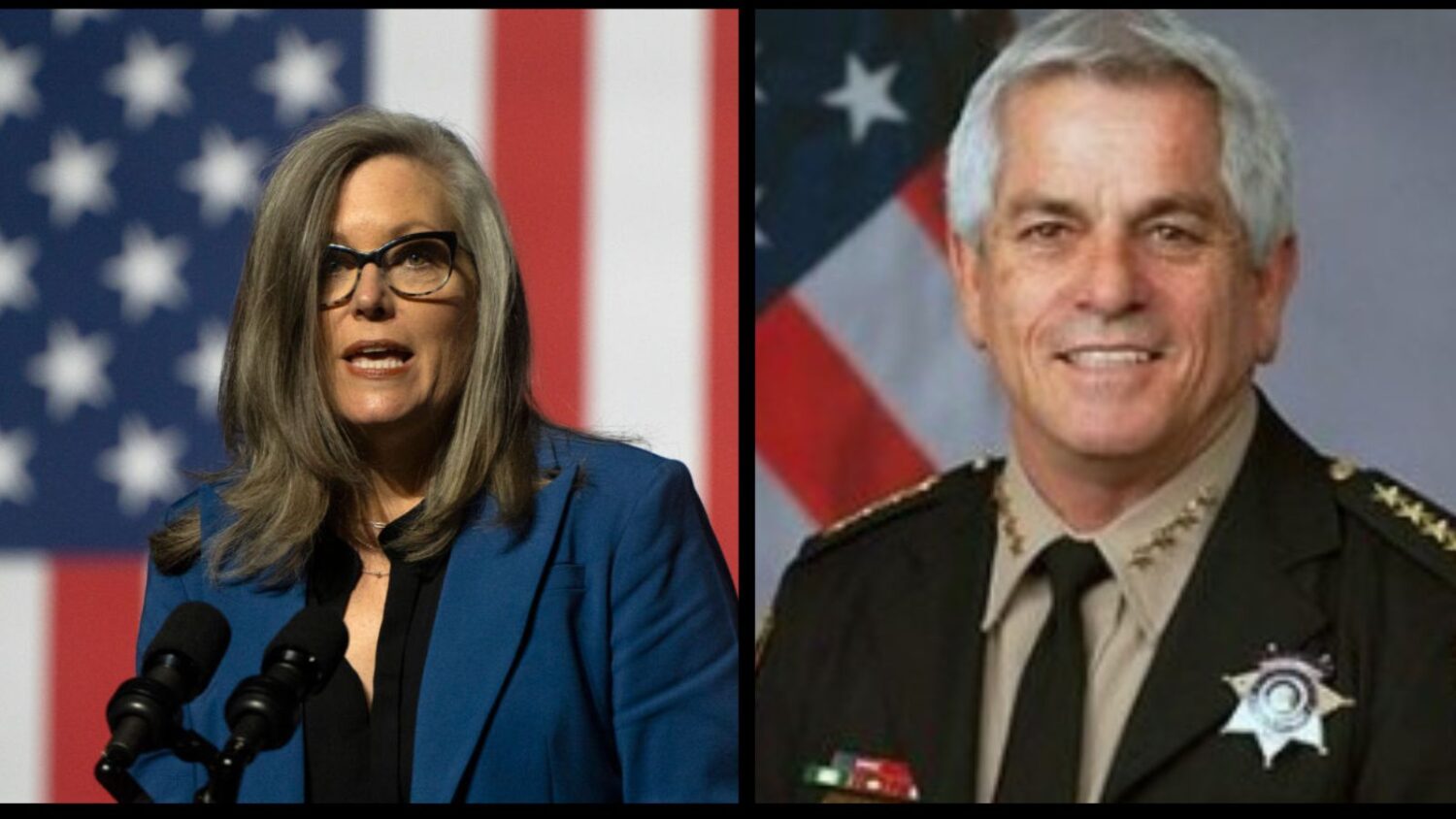
One Arizona sheriff spoke out against a joint border security task force initiative formed by Arizona Gov. Katie Hobbs because border security isn't the state's responsibility. (Photos by Getty images and Pima County Sheriff's Office Photo)
(Photos by Getty images and Pima County Sheriff's Office Photo)
PHOENIX — One Arizona sheriff spoke out against a joint border security task force initiative formed by Arizona Gov. Katie Hobbs because he feels that border security isn’t the state’s responsibility.
Pima County Sheriff Chris Nanos joined the Chris and Joe Show on KTAR News 92.3 FM on Friday to discuss why he won’t take part in Hobbs’ new security task force dubbed Operation Desert Guardian.
Why Pima County Sheriff Nanos doesn’t agree with Hobbs’ task force
The creation of the new task force was meant to help federal and local law enforcement curb cartel drug smuggling and human trafficking across the state.
However, Nanos said being a member of another task force is the last thing his department needs, which is why he signed out of the virtual meeting in which Hobbs announced Operation Desert Guardian to sheriff’s departments.
“We are heavily involved in the narcotics trafficking industry here in Pima County, and we work closely with all of our partners. I don’t need a sixth task force; that was it. Good luck to you. I’m out and I left,” Nanos said about signing out of the meeting early.
Nanos said he is already a part of multiple task forces that all deal with similar border security issues. His department struggles with staffing shortages and Hobbs’ new order takes away from his department’s needs.
“I’m not here to do Border Patrol’s job. We assist Border Patrol down here. We work closely with Border Patrol, always have, always will, but we don’t do their job. They don’t do ours,” Nanos said.
What are Pima County’s concerns?
Border security isn’t Nanos’ top priority and he said less than 1% of the calls his department receives occur near the border.
The main issue Pima County faces is violence. In one year, his department responded to approximately 400 homicides, according to Nanos.
“That’s every single night. How many gunshots have I had at the border? Zero. How many homicides have I had at the border? Zero. How many migrants were involved in the homicides and the violent crime here in the Tucson metropolitan area? Zero. I let data dictate to me my needs,” Nanos said.
However, Nanos said he needs to fill 200 positions within his department to respond to the 140,000 calls they receive a year.
Nanos’ primary concern is how his department will be impacted by the Department of Government Efficiency’s funding cuts. Pima County receives $150 million in grants from the federal government, according to Nanos.
“I would hope that the governor’s office would sit back and say, ‘How is it, if these grants shut down, how does it impact the state?'” Nanos said. “If there’s a cost shift to the county, what does that mean for me? I’m the biggest funded portion of our county budget.”
Related
 Arizona Gov. Hobbs creates Operation Desert Guardian border security task force
 Kris Mayes to host town hall in Phoenix on how DOGE cuts are impacting workforce
 Goodwill set to open new West Valley thrift store with donation center
 59-year-old Gilbert man arrested for alleged child sex crimes
 Vestar moves ahead with Gateway Crossing, a mixed-use project in southeast Mesa
 Arizona man sentenced for livestreaming children being sexually abused

Comments
0 Comments