
ASU students heading to Wyoming to study eclipse from edge of space
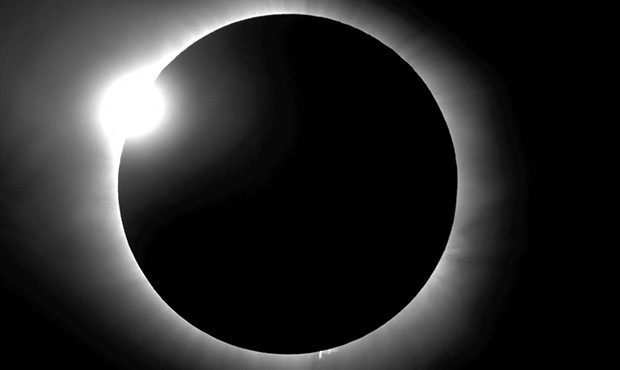
A group of Arizona State University students will travel to Wyoming to study next week's total solar eclipse using weather balloons.
(R. Baer, S. Kovac/Citizen CATE Experiment via AP)
(R. Baer, S. Kovac/Citizen CATE Experiment via AP)
PHOENIX — A group of Arizona State University students will travel to Wyoming to study next week’s total solar eclipse using weather balloons.
“We are going up to the path of totality to launch high-altitude balloons,” Tom Sharp, a professor at ASU’s School of Earth and Space Exploration, said.
Sharp and four students will be in the 70-mile wide totality, where the sun will be entirely blocked by the moon. The professor said he and the students will image the moon’s shadow from between 60,000 and 90,000 feet above the Earth.
“High-altitude balloons typically go to about 100,000 feet before the balloon bursts and then the payloads come down on a parachute,” he said.
That payload will include NASA cameras and several student-built experiments.
“A series of measurements — temperature, pressure, various wave lengths of light,” he said. “There’s a number of sensors on this thing.”
Other student experiments include a three-axis gyroscope to measure spin, a humidity sensor and thermal couples for temperature and a FLIR duo infrared camera to measure temperature changes on the ground as the moon’s shadow passes.
Sharp said an accelerometer will measure the payload’s fall from the edge of space.
“The ride is very rough on the way down but we’d like to know how rough it is,” he said.
Sharp said one student team will focus on launching the balloons and another will be in charge of recovering the payload after it parachutes back to Earth.
The project was funded by the Arizona NASA Space Grant Consortium.
Related
 ‘We know it’s gonna be close,’ Gov. Katie Hobbs says as likely Andy Biggs matchup looms
 Live updates for Arizona’s 2026 primaries: Supervisor explains technical issue
 Technical issues disrupt a small number of Maricopa County voters on Election Day
 Election changes could lead to quicker results in Maricopa County, Adrian Fontes says
 3 defendants sentenced to years in prison in Arizona meth trafficking case
 Main roadway between Maricopa and metro Phoenix reopens after fatal incident

Comments