
Ballot measure filed in effort to alter Arizona’s school voucher program
Accountability for Arizona’s school voucher program could be on your November ballot after a new voter initiative was filed last week.

Watch: Ballot measure filed in effort to alter Arizona’s school voucher program | 1 min
PHOENIX – Accountability for Arizona’s school voucher program could be on your November ballot after a new voter initiative was filed last week.
The state’s Empowerment Scholarship Account (ESA) program allows families to use public education tax dollars for private school or homeschooling expenses.
A ballot initiative to alter the program, which has over 100,000 enrolled students, was filed with the Arizona Secretary of State’s Office on Friday by families and educators represented by the Arizona Education Association teachers union and the Save Our Schools Arizona advocacy group.
Organizers must collect and submit 255,949 valid signatures by July 2 to put what’s called the Protect Education, Accountability Now Act on the ballot for the 2026 general election.
What’s in the Arizona school voucher ballot initiative?
Supporters of the measure say it would add much-needed accountability to the ESA program by addressing the following issues:
- Misuse of funds: School voucher money could not be used for items that aren’t school related. Additionally, any unused ESA money at the end of the year would go back into the public school fund, and the Arizona Department of Education would have to report how much ESA money is given out to a school each quarter.
- Income cap: The measure would limit the ESA program to families who make $150,000 a year or less. Families of students with disabilities would not be subject to the income cap.
- Safety: The initiative would require any school receiving ESA dollars to adhere to state fire codes, have teachers submit background checks and investigate allegations of teacher misconduct.
- Accountability of academics: All schools receiving voucher money would be required to have students complete state testing or become nationally accredited.
The ballot language in the filing could still change because it is subject to a 30-day Legislative Council review period.
Organizers say lawmakers failed to put guardrails on ESA program
Marisol Garcia, president of the Arizona Education Association, told KTAR News 92.3 FM on Monday the program lacked boundaries when the Republican-led Legislature and then-Gov. Doug Ducey made the voucher program universal in 2022. Four years earlier, voters overwhelmingly rejected an ESA expansion.
“We’re the first state to try it out. And I really think the way to get it through the Legislature by then Gov. (Doug) Ducey was to say anybody can have it. And then we’d figure it out on the back end. Unfortunately, they have not figured it out on the back end,” she said.
Beth Lewis, executive director of Save Our Schools Arizona, said the Protect Education, Accountability Now Act is simply a way to let Arizona voters choose how the program is run.
“The Legislature has passed zero new guardrails when it comes to making sure that our taxpayer dollars are accounted for, making sure that kids are safe and learning. They’ve done absolutely nothing,” she told KTAR News.
The program has had controversial purchases in the past, with diamond rings and crystals being bought with voucher money before being audited.
According to Lewis and Garcia, the goal is to support public school students and teachers while holding the ESA program accountable for invalid purchases and misuse of funds.
Lewis said the $150,000 income cap for families using the program is important.
“That is almost double the median household income in Arizona, a very reasonable bar, just making sure that this isn’t being utilized as a coupon for the wealthy. But that income cap does not apply to students with disabilities,” she said.
Officials react to school voucher ballot initiative
Arizona State Superintendent Tom Horne opposes the measure, telling KTAR News the program is “already very accountable.” He said the initiative is trying to take away a space for competition in the school market.
“What people forget to say is we get the money back afterwards if somebody abuses the system. And we’ve gotten already $1.2 million back from people on these under-$2,000 purchases where they were abusing the system,” he said.
Arizona House Speaker Steve Montenegro released a statement calling the ballot initiative “a direct attack on parents” and saying the action would limit school choice in the state.
“ESA opponents are willing to sacrifice students’ futures to protect an education bureaucracy that puts its own power ahead of kids. … Make no mistake: They will not stop until families are once again forced into district systems where unions call the shots and parents have none,” Montenegro said in the statement.
Garcia argued that the initiative is not removing school choice from parents; it’s just adjusting what is allowed within the program.
“There are thousands of options for every parent. We’re not trying to take away any of those options. What we’re trying to do is protect the fiscal responsibility of taxpayer money,” she said.
Gov. Katie Hobbs has called for accountability of the ESA program in the past, mentioning improper spending in her State of the State address last month. Attorney General Kris Mayes has also spoken about the lack of transparency in the voucher program, specifically the $2,000 auto-approval policy.
Funding for this journalism is made possible by the Arizona Local News Foundation.
Related
 Why are Arizona families moving their kids from public to private schools?
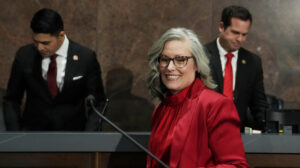 Arizona Gov. Katie Hobbs says Republicans should be ‘embarrassed’ by ESA program costs
 Does Arizona's ESA program cost $1 billion? Nonprofit clashes with officials over exact amount
 Arizona Supreme Court approves GCU College of Law without ABA accreditation
 Peoria Unified faces $650K claim over alleged sexual misconduct by Mr. ORNG
 Scottsdale Unified would have to cut $14.9M in non-classroom spending if Prop 320 passes

Comments
5 Comments
This entitled system is going to plunge Arizona into a significant budget crisis and this will accelerate if all the wish list of tax breaks are given.
It’s fraud!! Scrap the scam !
Of course MAGA politicians oppose the $150K income limit. That would exclude the exact people this was implemented for — them, their friends and family, and most importantly their donors.