
Appeals court says fishermen’s claim in lobster defamation suit raises First Amendment questions

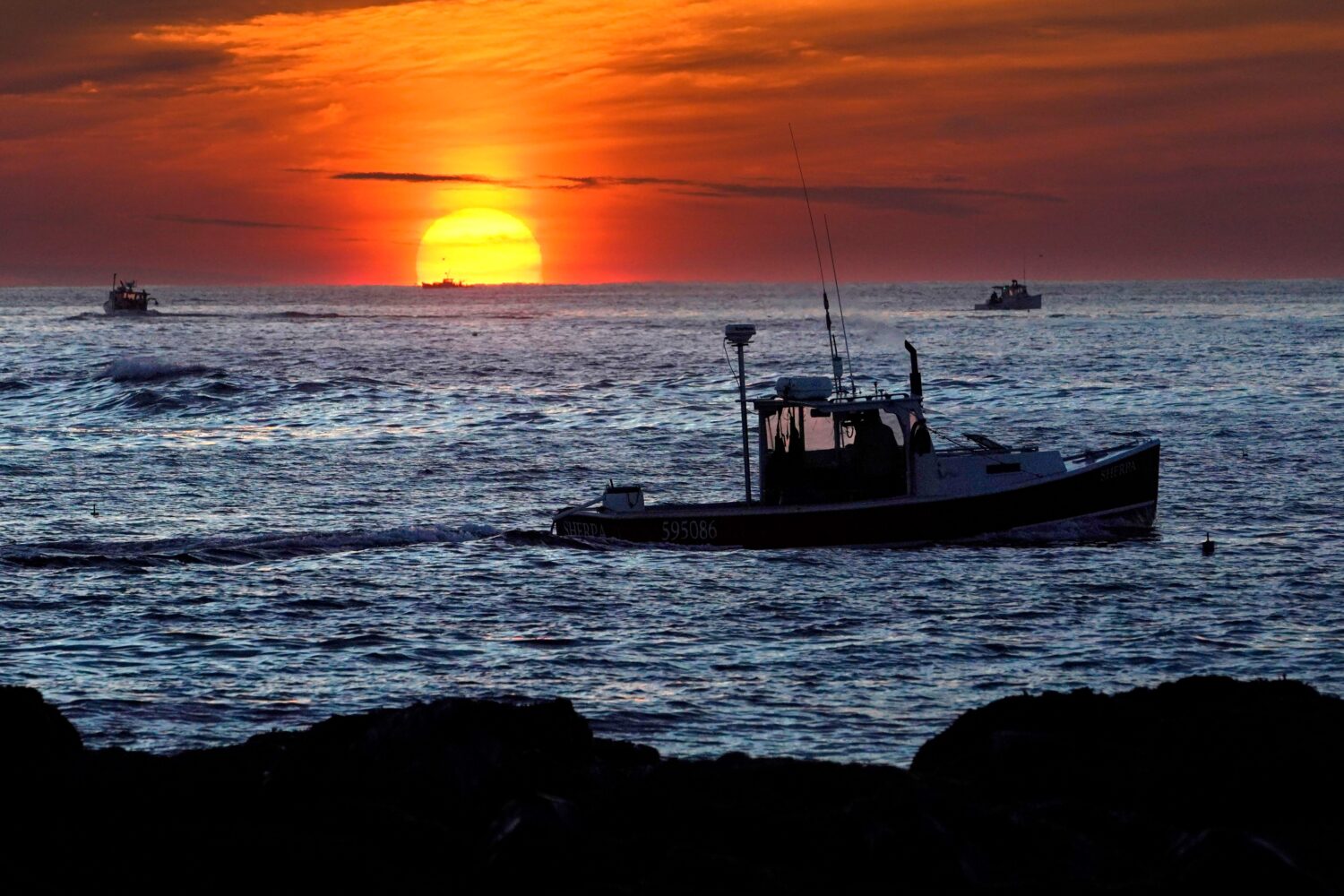
FILE - Lobster fishermen work at sunrise, Sept. 8, 2022, off Kennebunkport, Maine. (AP Photo/Robert F. Bukaty, File)
Credit: AP Photo/Robert F. Bukaty
(AP Photo/Robert F. Bukaty, File)
SCARBOROUGH, Maine (AP) — A federal appeals court signaled that it might not allow a lawsuit brought by fishing industry businesses and trade groups against a California aquarium to proceed because of the case’s potential impact on free speech.
The New England-based plaintiffs sued the Monterey Bay Aquarium for defamation after the aquarium’s Seafood Watch conservation program placed American and Canadian lobster on its do-not-eat “red list” in 2022. The Boston-based 1st U.S. Circuit Court of Appeals is deciding whether the lawsuit can go forward.
One of the appellate judges, Judge Seth Aframe, said during oral arguments on July 26 that it doesn’t strike him as a defamation claim and that he finds the case troubling “from a First Amendment perspective.”
“The more you broaden the class of people that fall within this, the more it feels like everybody can sue,” Aframe said.
Seafood Watch placed lobster on its list of seafood to avoid because of the threat posed to rare whales, such as the North Atlantic right whale, by potential entanglement in fishing gear.
The lobster fishing industry, based mostly in Maine, has pushed back, saying the claim inaccurately portrays it as a threat to whales and constitutes defamation that has caused economic harm. It claims that the whales face greater threats from other fishing industries, including the Canadian snow crab fishery.
Conservation groups have long made the case that lobster and crab fisheries are both dangerous to the whales, and government agencies have acknowledged that entanglement in fishing gear is a critical threat to the giant animals.
The industry is sticking to that claim despite the judges’ comments during oral arguments, Kevin Lipson, an attorney for the plaintiffs, said Wednesday.
“Monterey Bay Aquarium in their Seafood Watch report didn’t disclose any of the countervailing evidence. In fact, they hid that evidence,” Lipson said.
Seafood Watch is one of the most cited sustainability reports about seafood, and many restaurants and stores use it to inform which products to carry. Some major retailers, including Whole Foods, announced they were pulling Gulf of Maine lobster after the red listing.
A representative for Monterey Bay Aquarium declined to comment Wednesday. During oral arguments, Amy Saharia, an attorney for the aquarium, said that Seafood Watch didn’t single out any of the plaintiffs with a direct reference.
The case has lingered because of ongoing legal machinations. A lower level federal court ruled last year that the lawsuit could proceed after the aquarium had requested it be tossed.
Maine fishermen caught more than 78 million pounds (35 million kilograms) of lobster last year — a down year by the industry’s recent standards. The crustaceans were worth more than $460 million at the docks and are a key piece of the economy and culture in the state.
Related
 State of New Mexico sues Justice Department and Todd Blanche, saying they blocked its Epstein probe
 Arizona’s Democratic superintendent nominee wants public schools to get stockpiled ESA funds
 FAA is investigating why a plane was allowed to take off as President Trump’s helicopter approached
 Judge criticizes the Justice Department as he dismisses Jan. 6 seditious conspiracy case
 Motorcyclist dead after single-vehicle collision in West Valley
 El-Sayed campaign says Stevens has called to concede in Michigan Senate primary
Comments
0 Comments