
Saturn, eye-catching rings stand out from the crowd during March
Saturn, the sixth planet from the sun, is a most amazing world, in great part because of its well-developed ring system.
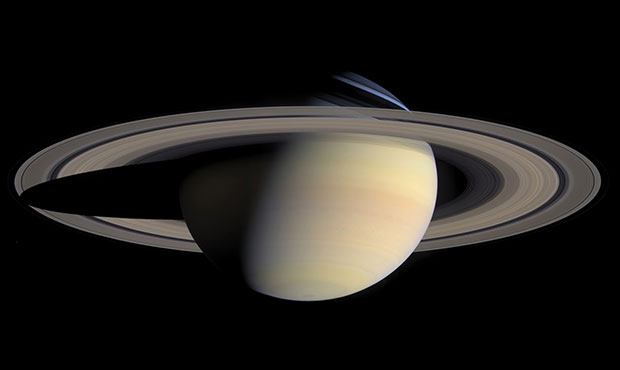
(NASA-AP Photo)
(NASA-AP Photo)
Saturn, the sixth planet from the sun, is a most amazing world.
This planet exhibits one of the most amazing structures in the entire solar system, a true well-developed ring system, which has been the subject of much research over the past four hundred years or so.
First observed by Galileo in 1610 with a crude telescope, he noticed that the planet had some type of elongated mass protruding from each side.
He did not actually discover the true nature of the “ring,” but helped to encourage others, like Christian Huygens, to actually suggest that Saturn had a true ring around it.
This revelation came about in the year 1655.
It was not until 1675 that astronomer J.D. Cassini, determined that Saturn had a rather extensive ring, made up of many smaller rings with a series of gaps between them.
Saturn has the most extensive ring system of any planet in our solar system.
How did the ring system of Saturn actually form and what is the current status of the ring system?
Today, we know that the main components of the ring system, working outward from the planet, are labeled C, B and A, with the Cassini Division the largest gap in the whole ring.
Much has been learned from the NASA robotic craft, known as Cassini.
Add to the listed rings above, Cassini helped to discover the additional rings D, closest to the planet, as well as G and E.
The best estimates as to the formation of these rings, is that they were formed between 10 and 100 million years ago, as a large comet or planet came too close to the gravity of the primary planet.
Some estimates claim that the rings of Saturn may vanish in the next 300 million years or sooner!
The rings of Saturn are made up of water ice and solid particles, and may be raining down on the main body of Saturn, due to gravity and the magnetic field of the planet.
If this is correct, the ring system may disappear in the next 100 million years or less!
For now, Saturn makes for one of the most amazing sights in the night sky, if you have a small telescope and a clear sky.
Saturn lovers, pay attention!
We get to view a most amazing conjunction of both Mars and Saturn, low in the southeast sky, before dawn, March 31.
Mars, the god of war, will move to a close embrace with Saturn, the agricultural god, right around the end of the month.
These two objects will come within a degree apart in the sky!
To print your very own star chart, click here.
To view satellites/dates/times of passage, click here.
Listen to Dr. Sky on KTAR News 92.3 FM every Saturday at 3 a.m.
Comments