
President-elect Trump uses Twitter as controversial mouthpiece following election
Since his election, Trump has used Twitter, to interact with his supporters, introduce policy positions and state his opinions on current events.
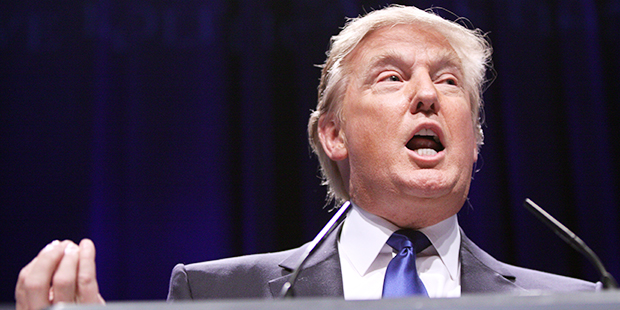
(Flickr/Gage Skidmore)
(Flickr/Gage Skidmore)
PHOENIX – In less than a month, President-elect Donald Trump will be sworn into office as president of the United States.
Since he was elected by the American people on Nov. 8, Trump has used his preferred method of communication, Twitter, to interact with his supporters, introduce policy positions and state his opinions on current events.
Here is a comprehensive, but not exhaustive, list of his tweets, complete with background information, since Nov. 8.
Nov. 9: Introducing President-elect Donald Trump
Such a beautiful and important evening! The forgotten man and woman will never be forgotten again. We will all come together as never before
— Donald J. Trump (@realDonaldTrump) November 9, 2016
Everything was looking bright for the newly-elected president-elect. Using his preferred method of communication, Twitter, Trump fired off a tweet shortly after it was announced that he won the election, thanking his supporters and vowing to move forward with a strong, positive agenda.
He reflected his sentiments in his victory speech as well, saying he pledged “to every citizen of our land that I will be President for all of Americans.” Days later, the president-elect sat down with President Barack Obama for the first time and called the meeting “fantastic.”
But just two days later, the president-elect tweeted that professional protesters “incited by the media” were protesting his election. He had a change of heart the next day, though, tweeting that he loves that the “small groups of protesters…have passion for our great country.”
Nov. 19: Controversies Arise
I settled the Trump University lawsuit for a small fraction of the potential award because as President I have to focus on our country.
— Donald J. Trump (@realDonaldTrump) November 19, 2016
The ONLY bad thing about winning the Presidency is that I did not have the time to go through a long but winning trial on Trump U. Too bad!
— Donald J. Trump (@realDonaldTrump) November 19, 2016
Just 10 days after being elected into office, Trump continued to bypass reporters and use Twitter as his personal mouthpiece.
Trump University, established in 2005, was a for-profit company that operated in real estate training. Three lawsuits – two class-action – were filed against the company, alleging that it defrauded students by using misleading and aggressive practices.
Despite saying throughout his campaign that he would not settle the lawsuits, Trump settled all three on Nov. 18 for $25 million.
The next day, Trump dominated news headlines for tweeting about Vice President-elect Mike Pence’s experience at the “Hamilton” musical. Pence attended a showing of “Hamilton” in New York City and was booed by several audience members. After the show, lead actor Brandon Victor Dixon addressed Pence directly, saying the cast is the “diverse America who are alarmed and anxious that your new administration will not protect us.”
Trump fired off on Twitter, saying the cast should immediately apologize for their “terrible behavior.”
Nov. 27: Trump begins perpetuating myth of widespread voter fraud
In addition to winning the Electoral College in a landslide, I won the popular vote if you deduct the millions of people who voted illegally
— Donald J. Trump (@realDonaldTrump) November 27, 2016
In the weeks following the election, it became apparent that Trump lost the popular vote, despite gaining 290 electoral votes to win the presidency. (Democratic competitor Hillary Clinton currently holds a 2.9 million vote lead over the president-elect, according to certified election results.)
He was not happy with those results, taking to Twitter to express his feelings. He alleged — falsely, as there is no evidence to prove otherwise — that there was “serious voter fraud” in Virginia, New Hampshire and California. Clinton won all three states, giving her 72 electoral votes.
Trump said he would have won the “so-called popular vote” “even more easily and convincingly” if he campaigned in just three or four states with large populations, such as New York, Florida and California.
In the months leading up to the presidential election, Trump repeatedly claimed that the election was “rigged” against him, claims that analysts said were unfounded and could undercut the essence of American democracy.
On Dec. 19, when the Electoral College officially cast their votes, he again took to Twitter to say he won the election “despite the distorted and inaccurate media.”
Nov. 30: Trump agrees to turn business over to children, end conflict-of-interest
I will be holding a major news conference in New York City with my children on December 15 to discuss the fact that I will be leaving my …
— Donald J. Trump (@realDonaldTrump) November 30, 2016
great business in total in order to fully focus on running the country in order to MAKE AMERICA GREAT AGAIN! While I am not mandated to ….
— Donald J. Trump (@realDonaldTrump) November 30, 2016
On Nov. 30, Trump announced via Twitter that he would be leaving his organization “in total” and turning over the business to his three eldest children, Donald Jr., Ivanka and Eric. He said in a December interview that his executives would also run the business empire with his children.
He also said he would expand upon the transition process in a press conference on Dec. 15, which was cancelled shortly before.
Throughout his campaign, Trump repeatedly stated that he would turn his business, which is currently valued at $3.5 billion, to a “blind trust” if he was elected president.
While he is not required to step away from his businesses while serving as president, turning his business over to his children is not a true blind trust. By definition, a blind trust is when an independent trust controls the assets of a private business and the owner does not know how they are managed.
In December, Trump tweeted that he would leave his business on Jan. 20 so he can focus on the presidency and stated that “no new deals will be done” while he is in office.
On Christmas Eve, Trump announced in a statement that he would also the foundation.
I gave millions of dollars to DJT Foundation, raised or recieved millions more, ALL of which is given to charity, and media won't report!
— Donald J. Trump (@realDonaldTrump) December 27, 2016
The DJT Foundation, unlike most foundations, never paid fees, rent, salaries or any expenses. 100% of money goes to wonderful charities!
— Donald J. Trump (@realDonaldTrump) December 27, 2016
The foundation has garnered controversy throughout the election, after reports surfaced that Trump used the charity’s money to settle lawsuits, contribute to political campaigns and purchase items to display at his properties.
But New York Attorney General Eric Schneiderman said the foundation cannot be dissolved because it is still under investigation for violating IRS regulations. In a statement, Trump said he would continue to “pursue my strong interest in philanthropy in other ways.”
Dec. 3-Present: Trump attacks ‘Saturday Night Live,’ media, Green Party, union worker, Obama, etc.
Just tried watching Saturday Night Live – unwatchable! Totally biased, not funny and the Baldwin impersonation just can't get any worse. Sad
— Donald J. Trump (@realDonaldTrump) December 4, 2016
Just one day after dominating headlines for his “congratulatory” phone call with the president of Taiwan, Trump decided to kick his feet up and catch an episode from “Saturday Night Live.”
Unfortunately for him, the writers at SNL decided to poke some fun at Trump retweeting a 16-year-old’s tweet attacking a CNN reporter for finding “no sufficient evidence” that the president-elect did not “suffer from voter fraud.”
WARNING: This video contains mature language.
Shortly after, Trump attacked the Green Party for Jill Stein’s attempts to force a vote recount in Pennsylvania and Wisconsin by raising millions of dollars.
He also attacked the media for not covering him “accurately and honorably” and defended his use of Twitter to communicate. He later attacked CNN for reports that he would work on “The Apprentice” in his spare time – reports sparked by his own campaign manager, Kellyanne Conway.
Two days later, Trump called out Chuck Jones, the president of United Steelworkers 1999, for doing a “terrible job representing workers.” The backlash came after Jones said Trump took credit for keeping 1,100 jobs from being outsourced to Mexico in a deal with an Indiana-based manufacturing plant for Carrier.
On Dec. 15, Trump personally called out Vanity Fair Editor Graydon Carter after the magazine published a rather-critical review of Trump Grill(e) in New York, saying the restaurant could be “the worst…in America.”
After a relatively calm Christmas Eve and Day, the president-elect used Twitter to spark another social media attack on President Barack Obama, saying there was “no way” Obama could have won against him.
President Obama campaigned hard (and personally) in the very important swing states, and lost.The voters wanted to MAKE AMERICA GREAT AGAIN!
— Donald J. Trump (@realDonaldTrump) December 27, 2016
Trump is expected to take over Obama’s presidential Twitter account, @POTUS, on Jan. 20, but I have a feeling that we’ll still be following @realDonaldTrump for years to come.
Related
 Katie Hobbs won’t rule out Republican as her pick for Arizona’s 1st lieutenant governor
 East Valley students start heading back to class for 2026-27 school year
 Enter to Win ASU Pat Tillman Jersey
 Democratic state lawmakers say Surprise ICE facility should be stopped ‘at all costs’Pat Tillman Jersey Giveaway
 17-year-old charged for allegedly throwing a firework at Glendale Police officers during protest

Comments
0 Comments