
Lunar eclipse will give sky watchers something to see early Friday
Observers across North America will get to experience one of the most amazing celestial events - a near total lunar eclipse Friday morning!
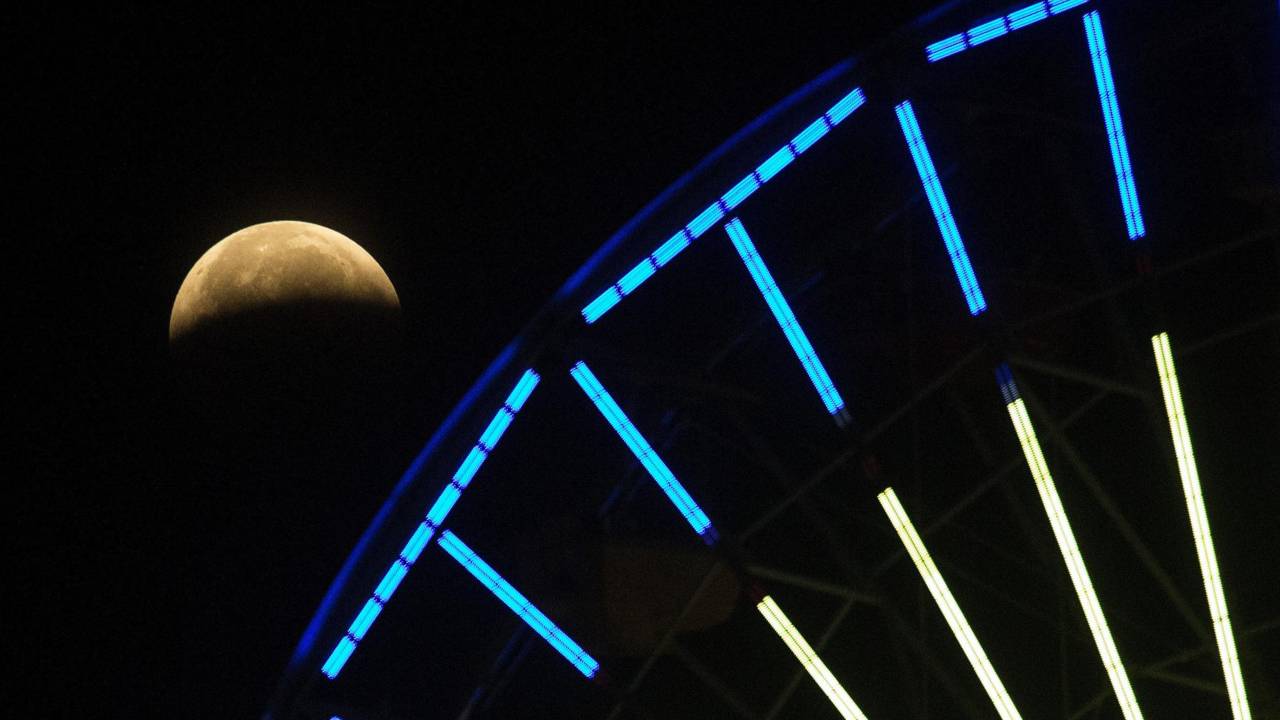
(AP Photo/Ringo H.W. Chiu)
(AP Photo/Ringo H.W. Chiu)
Observers across North America will get to experience one of the most amazing celestial events – a near total lunar eclipse Friday morning!
Lunar eclipses are quite long and interesting and offer something for everyone, from the beginner to the advanced observers.
This particular eclipse is listed as the longest lunar eclipse of the century and in total, from the penumbral phase to the end of the penumbral phase, is some six hours in length.
The true visual portion of this eclipse, from the beginning of umbral phase to the end of the umbral phase, is some three hours and 28 minutes in length.
I will be your guide to getting the most out of this rather rare celestial event.
Listed as the longest lunar eclipse of the century, the eclipse from penumbral event to the end of penumbral event is some six hours long. The difficulty in seeing the faint penumbra makes the eclipse three hours and 38 minutes long.
The eclipse will technically begin at 11:02 p.m. (all times listed are Arizona time) on Thursday, as the moon moves into the Earth’s outer shadow.
Not much visible here as the start of the deeper umbral shadow will darken the upper left of the moon, beginning at 12:18 a.m. Friday.
From here, the moon will darken and reach its maximum eclipse of some 97.4% at 2:02 a.m.
The end of the visible umbral phases will end at 3:47 a.m., with the outer shadow of the penumbra moving off the moon at 4:10 a.m.
Here is a basic graphic of the entire eclipse with times listed.
At the time of maximum eclipse, the Arizona sky will return to showing its many stars. In my opinion, this is the best time to take some wide-angle pictures of the moon, looking like a Chinese lantern and offering you a short opportunity to possibly see some of the Leonid meteors, coming from the near peak of this meteor shower.
Here are some tips on how to best take pictures of the lunar eclipse.
Here are the fine details on Friday’s lunar eclipse.
If you miss this lunar eclipse, we will get to see a total lunar eclipse here in the west on the night of May 15-16, 2022.
Lunar eclipses are not all that rare, but eclipses which occur during the early evening hours are less frequent.
Here are the details of the May 2022 total lunar eclipse.
Finally, to get ready for this eclipse on Friday morning, we note that the moon will rise Thursday at 5:09 p.m. to the left of true east at 69 degrees azimuth.
This is in the constellation of Taurus the Bull.
The November full moon is known as the full beaver moon and will actually be considered a micro moon, as it will be nearly at its farthest at some 251,000 miles away.
Enjoy the longest lunar eclipse of the century!
To print your own monthly star chart, click here.
To view satellites/dates/times of passage, click here.
Listen to the Dr. Sky Show on KTAR News 92.3 FM every Saturday at 3 a.m.
Podcasts are available here.
Comments
0 Comments