
What the closure of Saudi Arabia’s East-West pipeline could mean for oil flows

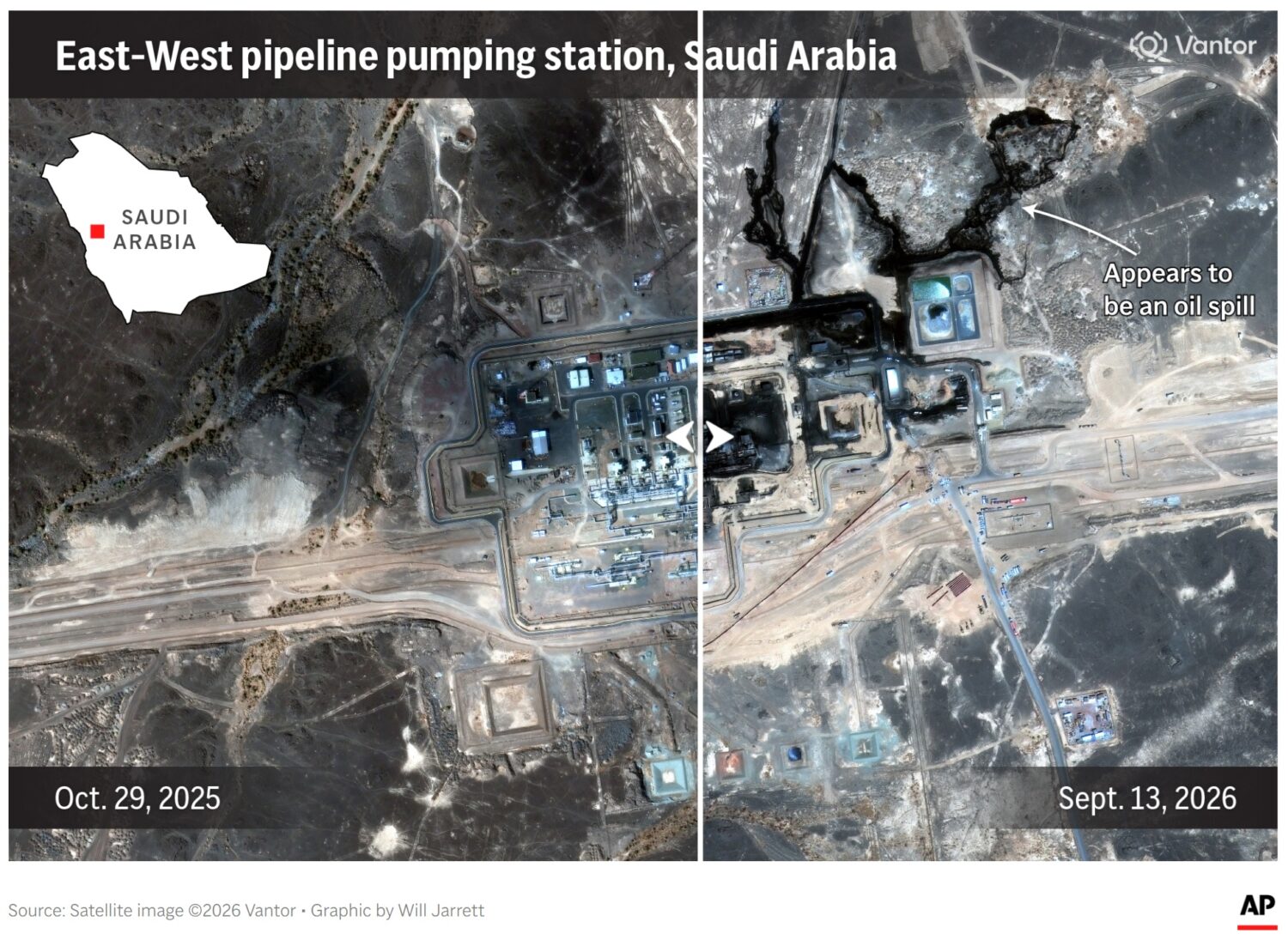
A slider showing damage to a pumping station on the East-West pipeline in Saudi Arabia. (AP Digital Embed)
Credit: AP Photo/Will Jarrett
(AP Digital Embed)
CHICAGO (AP) — Saudi Arabia’s closure of a major oil pipeline after a recent attack is raising fears that global energy markets in crisis because of the war with Iran could face even starker shortages, pushing prices higher for fuel and other essentials.
The largest oil producer in the Middle East closed its East-West pipeline on Friday after the attack, which it blamed on drones from Iranian-backed militias in Iraq. Two regional officials told The Associated Press that repairs could take three to five weeks.
The pipeline is crucial to getting some crude out of the Middle East by shipping it to the Red Sea rather than through the Strait of Hormuz, the narrow waterway through which roughly a fifth of the world’s oil supply passed before the U.S. and Israel attacked Iran in February.
Yemen’s Iran-backed Houthi rebels have seized islands along key Red Sea shipping routes, further threatening Saudi exports. And while several limited alternatives remain, including trickles of tanker traffic in Hormuz, experts warn more supply shocks and higher prices straining households could pile up. Brent crude, the international standard, traded at more than $105 a barrel Monday.
Here’s what we know:
Saudi Arabia’s East-West pipeline stretches some 1,200 kilometers (746 miles) across the desert nation — carrying oil from a processing facility near the Persian Gulf westward to the Red Sea. There, crude is typically loaded onto tankers that head north towards Europe via the Suez Canal or south through the Bab el-Mandeb Strait, on the way to Asia.
The pipeline was built in the 1980s amid fears that Tehran would disrupt shipping through Hormuz during the Iran-Iraq war. And for the first six months of the current war, it was crucial to keeping at least some oil flowing out of the Middle East while most tanker traffic in Hormuz remained at a standstill.
Rystad Energy said Monday that an average 2.6 million to 4 million barrels of oil a day moved through the pipeline and out of the Red Sea port of Yanbu since late August — a volume it said is now at risk of “disappearing from the market.”
Four million barrels per day is about 4% of the global oil supply, according to the International Energy Agency. Saudi Arabia produced nearly 10 million barrels of oil a day in September 2025, but was down to 6 million barrels per day in August, the IEA said.
Janiv Shah, vice president of oil markets for Rystad Energy, noted the recent jump in Brent prices proves the market is already responding to “a significant loss of supply.” Saudi inventories could sustain exports in the coming days, but that could “change quickly,” Shah added.
The Strait of Hormuz is still top of mind. Before the war, about 20 million barrels passed through Hormuz each day.
Some tankers are again traversing the strait, but traffic is well below what it once was. Maritime data company Lloyd’s List Intelligence counted 90 transits in the first week of September. Before the war, about 130 ships passed through daily.
The Houthis have also tightened their hold on the Bab el-Mandeb Strait, a vital passage for the southern Red Sea. Analysts at Melius Research estimated that about 3 million barrels of oil a day were moving through Bab el-Mandeb in early September, but noted Monday that “it’s likely zero now.”
Because of Houthi attacks, most Saudi traffic from Yanbu went north to the Mediterranean, either via the Suez Canal or Egypt’s SUMED pipeline. But the Houthis have also begun targeting Saudi shipping in the north.
Salvatore Mercogliano, a professor of maritime history at Campbell University in North Carolina, noted that at least Hormuz is still on the table.
“If this (East-West pipeline) was the only method for Saudi Arabia to get their oil out it would be absolutely cataclysmic,” he said. “But since the Hormuz route has opened back up — not completely but opened up some — it’s not the death knell for Saudi Arabia. They’re getting oil out.”
Supply squeezes have led to soaring prices worldwide. And analysts warn that the latest disruptions could bring even more pain for consumers in the coming weeks and months.
One of the most immediate consequences is the cost of fuel and household energy bills. Countries in Asia and Africa, which rely more heavily on imports from the Middle East, have experienced some of the starkest shocks.
In Nigeria, for example, diesel prices are now 92% higher than they were in late February, and gasoline prices are up nearly 61%, according to energy tracker Global Petrol Prices. Countries including Indonesia (diesel up 87% and gas up 38%) and Lebanon (diesel up 80% and gas up 46%) have also seen steep spikes.
In the U.S., the price per gallon of regular gasoline was nearly $4.32 on average Monday, up almost 45% from the $2.98 seen before the war, according to motor club AAA. Diesel hit another all-time high (without accounting for inflation) of $6.23 per gallon on average Monday, up nearly 66% from the start of the war.
The cost of diesel, in particular, makes its way into other goods because the fuel is used for long-haul trucks and other delivery networks, as well as farm equipment.
“An inflationary spillover is likely,” warned Melius Research analysts on Monday, pointing to the war’s squeeze on essentials like fertilizer as well as energy sources. “The diesel crunch is also coming ahead of the U.S. harvesting and heating season.”
____
Anderson reported from New York. Associated Press writer Samy Magdy in Cairo contributed.
Related
 State Route 51 lane restrictions near Camelback Road lifted after 7 weeks
 Glendale pursuit video shows crash behind rare murder charge
 Chandler bee attack on Intel Ocotillo campus leaves 3 victims hospitalized
 80-year-old Scottsdale resident accused of shooting Segway-riding salesman in back
 Abbott agrees to settlement over closure of largest baby formula plant in the US
 Man pulled from pond at Mesa Riverview Park and rushed to hospital
Comments
0 Comments