
US stocks bounce back as Microsoft and chip companies lead the way

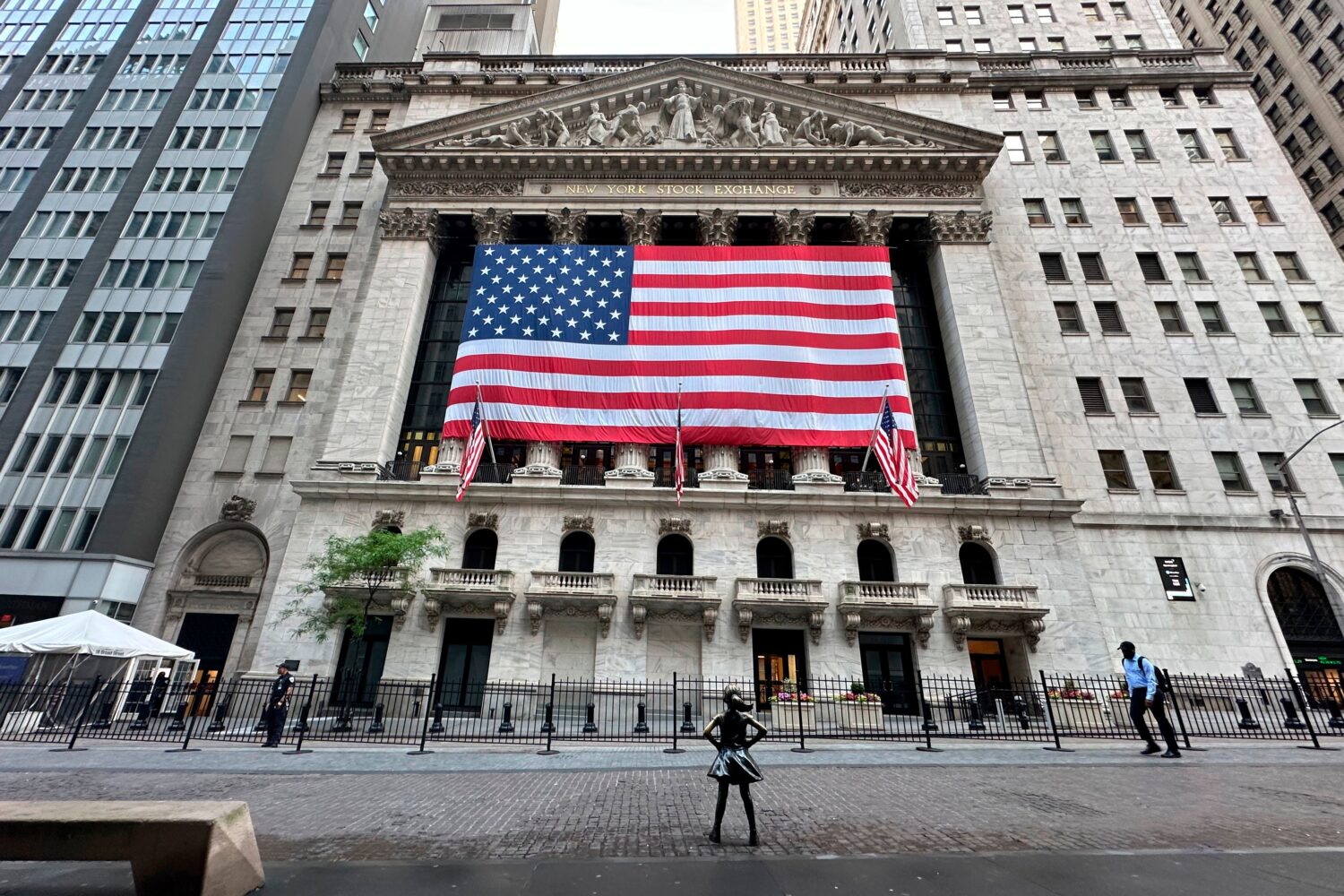
FILE - People pass the New York Stock Exchange on May 28, 2024, in New York. (AP Photo/Peter Morgan, File)
Credit: AP Photo/Peter Morgan
(AP Photo/Peter Morgan, File)
NEW YORK (AP) — U.S. stocks are bouncing back after Microsoft leaped on its latest profit report and computer-chip companies clawed back some of their big recent losses. The S&P 500 rose 0.6% early Thursday and recovered about half its drop from the prior day, which was its worst in seven weeks. The Dow Jones Industrial Average added 270 points. The Nasdaq composite, which is full of tech stocks, rose 1.6% a day after it fell 9.8% below its record set last month. European markets were higher and Asian markets were mixed overnight. The price of Brent crude oil fell 1.7%.
THIS IS A BREAKING NEWS UPDATE. AP’s earlier story follows below.
Wall Street was poised for a rebound Thursday and oil prices fell modestly even as the U.S. said it had conducted a “heavy wave” of strikes against Iran.
Futures for the S&P 500 jumped 0.5%, while futures for the Dow Jones Industrial Average rose 0.4%. Futures for the tech-heavy Nasdaq climbed 1.3%.
Markets appeared to shift their focus toward mostly solid corporate earnings while still absorbing the Federal Reserve’s decision a day earlier to leave its benchmark borrowing rate alone for the time being.
Microsoft shares soared more than 9% after it breezed past Wall Street profit expectations on the strength of its Azure cloud services business.
On the flip side, Facebook parent company Meta tumbled 8.3% after it missed profit targets while logging $42 billion in costs and expenses, a 55% increase over the same period a year ago. Investors remain concerned about if and when companies like Meta will begin to see profits from their massive investment in artificial intelligence.
In South Korea, the Kospi fell modestly after losing more than 16% over the past two days due to selling of AI stocks.
The Kospi fell 1.2% to 5,593.56, after a 10.8% drop on Tuesday and a nearly 6% loss on Wednesday. The benchmark is down more than 38% from its all-time closing high of more than 9,100 in June, though it’s still up nearly 30% so far this year.
Wild swings in the Kospi, a big beneficiary of the global boom in artificial intelligence, have been viewed by some analysts as a reflection of broader doubts about massive investments in building AI capacity.
Samsung Electronics fell 0.7%, even after the South Korean technology giant reported a record operating profit for the latest quarter, largely in line with estimates.
Chipmaker SK Hynix lost 5.6% after sinking more than 9% on Wednesday, when it also reported a record quarterly operating profit, which ballooned nearly sixfold. That was still lower than what analysts had expected and disappointed investors dumped its shares.
In Tokyo, the Nikkei 225 gained 0.7% to 61,867.43, recovering some of its losses after falling 1.5% a day earlier. Open-AI investor SoftBank Group fell 2.5%. But computer chip equipment maker Tokyo Electron climbed 4.5%. Memory chipmaker Kioxia Holdings added 2.9%.
Taiwan’s Taiex, which was also lifted by the AI boom, closed 0.3% lower. Its leading chipmaker TSMC edged up 0.2%.
Hong Kong’s Hang Seng edged up 0.2% to 25,858.88. The Shanghai Composite index lost 0.6% to 3,804.69.
U.S. markets stabilized Thursday morning after falling a day earlier when Fed officials voted to keep the U.S. central bank’s benchmark interest rate steady. Three members of the policymaking committee did want to raise rates. The Fed’s chairman, Kevin Warsh, implied the bond market may already be doing some of the work to restrain inflation, and he pointed to how yields have climbed since the central bank’s last meeting six weeks ago.
In the bond market, the yield of the U.S. 10-year Treasury was at 4.68%, up from 4.61% late Tuesday.
Warsh reiterated his commitment to get inflation back to 2% following years of faster-than-hoped increases in prices, but he also stuck to his plan of giving financial markets fewer clues about what the Fed may do with interest rates in the near future.
Higher rates can keep a lid on inflation, but they can also slow the economy and undercut prices for stocks and other investments.
In energy trading, the recent jump in oil prices subsided somewhat despite ongoing fighting in the Middle East.
Brent crude, the international standard, slipped $1.06 to $87.03 per barrel after rising earlier. It was trading around $72 a barrel in late February, before the Iran war began.
Benchmark U.S. crude lost $1.10 to $83.36 per barrel.
At midday in Europe, Britain’s FTSE 100 rose 0.4%, France’s CAC 40 surged 0.9% and Germany’s DAX ticked up 0.2%.
Related
 No charges for Arizona parents in case of toddler who was alive after being declared deadA 10-year-old saved his sister as they struggled in a New Jersey river before he died, mayor says
 Senate committee advances nomination of Dr. Erica Schwartz to be Trump’s CDC director
 After Lindsay Clancy killed her 3 children, first responders tell a jury what they found
 SAFE Alert issued as part of search for missing 92-year-old Mesa woman
 Southbound Loop 101 Pima Freeway reopens in Scottsdale after fiery crash
Comments
0 Comments