
The world inches toward catastrophic climate events: ‘Bigger shocks are on the way’

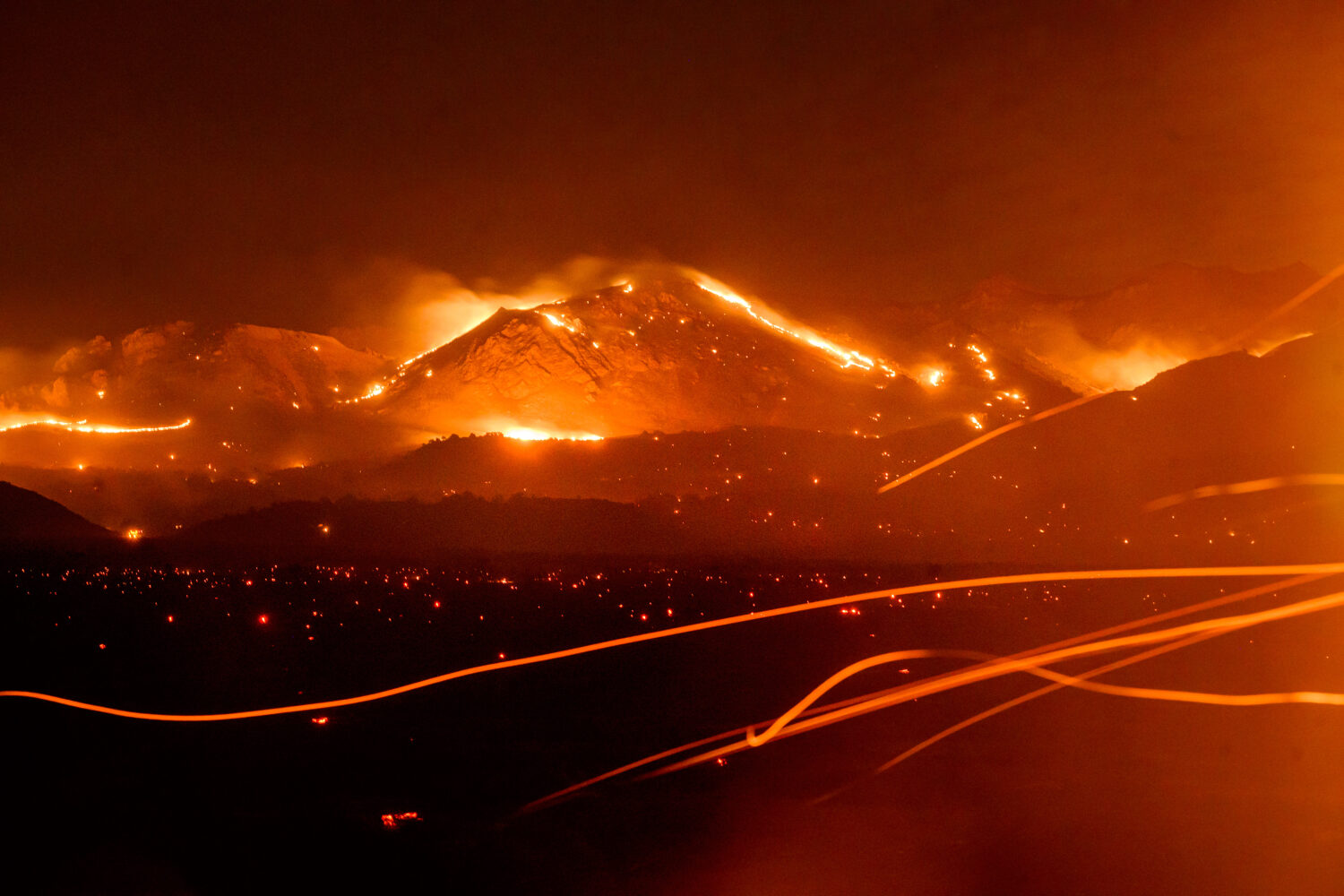
FILE - The Bug Fire burns near Doyle in unincorporated Lassen County, Calif., Aug. 13, 2026. (AP Photo/Noah Berger, File)
Credit: ASSOCIATED PRESS
(AP Photo/Noah Berger, File)
NEW YORK (AP) — In the opening scene of American writer Kim Stanley Robinson’s “The Ministry for the Future,” a heat wave combined with a breakdown of the electrical grid in India kills 20 million people. The devastation causes the world’s nations to unite to combat climate change.
Scientists have long warned that the world will experience more intense extreme weather events like heat waves, storms, floods and droughts. But what once seemed like the realm of fiction is now discussed as a possibility, even an inevitability.
Warning about an “extreme of extremes” or the “Other Big One,” a play off the California reference of a big future earthquake, can be fraught. After all, nobody can say for sure when a weather catastrophe may happen. But in the last few years, the planetary ingredients needed for a massive disturbance have been building. And alarm is growing.
“The risk is that people just think you are exaggerating,” said Daniel Swain, a climate scientist with the California Institute for Water Resources. “It’s the ‘Boy Who Cried Wolf’ problem. Sometimes wolves are real. If it’s outside the door, wouldn’t you want to know?”
In the 1850s, while living in Seneca Falls, New York, amateur scientist Eunice Newton Foote did a series of experiments that put different substances, including carbon dioxide and moist air, inside glass cylinders and left them in the sun. What she found was extraordinary: cylinders with carbon dioxide, a greenhouse gas that is released when coal, gas or oil is burned, heated up faster and took longer to cool after the sun went down.
Fast-forward: Today, Earth is being heated by massive amounts of greenhouse gases being pumped into the atmosphere, leading to a gradual rise in average global temperature. That increase, 1.44 degrees Celsius (2.59 degrees Fahrenheit) warmer in 2025 compared to the early 1800s, leads to more frequent, and more intense, extreme weather events.
The country that has released the most greenhouse gas, and thus contributed most to climate change, is the United States. But don’t expect recognition of that, much less major government-led efforts to combat it, as the country marks its 250th birthday. President Donald Trump has called climate change “the greatest con job ever,” referred to climate policies as a “Green New Scam” and said U.N. climate predictions were made by “stupid people.”
At any given time there are numerous extreme weather events happening around the globe. Indeed, some have already been so big that we have arguably entered an age of extremes.
Consider Australia’s “Black Summer” of wildfires in 2019 and 2020, when 19 million hectares (over 46 million acres) were scorched. Or Pakistan in 2022, when flooding left a third of the engulfed young campers; the Los Angeles wildfires that chewed through entire neighborhoods; and Typhoon Kalmaegi, which walloped Vietnam and the Philippines.
Sarah Perkins-Kirkpatrick, a climate scientist at Australian National University, says she had a “come to Jesus moment” when she realized that constant extreme weather events wouldn’t stop even if the world could immediately reach net zero, the point when as much greenhouse gas is taken out of the atmosphere as released into it. Many countries and major companies have net-zero targets for 2050 or beyond.
Because carbon dioxide can remain in the atmosphere for hundreds of years, and so much has already built up, the damage could take centuries to reverse. And we keep adding more.
“It’s the issue of the frog in the boiling water,” said Perkins-Kirkpatrick. “If we get used to bracing ourselves, are we going to notice?”
What’s clear is that no country is truly prepared for a major climate disaster, and the risks are changing.
Robinson, whose book was published in 2020, says if he were writing today he would include a chapter on wildfires, which have become larger and more destructive. And while the potential heat disaster he writes about in India would arguably be less likely today, thanks to less reliance on the grid and use of solar power, Robinson believes the risks of catastrophe have increased.
The book, he says, “still has a purpose.”
It’s basic psychology to avoid talking about uncomfortable things. Climate change, depressing and overwhelming, falls into that category.
Instead of taking action by radically reducing greenhouse gas emissions, or updating our infrastructure to live in a world altered by extreme weather events, a common response, from governments to individuals has largely been to ignore it. Part of the challenge is the care scientists must take when discussing extreme events.
It’s impossible to say, for example, that a disaster will happen in a certain year or even decade. But modeling improves every year, and the amount of time between extreme events is shrinking.
Sonia Seneviratne is a Swiss climatologist who vice chairs a working group of the Intergovernmental Panel on Climate Change, the top U.N. body of climate scientists. Seneviratne likens the risk to smoking and lung cancer. People who smoke won’t necessarily get lung cancer, but the chances are higher and doctors should say that. Similarly, the risk of massive extreme events rises with every tenth of a degree.
“If such an event happened, I could already see the criticism of people saying, ‘Climate scientists didn’t tell us,’” Seneviratne said. “But we did.”
While earthquakes are not connected to climate change, the way many cities in earthquake-prone California have prepared for a potential Big One is as an example of what’s possible. Central to that effort has been Lucy Jones, a seismologist and author of “The Big Ones: How Natural Disasters Have Shaped Us (and What We Can Do About Them).”
In 2014, Jones, then with the U.S. Geological Survey, worked with Los Angeles Mayor Eric Garcetti’s administration in developing an initiative that produced widespread retrofitting and earthquake preparedness in LA, and then later in other California cities. Two years later, she formed a nonprofit that advises on preparing for earthquakes and other disasters.
Jones says people will make changes if they believe risks are real and solutions are possible. Without that belief, the response will likely be to ignore the issue.
“Climate denial is one way of coping,” said Jones. She said people rationalize by thinking, ‘I won’t believe it’s true, so I’ll feel safer.’”
Over the last quarter century, many movies have focused on extreme weather events, which provide action and danger to any plot. The cinematic portrayals usually have one of two endings: everything will be okay or we are doomed.
Consider two popular climate movies that came out 15 years apart. In the 2004 “The Day After Tomorrow,” Jack Hall, played by Dennis Quaid, is a climate scientist who, speaking at a U.N. climate conference in Delhi, urges a major reduction in greenhouse gas emissions, warning that a failure to do so will lead to major extreme weather events.
“The climate is fragile,” says Hall.
“The economy is fragile,” responds the U.S. vice president.
Shortly after, the disaster that Hall warns about happens. Melting polar ice halts the North Atlantic Current, which moves warm ocean currents northeast across the Atlantic. There are giant cyclones, massive hailstones, heavy flooding and tornadoes before a big freeze takes over — so cold that anybody outside dies.
Eventually the vice president, who has become president, apologizes to the nation for exploiting nature.
“We were wrong,” he says.
In the 2021 satire “Don’t Look Up,” two astronomers played by Leonardo DiCaprio and Jennifer Lawrence discover a giant comet heading toward Earth. They try to spur action to avoid annihilation. The U.S. president, played by Meryl Streep, isn’t interested.
“At this exact moment, I think we sit tight and assess,” Streep says after learning the comet is heading straight toward Earth.
“How big is this thing? Can it destroy my ex-wife’s house?” jokes a television news host.
At the end, almost everybody dies, a scenario that even the worst predictions of climate impacts don’t envision.
As powerful as extreme weather events have already gotten, much worse is likely to come. It’s basic physics.
More than half all greenhouse gases produced by humans throughout history have been released into the atmosphere over 50 years. Those gases create heat, which scrambles weather patterns and ecosystems.
The when of a major climatic event, or more likely several in different parts of the world, can’t be known with certainty. A catastrophic event in any given area could be in 50 years, or 10 years, or sooner.
People who deny climate change is real will point out that scientists get projections wrong, and it’s true that not every climate model has been correct. But over the last decades, if anything, climate scientists have been too conservative. Climate impacts are happening much faster than predicted.
One of many examples: in January 2022, the U.K. Climate Risk Assessment said there was a 0.02% chance of 40C (104F) or above heat before 2040. That summer, parts of the U.K. topped 40C.
We have also reached a moment when “tipping points” — when deterioration of a given planetary system has crossed a threshold from which it can’t recover — are no longer positioned as theoretical or futuristic.
The most commonly cited is corals. According to the National Oceanic and Atmospheric Administration, between 2023 and 2025, 84% of the world’s corals suffered the expelling of microscopic algae in response to heat stress, which often leads to dying. Even if temperatures were to sharply drop, the recovery of most corals is doubtful.
The Amazon rainforest, which stores massive amounts of carbon dioxide and helps regulate the climate, is also at risk of a tipping point. Persistent drought, large wildfires and deforestation to make way for cattle have degraded swaths of forest in recent decades. The debate today is when, not if, the Amazon will release more carbon dioxide than it holds.
This year’s El Niño, a natural and periodic warming cycle, is expected to be the strongest ever recorded, which could push temperatures even higher, breaking records and leaving damage along the way.
Overall, the Earth is on a dangerous path.
“We need to be talking about some of the worst things that can happen,” said Tim Lenton, climate science professor at the University of Exeter. “It’s natural to think that some bigger shocks are on the way.”
___
Peter Prengaman is The Associated Press’ global director of climate news and can be followed on LinkedIn.
___
AP’s climate and environmental coverage receives financial support from multiple private foundations. AP is solely responsible for all content. Find AP’s standards for working with philanthropies, a list of supporters and funded coverage areas at AP.org.
Related
 Lawsuit filed by family of Phoenix mother killed by Valley Metro bus
 Man sentenced to 30 years in prison for deadly assaults on homeless individuals in Phoenix
 Gov. Katie Hobbs says she and her family recently received an execution threat
 Man arrested in death of woman found injured under car in Phoenix
 Phoenix Symphony to stop performing after Nov. 1 concert as money runs out
 New UN initiative will aim to tackle the military uses of AI
Comments
1 Comments
President Donald Trump has called climate change “the greatest con job ever,” referred to climate policies as a “Green New Scam” and said U.N. climate predictions were made by “stupid people.”