
Strawberry farmer hopes steam holds the key to healthy soil and a better crop

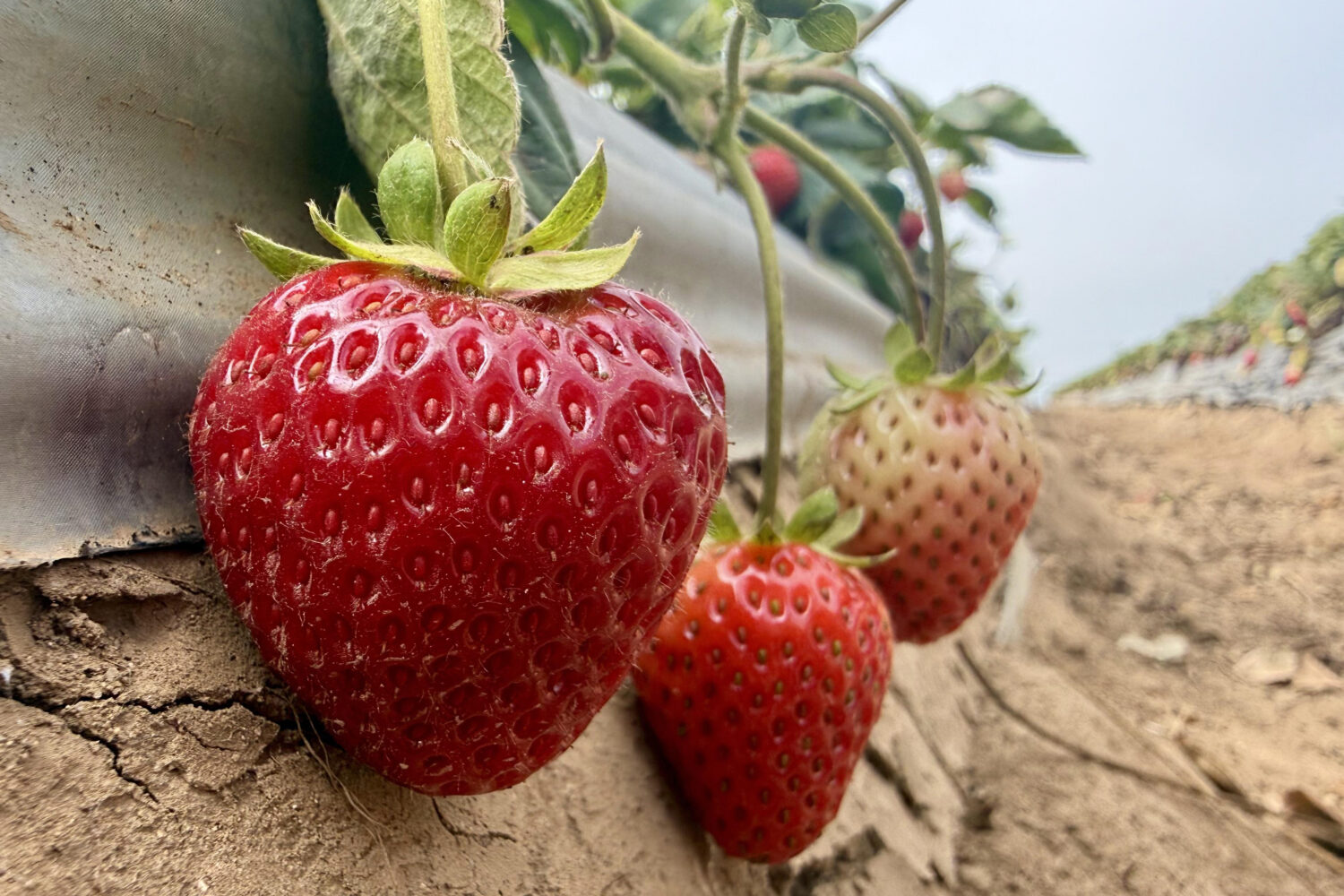
This photo taken with a smartphone shows strawberries grown using a steam-powered farming machine in Watsonville, Calif., Thursday, Oct. 1, 2026. (AP Photo/Haven Daley)
Credit: AP Photo/Haven Daley
(AP Photo/Haven Daley)
WATSONVILLE, Calif. (AP) — Long-time strawberry farmer Rod Koda has rows of plants on his California farm that are still producing fruit well after the harvest would typically end.
The fields brimming with green near the Pacific Coast have produced nearly twice the amount of organic strawberries this year as other plots thanks to steam, he said. The bountiful plots were treated with steam before Koda planted his organic strawberries as part of a project aimed at finding an alternative to chemical fumigants used to kill soil-borne diseases and weeds.
“It’s a very noticeable difference,” Koda said.
Steam has been used for decades in greenhouses, and researchers in California have been working to adapt the technology to the fields where strawberries, one of the state’s key crops, are grown near the Pacific Coast. It’s part of a broader push to help organic farmers become more productive and reduce the use of chemicals that environmental advocates say pose a health risk to farmworkers and those who live near the fields.
Rick Tomlinson, president of the California Strawberry Commission, said researchers have been working on steam for more than a decade and are tinkering with the technology so it can be applied to fields faster. The industry has also been working on other alternatives to chemical fumigants including cutting off oxygen to kill soil disease and developing more resistant plants, he said.
“Fundamentally, there’s this disease in the soil and if you don’t have some solution, you’re just rolling the dice and one of the years you’re going to end up bankrupt,” Tomlinson said, “because it can wipe out the entire field.”
Nine out of 10 strawberries grown in the United States come from California. The berry, which is grown on 35,000 acres (14,000 hectares), was one of the state’s top 10 commodities in 2025.
Strawberry growers have long relied on chemical fumigants because the fruit is grown close to the ground and is soft and fleshy, making it susceptible to disease, farm experts said. Using a machine to inject steam into the soil before planting can kill key soil-borne diseases and weeds and improve crop productivity, said Jenny Broome, a University of California, Santa Cruz researcher working on the project.
Four growers in California participated in the trials last fall, Broome said. On Koda’s farm, the steam-treated plots produced more berries and also suffered less damage from fusarium wilt, a fungal disease, she said.
Steam might also work on fields used for lettuce, carrots and other high-yield crops, she said. A challenge is making steam cost-effective for farmers, and proponents of the technology are trying to speed up the machines used in the process so they can cover more terrain faster.
“We’re going back to the future, where we’re looking back at an older technology but we’re finding more ways to engineer more efficiently and use it,” Broome said.
David Andrews, chief science officer for the Environmental Working Group, welcomed the push for an alternative to traditional fumigants, noting farmworkers in the fields and their families are the ones who have been exposed to the chemicals. He said the technology has improved while concerns about the impact of fumigants have risen.
“The economics are shifting,” Andrews said.
Related
 Mamdani’s Oct. 7 commemoration outrages supporters and critics of Israel
 Atlantic hurricanes starting with ‘I’ typically bring death and destruction. Isaias is up next
 Camelot Homes to build 19-home gated enclave at Peoria’s Saddleback development1 person shot at federal courthouse in Tennessee, police say
 Maricopa residents urged to boil tap water after preliminary testing indicates E. coli
 Vance says Microsoft is being suspended from program to apply for green cards for H-1B visa workers
Comments
0 Comments