
Press Forward completes nearly $600M in journalism investments about 2 years early

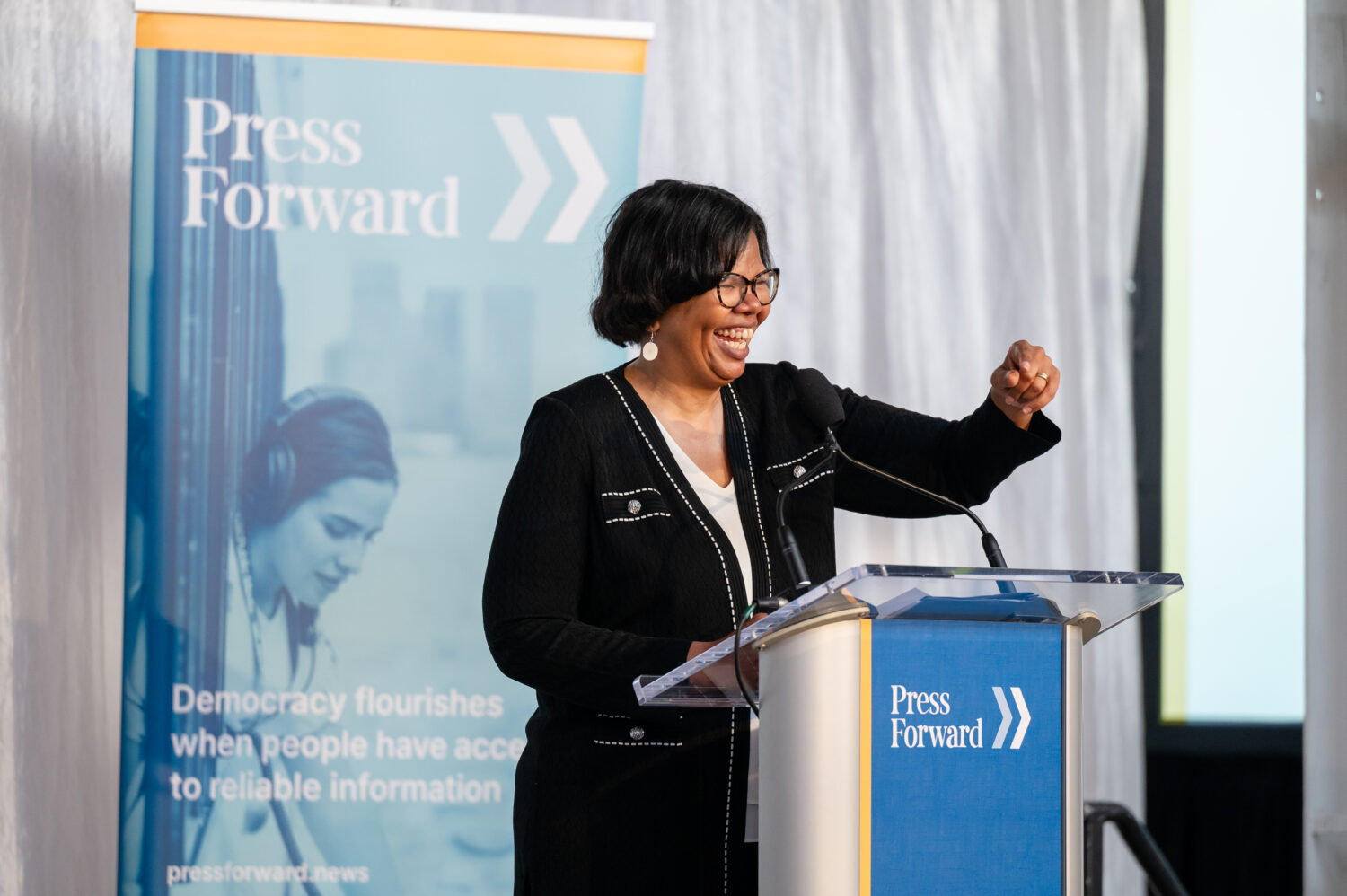
Press Forward Executive Director Dale Anglin speaks at a convening of the nonprofit's local chapters in Cleveland, Ohio on Oct. 24, 2024. (Kamron Khan for Press Forward via AP)
Credit: Press Forward via AP
(Kamron Khan for Press Forward via AP)
Press Forward, the nonprofit launched in 2023 to strengthen local news as outlets struggle with economic and technological changes, announced Tuesday that it has completed investing nearly $600 million in journalism organizations, about two years ahead of schedule.
However, Press Forward Executive Director Dale Anglin said the organization’s work is far from complete. Not only will the group continue raising and investing money, it will also expand its range of initiatives to support journalism.
“The industry is going through an incredible transformation,” Anglin told The Associated Press in an interview. “It took 20 years to get to this point – if not longer. It’s going to take us a while to get out of it.”
According to “ The State of Local News 2026 ” from Northwestern University, the number of news deserts – counties that have no locally based professional sources of news – grew by 12% this year to 238, as advertising and audiences continued to decline. Though there were dozens of newsrooms started this year, more than two newspapers closed for each outlet launched.
Anglin said she has had success convincing more funders to support Press Forward, which launched in 2023 through donations from the John S. and James L. Knight Foundation, the John D. and Catherine T. MacArthur Foundation, the Democracy Fund and 19 other funders. The nonprofit now has 144 funders and has explained how longer-term support for journalism is necessary, similar to arts or education funding in a community.
Press Forward has established a $21 million impact investing fund to support outlets with small loans they would likely not get elsewhere. It already has 50 local Press Forward chapters that have invested $87 million to strengthen journalism in their communities, including $53 million in the past year.
“The challenges in local news were really kind of universal,” Anglin said. “But it turns out, as we have learned over the last three years, that a lot of the solutions are local.”
Tracy Baim, executive director of Press Forward Chicago, said her chapter believes it has developed part of the solution to journalism’s funding problems.
In addition to accepting traditional donations, Press Forward Chicago has established a pooled fund, which uses donations from multiple organizations to support specific initiatives.
“It is a way to tiptoe into journalism funding,” said Baim, adding that many foundations, especially smaller ones, saw supporting individual news outlets as too intimidating. She said the potential pitfalls of being associated with a controversial project or being accused of influencing coverage because of their donations kept some foundations from getting involved.
“A pooled fund mitigates those risks,” Baim said. Chicago’s fund further minimizes risk for donors by distributing the donations to multiple outlets.
Its first pooled fund was used last year to fund increased immigration reporting. Nearly $1 million was collected from 12 donors and distributed to 12 organizations, ranging from national outlets like ProPublica and major local outlets like Chicago Public Media and Block Club Chicago to smaller outlets serving Latino and Chinese communities. The donations allowed the outlets to add reporting, editing and presentation capacity right before the Department of Homeland Security launched the immigration operation “Midway Blitz” in Chicago.
A second pooled fund focused on education and allowed outlets to increase coverage of the Chicago Board of Education elections.
“We are making these outlets stronger,” Baim said. “We’re not just giving an organization a grant to cover stuff. We are amplifying their work so that they can get new subscribers and that’s a pipeline of potential donors.”
Supporting that sort of sustainable growth is the next phase of Press Forward’s work. And Knight Foundation President and CEO Maribel Perez Wadsworth said that is more significant than cofounding the organization.
“Announcing half a billion dollars in national funding toward journalism was important in terms of demonstrating the urgency and the importance of supporting local journalism,” Wadsworth said. “But the more important thing, ultimately, is to really catalyze and create deeper awareness at the local level about the essential nature of access to reliable news and information as a public good.”
There are signs that donors, both big and small, are making journalism a priority because it provides an information base that supports other initiatives. Last month, the Ford Foundation, one of the world’s largest grantmakers, said that supporting journalism would become one of its priorities as it overhauls its giving to focus on the building blocks of democracy. The much smaller nonprofit Public Media Co. has made providing trustworthy local information a cornerstone of its work to keep public radio stations operating following ongoing federal funding cuts.
Perez Wadsworth said that having local and regional funders work together to keep local news outlets open in their communities is a more sustainable solution to many journalism outlets’ budgetary problems.
“Philanthropy writ large is not a business model,” she said. “And it’s not sustainable to believe that philanthropy is just going to always support whatever the thing is, no matter how important.”
Press Forward’s Anglin said there is “no silver bullet” to solve journalism’s economic problems. But philanthropy can help strengthen news outlets until they figure out a new business model that will make them sustainable.
Press Forward plans to promote solutions through public policy changes, encouraging cooperation and resource-sharing between outlets and supplying infrastructure and capacity-building grants. Its chapters, which operate independently, have met a wide spectrum of needs – from helping defray some Minnesota outlets’ cost of covering the surge of Immigration and Customs Enforcement agents in Minneapolis earlier this year to training local residents in Kentucky to become reporters.
“You can’t nonprofit your way out of this problem,” Anglin said. “We understand that some things will still close. But we are building for the long term.”
______
Associated Press coverage of philanthropy and nonprofits receives support through the AP’s collaboration with The Conversation US, with funding from Lilly Endowment Inc. The AP is solely responsible for this content. For all of AP’s philanthropy coverage, visit https://apnews.com/hub/philanthropy.
Related
 Defense Sec. Pete Hegseth pushes back against impeachment effort
 Inflation ran hotter than expected last month, underscoring affordability challenges
 Northbound Loop 101 reopens in Glendale after investigation into deadly crash
 Anthropic seeks valuation of about $1.3 trillion when it becomes a publicly traded company
 John Thune seeks another term as Senate Republican leader as the party reckons with election losses
 House Republicans are choosing their next leader as they prepare to be in the minority
Comments
0 Comments