
Mississippi has 23 public colleges and universities. Can the state sustain them?

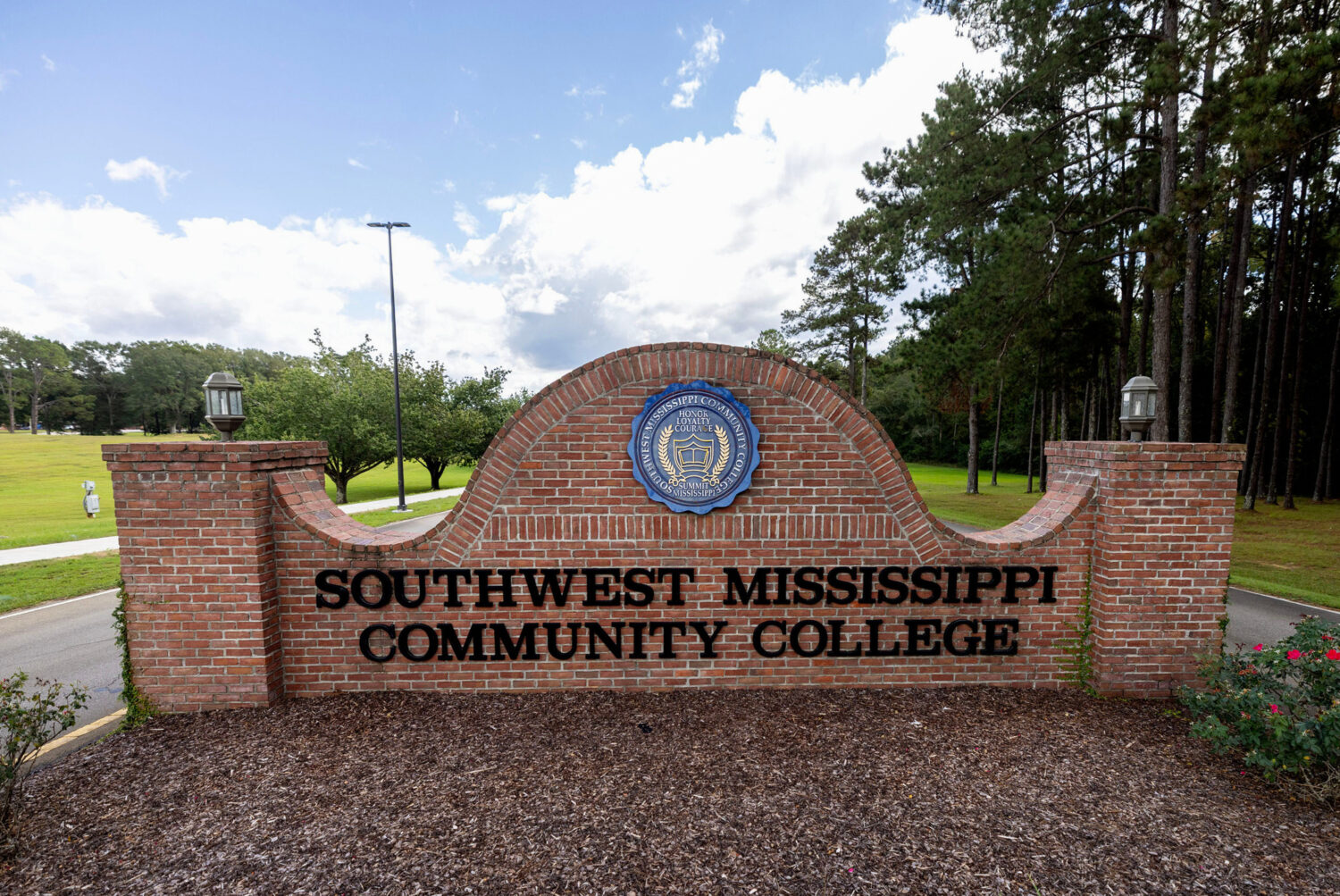
A Southwest Mississippi Community College sign stands in Summit, Miss., Friday, Oct. 9, 2026. (Eric Shelton/Mississippi Today via AP)
Credit: ASSOCIATED PRESS
(Eric Shelton/Mississippi Today via AP)
When Rep. Trey Lamar, a Republican from Senatobia, introduced House Bill 1284 in January to merge six community college districts, college leaders and students quickly launched a petition to shut it down.
The bill died in committee, but the question behind it did not: Does Mississippi still need 23 public colleges and universities?
“I wanted to start a conversation,” said Lamar, who is also a member of the House Select Committee on Consolidation. “What worked for our colleges decades ago doesn’t always work today.”
House Bill 1284 would have merged Coahoma Community College with Mississippi Delta Community College; Meridian with East Mississippi; and Southwest Mississippi with Copiah-Lincoln. The mergers would not have closed any campuses but were meant to reduce administrative costs by consolidating college districts from 15 to 12. Any money saved from merging would have been put back into the community college system, Lamar said.
Lamar’s bill intensified discussions about college mergers, said Rep. Donnie Scoggin, a Republican from Ellisville who co-chairs the House consolidation committee. Scoggin also chairs the House Colleges and Universities Committee, which he said allowed the bill to die because there wasn’t enough time to study the issue.
“We didn’t want to do anything that was rushed and just start closing colleges,” Scoggin said. “But now we’re taking time to examine all factors to make informed and better decisions.”
Mississippi’s public universities and community colleges are funded through a mix of state appropriations, federal funds, student tuition and local tax revenue. Overlapping districts can leave some property owners paying more in taxes to support multiple colleges — a situation Lamar said is unfair.
Meridian Community College serves Lauderdale County, which is also part of East Mississippi Community College’s six-county district. Merging the two districts could reduce duplicative administrative costs, he said.
Dips in population across the districts are also driving the move to consolidate. Over the past decade, thousands fewer residents have lived within the Coahoma and Mississippi Delta community college districts. In 2010, there were 26,000 residents in Coahoma County; a decade later, there were 21,000 residents, according to Census data. In Sunflower County, home to Mississippi Delta Community College, the population dropped by 4,000 people over the same period.
For Cole Cooksey, a sophomore studying pre-political science at Southwest Community College, attending the school was the next logical step after high school graduation. He received scholarships that covered his first year of tuition, and the campus’ proximity to his parents’ home in McComb made college more affordable and accessible, he said.
When Lamar’s bill threatened to merge Southwest with Copiah-Lincoln Community College, rumors of closure began circulating online. Cooksey said he wanted to raise awareness about the importance of the state’s oldest public college system and its benefits to students in rural and underserved communities.
So, Cooksey launched an online petition to “Stop The Progression of House Bill 1284,” on Jan. 23 which received more than 330 supporters in its first day. When the bill died in the House committee, the petition had attracted the support of 750 people.
“Community colleges help fill in the gaps of support and education that high schools are not able to do and they fill in the gaps that universities refuse too,” Cooksey said. “The more conversations we have about their benefits and services, the more we are able to open other people’s eyes to the good community colleges do within our state.”
The state should not have to maintain separate community college boards in areas serving fewer people, Lamar said.
The Mississippi Community College Board operates as the statewide coordinating board for each of the 15 colleges. Each college also maintains its own local board of trustees, which works with the college board. The local boards are responsible for the day-to-day operations, local administration, facilities, personnel decisions and local tax support for their respective campuses, according to state law.
Legislators’ consolidation discussions have also questioned if colleges in overlapping communities have duplicate academic programs or services and whether students are earning college credentials that lead to jobs, he said.
Legislators are asking similar questions about the state’s eight public universities.
Sen. Nicole Boyd, a Republican from Oxford, is pushing trustees overseeing the Mississippi Institutions of Higher Learning to tie state funding to graduation rates, job placement and earnings.
The state college board’s new performance-based funding formula would aim for universities to meet the state’s workforce and education attainment priorities.
In June, IHL trustees took a step toward adopting a proposed public university funding formula that would tie a portion of state money to graduation rates, student retention and workforce outcomes. As of October, the college board is still working to define specific metrics and goals for the universities. It is also unclear when it will be fully implemented.
In 2024, Boyd introduced Senate Bill 2725, which would have created a 10-member task force to examine funding formulas as Mississippi approached a looming enrollment cliff because of a predicted sharp decline in high school graduates. That same year, former Sen. John Polk, a Republican from Hattiesburg, also authored Senate Bill 2726, which would have required college board trustees to close three universities based on similar factors such as graduation rates, enrollment and student retention outcomes.
An enrollment dropoff could put pressure on the state’s regional universities, particularly Mississippi University for Women, Delta State, Alcorn and Mississippi Valley State by forcing them to compete with the state’s flagship universities, University of Mississippi and Mississippi State University, for a shrinking pool of students.
The conversations around university funding are about more than finances, Boyd said. It’s about centering students.
“These conversations are a cultural shift for Mississippi,” Boyd said. “We just want to make sure students aren’t leaving school saddled with debt and now worse off because of it.”
Consolidating the state’s smaller colleges and universities could hurt rural students’ access to higher education, said Pernell Goodwin, vice president of Copiah-Lincoln Community College’s Natchez campus. Having to travel further for college would make it more difficult for students to visit campuses and increase their overall college costs, he said.
Accessibility was the goal behind the creation of Mississippi’s community college system, Goodwin said.
“It was to ensure that no matter where a student attends college, he is at least within a certain distance from his home to get to campus and access education.”
Bruce Hanson, who was a state representative in the 1980s, has pushed back against closing or consolidating universities.
As chair of the Citizens Coalition for MUW and Mississippi School for Mathematics and Science, Hanson has sought to protect the two campuses from consolidation proposals seeking to close schools that enroll fewer students. He said smaller public universities play a crucial role in providing affordable tuition and easy access to higher education for Mississippi students.
They nevertheless generate millions of dollars and produce graduates who are essential to the state’s economy and workforce, Hanson said.
“If these institutions disappear, where will the children in our community go?”
___
This story was originally published by Mississippi Today and distributed through a partnership with The Associated Press.
Related
 AP Decision Notes: What to expect in Mississippi on Election DayAP Decision Notes: What to expect in Massachusetts on Election Day
 What’s that sound? West Valley nuclear plant testing emergency sirens
 AP Decision Notes: What to expect in Maryland on Election DayAP Decision Notes: What to expect in Washington, D.C., on Election Day
Comments
0 Comments