
Judge again bars Trump administration from implementing order that sought to limit mail voting

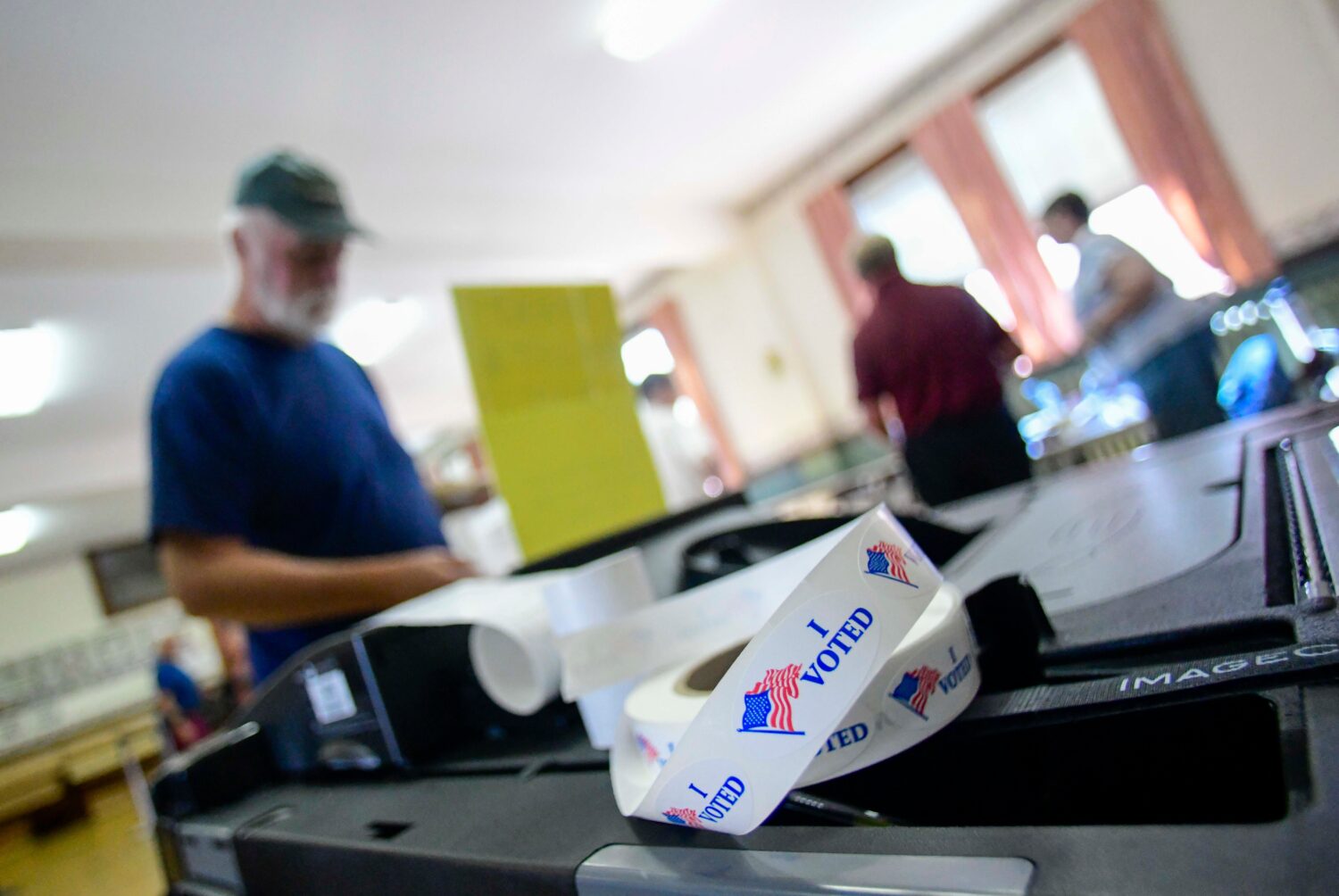
Sean Reid of Rockingham, Vt., casts his ballot at the polling station in Rockingham during Vermont's state and federal primary elections on Tuesday, Aug. 11, 2026. (Kristopher Radder/The Brattleboro Reformer via AP)
Credit: Kristopher Radder/The Brattleboro Reformer via AP
(Kristopher Radder/The Brattleboro Reformer via AP)
BOSTON (AP) — A federal judge on Tuesday ruled against President Donald Trump’s executive order that sought to create a federal voter list and directly involve the U.S. Postal Service in election operations in a way that would limit mail voting.
U.S. District Court Judge Indira Talwani had already halted the order Trump signed in March, his second one attempting to set national election rules. On June 25, she sided with Democratic state attorneys general in granting summary judgment, preventing the core parts of Trump’s order from taking effect.
Tuesday’s ruling creates another legal hurdle for the Trump administration to overcome should it get the initial injunction lifted by the U.S. Supreme Court.
“That it is now less than 90 days before the November 3, 2026 midterm elections underscores the critical need for an injunction to prevent Defendants from changing election rules on the eve of the election,” she wrote.
The Trump administration in late July requested that the Supreme Court halt lower court decisions that have blocked the sweeping changes in nearly half the country.
In the latest lawsuit, Talwani, who was nominated by Democratic President Barack Obama, sided with the League of Women Voters and other voting rights groups.
Her ruling granting a preliminary injunction barred the Postal Service from taking any steps to implement the order for this year’s midterm elections. She said the administration has so far declined to defend the constitutionality of the executive order.
“The executive branch has no authority to regulate elections,” she wrote.
Plaintiffs argued in two lawsuits, both filed in federal court in Boston, that the Republican president’s order should be found unconstitutional because the states and Congress, not the president, have the power to set election rules. The League of Women Voters also argued that Trump lacked the authority to issue his order and the U.S. Postal Service and other defendants lack the authority to carry it out.
Trump’s Republican administration, in its motions to dismiss the lawsuits, argued that the plaintiffs lacked standing to bring their claims. They also argued that the motions are premature and that plaintiffs lack the legal basis to bring their claim based on the Administrative Procedure Act, which governs how federal agencies develop and issue regulations.
Stephen Pezzi, a lawyer for the Trump administration, said the harms the plaintiffs referenced were subjective, because much can change with the voting list before it is made final. He also said no one would be prosecuted for violating the order.
Trump’s executive order, the second one aimed at elections during his second term, comes as he continues to suggest that there is widespread voting by noncitizens. Along with his executive orders, Trump is pushing legislation in the Republican-controlled Congress to create a proof-of-citizenship mandate. The SAVE America Act has passed the House but has stalled in the Senate.
States already have detailed processes aimed at keeping their voter rolls accurate, and voting by noncitizens has been shown to be rare. It also is a felony that can be punishable by deportation.
Trump issued the order in March after a bill he supported to overhaul voting stalled in Congress. The order would have had the federal government create a list of eligible voters and then directed the U.S. Postal Service to deliver mail ballots only to those on the list. Election officials argued that it was ripe for abuse and could cause chaos, and the postal union has objected to the idea of mail carriers policing ballots.
The Postal Service had published a proposed rule required by Trump’s executive order in the Federal Register, but it was put on hold by Talwani’s first ruling.
In a separate lawsuit filed against the executive order, a federal judge in Washington in May agreed with the Trump administration that it was too early to block the order because it had yet to be implemented. That lawsuit was brought by Democratic and civil rights groups. In July, a three judge panel of the U.S. Court of Appeals for the District of Columbia upheld the May ruling by U.S. District Court Judge Carl J. Nichols that said an injunction against the order was premature.
Other rulings have gone against the Trump administration’s first executive order on elections, signed just months after he took office in his second term. That order would have required people to show documents proving their citizenship when registering to vote, among other changes.
Since his 2020 presidential election loss to Democrat Joe Biden, Trump has groundlessly claimed mail voting is rife with fraud and has launched a federal investigation into that year’s vote, even though repeated audits and investigations, including ones run by Republicans, found it was free of widespread fraud. Trump also has said he wants to “take over” election administration in Democratic areas.
___
Riccardi reported from Denver.
Related
 Researchers, advocates rail against government’s efforts to end workforce data collection
 Video captures rescue of river tubing group stranded for 3 days, living off bark and flowers
 Tempe halts all Flock camera data sharing, launches transparency portal
 ICE plans to give officers gloves that can deliver painful electric shocks
 3 states are set to hold executions on the same day, a first in the US since 2010
 Parents accused of walking kids in extreme heat while intoxicated after Cardinals training camp
Comments
0 Comments