
In scathing rebuke of college sports, former Big 12 AD calls NIL system ‘money laundering’

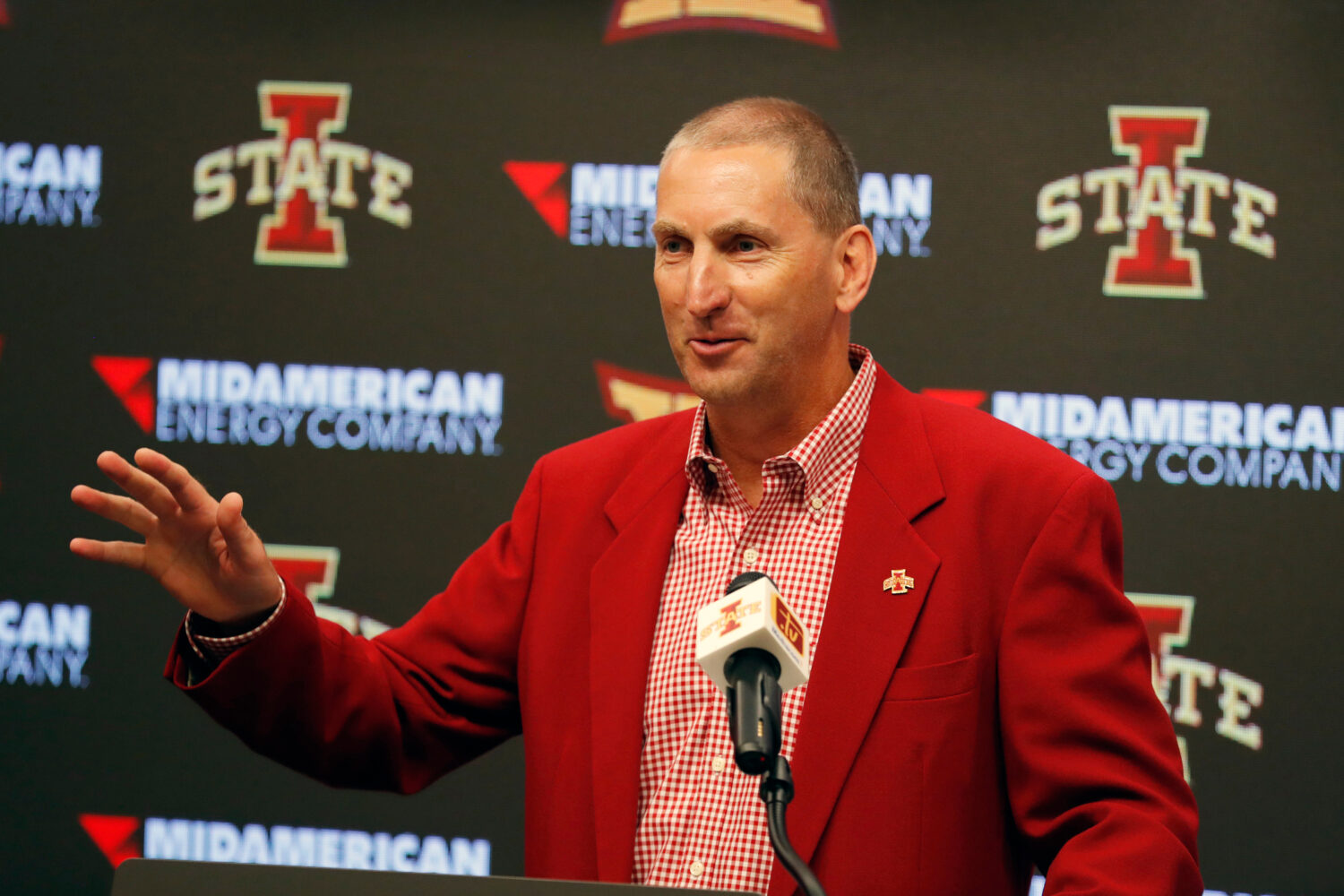
FILE - Iowa State Athletic Director Jamie Pollard speaks during an NCAA college football news conference in Ames, Iowa, Aug. 1, 2018. (AP Photo/Charlie Neibergall, File)
Credit: AP Photo/Charlie Neibergall
(AP Photo/Charlie Neibergall, File)
Former Iowa State athletic director Jamie Pollard delivered a scorching appraisal of the world he recently left, predicting college sports could be triggering the country’s next savings-and-loan crisis and equating the system that generates NIL payments to players as a money-laundering operation.
“Somehow we’re taking money that was supposed to come to our institution and find a way for it to be not given to our institution so we can launder it and create a manufactured NIL deal,” Pollard said Wednesday at a seminar held by the college watchdog Knight Commission.
He was referring to the practice most Power Four schools use when they work with third parties to broker NIL deals for players, which is an allowable construct that lets the schools blow past the $21.5 million revenue-sharing cap set by the landmark House settlement that allows college athletes to be paid.
Since the onset of NIL, some sports-focused donations that would normally go to an athletic department have been diverted to businesses closely affiliated to the schools. They, in turn, have negotiated the so-called third-party NIL contracts.
Pollard, who spent 21 years as the Cyclones AD before stepping down this fall, decried this process as creating a lack of transparency that “is fueling emotional and irrational decisions” made by schools.
While schools must report player contracts to the newly created College Sports Commission and the commission gives a broad-brush overview of how much money is spent, there’s still very little verified information about how much each school spends on rosters or how much individual athletes make.
Without that transparency, a handful of schools are reportedly spending $50 million on football rosters to stay competitive.
“Those decisions are multiplying like rabbits,” Pollard said. “We’ve created distrust within our industry, (among) our colleagues.”
Pollard, whose Big 12 program was a steady presence at both men’s and women’s March Madness in basketball but rarely broke through in football, cited other research that showed about 16% of public universities lost money in at least five fiscal years between 2014-23. He linked spiraling expenses in sports as part of the reason.
A report this year from the U.S. Government Accountability Office found that 94% of NCAA Division I athletic programs spent more money than they generated in athletics revenue in 2023-24.
“If we’re not careful, we’re sitting on the next savings and loans crisis in higher education,” Pollard said.
A combination of high interest rates and poor management led to the closure of more than 1,000 savings-and-loan institutions around the country in the late 1980s and early ’90s.
Other seminar speakers included Robin Harris, the executive director of the Ivy League, and Steve Eigenbrot, the athletic director at Towson, which plays in Division I’s smaller-school Football Championship Subdivision.
Harris lauded the Ivy League’s efforts to stay relevant despite not tapping into revenue sharing models that all but about four dozen of the 365 schools in Division I have signed onto.
“The Ivy League remains even more committed to our model in the face of these external pressures,” Harris said.
She said in light of the recent announcement of the College Football Playoff’s recent expansion to 24 teams that “it is time for a meaningful examination of the CFP and FBS football’s financial relationship with the NCAA, given the many services the NCAA provides FBS.”
FBS is the Football Bowl Subdivision that includes the Power Four and Group of Six conferences — a total of 137 teams.
Eigenbrot questioned the legitimacy of the market college sports has established for its players.
He compared the $45,000 average salary of a player in the NBA’s developmental G-League — considered an option for players who don’t want to attend college — against the six and seven-figure payments that often go to college players.
“I’m not so sure that if we fast forward three, four, five years down the line, that we haven’t done ourselves a disservice relative to the actual name, image and likeness value of an 18- to 22-year-old,” Eigenbrot said.
___
Sign up for Top 25 poll alerts here, visit the Top 25 here and see AP’s full college football coverage here
Related
 Buckeye officer injured after suspected impaired driver rams police vehiclesIllinois man charged in connection with bomb found at Peoria ethanol plantOutage math at the airport: When a four-hour Uber beats waiting out a ground stop
 Greg Stanton slams ‘failed’ leadership after nationwide ground stop, raises possible subpoena
 Mullin defends use of government plane to go to college football game after ground stop
 Snowbowl opens early, kicking off Arizona ski season Thursday
Comments
0 Comments