
Analysis: For Trump, results have often revealed the art of no deal

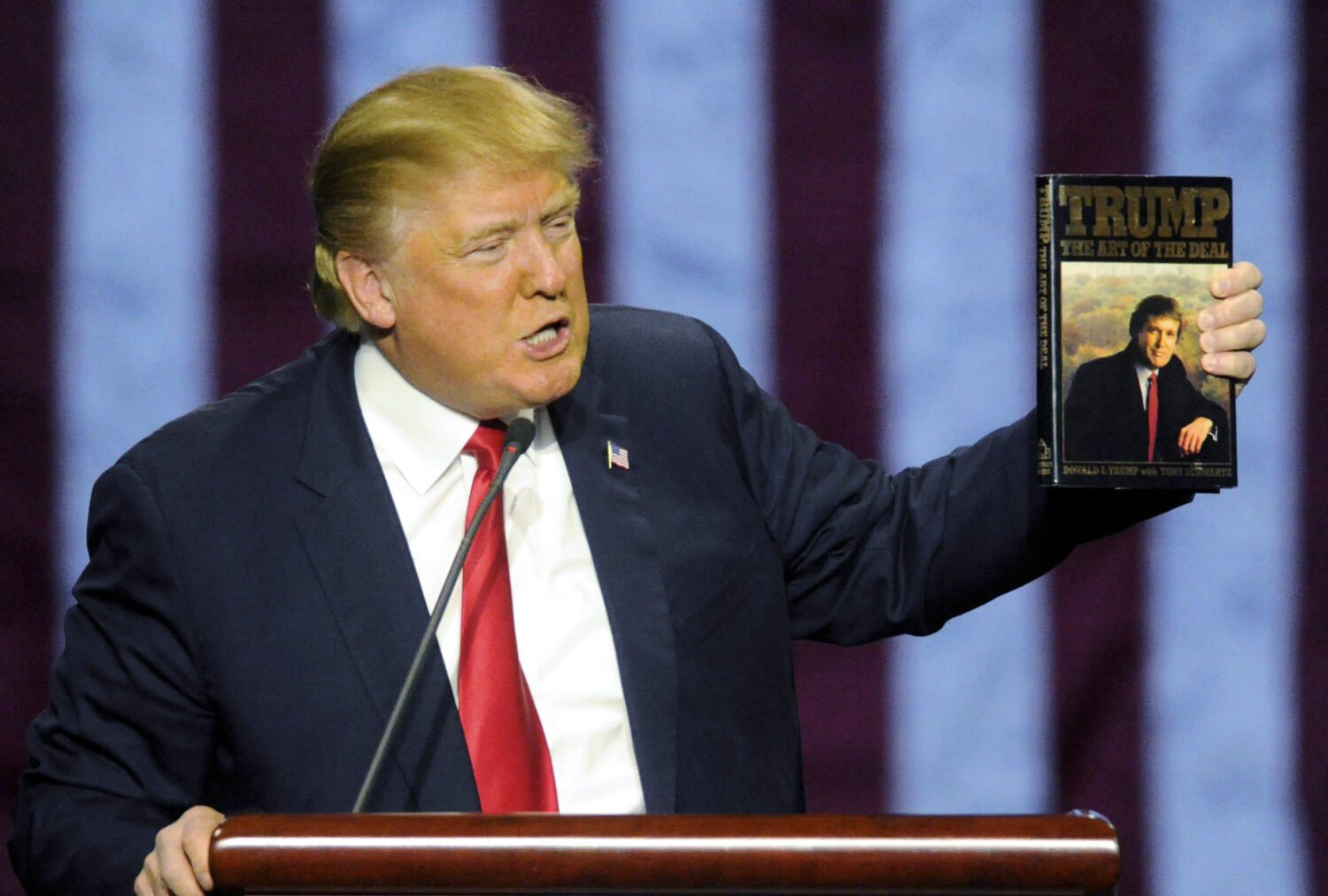
FILE - Then-Republican presidential candidate Donald Trump holds up his book "The Art of the Deal," given to him by a fan as he speaks during a campaign stop, Nov. 21, 2015, in Birmingham, Ala. (AP Photo/Eric Schultz, file)
Credit: AP Photo/Eric Schultz
(AP Photo/Eric Schultz, file)
WASHINGTON (AP) — Trump Tower had just opened and “The Art of the Deal” three years from publication when 38-year-old Donald Trump suggested he could negotiate Russian arms control better than Ronald Reagan.
“It would take an hour-and-a-half to learn everything there is to learn about missiles,” Trump told The Washington Post in 1984. It was all about dealmaking prowess. “You either have it, or you don’t,” he said.
Before there was much talk of being a personal brand, Trump had landed on his: the consummate, swashbuckling, never-lose negotiator.
It was an image he cultivated in the New York tabloids and later on reality TV, repeating it so often that, to his supporters, perception became reality.
Now, as he zigzags the country for Republican candidates, from Florida to Alaska, Trump is exhorting voters to again embrace him as an unqualified success in a midterm election that has become a referendum on his presidency and his record as a dealmaker.
An examination of Trump’s dealmaking, both in his time in the White House and in the private sector, shows decidedly mixed results.
“He’s not as good at this as he thinks he is,” said Christopher Preble, senior fellow and director of the Reimagining U.S. Grand Strategy program at the Stimson Center, an international security think tank.
He insisted that Iran would be defeated in mere weeks. He later brokered what he called a “great” ceasefire, though it quickly fizzled. Trump repeatedly has said Tehran is desperate to make a deal to end fighting. That also proved untrue.
He promised to negotiate an end to Russia’s war in Ukraine in a day. He announced an agreement that he said meant Moscow and Kyiv would not attack each other’s energy infrastructure. That pause never happened, even as the president insisted it would hold. “I said, ‘You agreed,’” Trump said in defending his assertions. “That’s why.”
Trump promised he would use the threat of tariffs to negotiate the best trade deals ever, only to offer unilateral duties nearly the whole world over. Those import taxes have raised domestic prices and sparked trade wars with America’s close friends, including Canada. The levies brought in more than $83 billion this year through September, much of it paid for by American consumers and still far less federal revenue than Trump suggested.
Even on less consequential matters, Trump’s deals have foundered. He said he had a “guy who’s unbelievable at doing swimming pools” who could fix the Lincoln Memorial’s Reflecting Pool for a little more than $1 million. The cost has been closer to $20 million so far.
The president’s public acts typically mirror a well-traveled private sector pattern.
He frequently boasted about doing better in negotiations than he really had, then sought to cover expensive missteps by refusing to pay people working for him, often suing them. His biggest successes came when he had maximum leverage.
“You can spin a real estate deal, as, ’Oh, you know, I got the better part of the deal because I bought it for this much and I sold it for this much,’” Preble said. “There’s a certain bit of tap dancing around those details that he just can’t do given what’s happening in the world today.”
Trump’s core narrative as master dealmaker had begun to fade until “The Apprentice” debuted in 2004. Allowed to play a rich and powerful tycoon on television, Trump rebooted his dealmaker persona.
That image of wealth and success helped launch his first presidential run “because people feel like, ‘Well, if he’s the president some of that success and wealth is gonna rub off on me,’” said Joel Penney, a professor at Montclair State University who studies the intersection of pop culture and politics.
But even now, as his approval ratings have sunk to near-historic lows, Trump still insists he is among the best dealmakers the world has known.
Tim O’Brien, author of “TrumpNation: The Art of Being The Donald,” said Trump may finally find out after Election Day on Nov. 3 “how much voters believe that he’s a competent manager and a great dealmaker.”
Marty Latz, a negotiation expert and author of “The Real Trump Deal: An Eye-opening Look At How He Really Negotiates,” said Trump the businessman saw every negotiation as a zero-sum game.
“The reality is, he did negotiate some excellent deals, but also that he did fail spectacularly in a number of deals, and that he has never really successfully negotiated as president in a significant number of contexts,” Latz said.
Trump has long been guided by the notion that he can only win.
“He could be a better negotiator if his ego didn’t get in the way,” said Barbara Res, a former executive vice president in charge of construction at the Trump Organization, who wrote “Tower of Lies: What My Eighteen Years of Working with Donald Trump Reveals about Him.” “Any concession that should be made, he can’t make. Then, with the other parts of it, nothing can continue. He just has to win everything.”
Top officials in the Trump administration go to great lengths to amplify the idea that he is a master negotiator.
“I make one of those deals every day that no normal person would make,” the president said in May, defending having the U.S. take a stake in the Union Pacific-Norfolk Southern rail merger.
A parade of advisers, including former White House press secretary Karoline Leavitt, Commerce Secretary Howard Lutnick and Interior Secretary Doug Burgum, have all labeled Trump “the dealmaker in chief.”
Republican South Carolina Sen. Tim Scott posted on X that the ceasefire with Iran “once again” proved that Trump “is the Dealmaker in Chief” — before it fell apart.
Trump has credited his own negotiating chops with helping to lower prescription drug prices and stimulate domestic manufacturing. The White House also pointed to a long list of trade agreements that Trump announced since last year with China, Japan and countries across Europe, Southeast Asia and elsewhere.
White House spokesman Matthew Middleton said “this administration will continue advancing an America First economic agenda.”
“Downplaying President Trump’s record as a dealmaker-in-chief would require overlooking the nearly 20 trade agreements he successfully negotiated and the trillions of dollars in announced manufacturing investments secured during his presidency,” Middleton said in a statement.
The president’s ledger also includes successes such as his first-term Abraham Accords and a ceasefire agreement that ended fighting between Israel and Hamas in Gaza — though strikes, raids and killings have continued there ever since. Neither deal succeeded in achieving larger and lasting Middle East peace as Trump predicted they would, though.
An agreement on civil nuclear cooperation with Saudi Arabia is in the early stages. An accord allowing the U.S. to help tap Venezuela’s petroleum reserves that Trump calls “probably it’s the biggest deal in the history of our country” will similarly take years to pay dividends — if it ever does.
O’Brien said Trump long sought to create unpredictability in negotiations, viewing them as an extension of his ego: “If he’s the one causing the chaos, he’s often the only one who can end it.”
The president describes his negotiating style as following his instincts and pushing for everything he can imagine, then not stopping until he gets it.
“I aim very high, and then I just keep pushing and pushing and pushing to get what I’m after,” he said in “The Art of the Deal” with ghostwriter Tony Schwartz, who later became so disillusioned that he noted that Trump did not write the book and may not have even read it.
Published in November 1987, “The Art of the Deal,” nonetheless made Trump nearly as well-known for his appearances on ”Lifestyles of the Rich and Famous” as any real estate venture. “We need a leader that wrote ‘The Art of the Deal,’” Trump declared when launching his 2016 presidential run.
Latz said Trump has changed the way he pursued deals when he was in the business world since returning to the White House in 2025, automatically assuming that the power of the presidency “translates to negotiation leverage.”
And a business negotiation is far different from one involving multiple countries, Latz said, like the Russia-Ukraine war and the conflict with Iran, where superior military might is not always enough.
“We may have conventional power,” Latz said, “and yet we may not have power at negotiation. Donald Trump used to understand that.”
In business, the stakes were markedly lower, and his showmanship was not always in public view.
Res said she and others on Trump’s team would often use performative tactics to keep him happy.
Before meeting with Trump, Res said she often would advise those she had already negotiated with to add a small percentage to their asking price. That way, Trump could get them to agree to a lower price and feel like he had won something.
“We did that because we knew he wanted to feel that he was better than everybody,” she said.
Trump also thrived in another area most successful business leaders do not — going to court constantly, either by refusing to pay those working for him and filing lawsuits, or getting sued. That was another strategic choice, Latz said, because doing so often let him reduce his own costs or to settle with his creditors for far less than he actually owed.
It meant “taking advantage of a system which many of us would think is morally wrong,” Latz said. “But it reflected an understanding of leverage.”
All told, Trump was involved in 4,000-plus pieces of litigation over 40 years of business, which meant even his best deals “resulted in suing,” Latz said, “And that’s not a coincidence.”
That practice has continued right into Trump’s presidency, as lawsuits remain active against everyone from the BBC to JPMorgan Chase.
Res said it was not “a matter of whether he’s right, or whether he can win. The power of being able to manipulate the legal system is terrifying.” She said Trump avoided signing “a contract that allows for arbitration” in favor of court and then, cases take so long, that “people can go bankrupt in the first year if they don’t play the game his way.”
___
Editor’s Note: Will Weissert has covered politics for The Associated Press since 2011 and the White House since 2022.
Related
 Trump dominated rural America. Iowa is testing whether Democrats can win them back
 Latino voters helped put Trump back in the White House. What’s their next move?
 Consumer apprehension grows as US retailers adopt AI-assisted pricing tools
 Hurricane warning: Miami poised for No. 1 after 5 of the top 7 teams lose in historic Top 25 day
 Rubio heads to Central Asia as some wonder if he’s keeping the most pressing matters at a distance
 Trump’s new pitch for Republican candidates — they’re really good looking
Comments
0 Comments