
New homeless data shows increase in shelter population as total remains flat
New data from the 2026 Point-in-Time homelessness count shows a mixed bag of progress in Maricopa County.


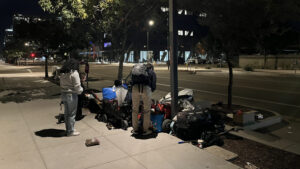
New data from the 2026 Point-in-Time homelessness count shows a mixed bag of progress in Maricopa County. (KTAR News/ Balin Overstolz-McNair)
(KTAR News/ Balin Overstolz-McNair)
New data from the 2026 Point-in-Time homelessness count shows a mixed bag of progress in Maricopa County.
The Point-in-Time, or PIT, count is a one-day street census of the homeless population in a given region, required by the U.S. Department of Housing and Urban Development (HUD) for federal funding.
According to the Maricopa Association of Governments (MAG), which administers the count, key findings in the county include:
- 9,726 people were experiencing homelessness on Jan. 27
- 53% of the overall population was in shelter; 47% was unsheltered
- The sheltered population rose 14%; unsheltered dropped 12%
- The largest age group was adults aged 35-44 (2,162 people or 22% of total)
- 611 families were experiencing homelessness
The total number of people experiencing homelessness in the county is roughly the same as the 2025 count, with a difference of only eight people.
However, the 2026 total is a 31% increase from 2020, when the count indicated there were 7,419 people experiencing homelessness in Maricopa County.
While the PIT count is a key metric for understanding regional homelessness trends, the data has limitations as it only looks at one day of the year.
The full report can be found here.
Local leaders say shelter increase indicates progress
Both the city of Phoenix’s Office of Homeless Solutions and MAG said the 2026 count data shows a step in the right direction with more people in shelters rather than on the streets.
In Phoenix, 4,041 people were marked as sheltered for the count while 5,159 were for the whole county, which is a 15% and 14% increase from the 2025 count, respectively.
“We had 55% of the people experiencing homelessness in Phoenix on that day (Jan. 27) that were in shelter, which is huge. That is exactly what we’ve been working toward the last several years,” Rachel Milne, director of the Office of Homeless Solutions, told KTAR News 92.3 FM.
The total number of people in shelters is about 200 fewer than the number from 2024, when 5,359 unhoused individuals were recorded in countywide shelters.
However, MAG’s Tim Burch emphasized that the 2026 sheltered numbers still show progress despite trailing 2024 because those levels were reached amid diminished federal funding.
“(At) the end of 2024, we began to lose access to a lot of the federal ARPA (American Rescue Plan Act) dollars, the money that came out of the pandemic response,” Burch said.
Milne added that Phoenix now has more permanent shelter beds than it did prior to 2024, due to investing in capital and infrastructure improvements in its system.
Additionally, a definition disagreement between the city of Phoenix and HUD has led to around 200 people being listed as “unsheltered” even though the city believes they should be counted as sheltered.
That’s due to those individuals living in the city’s “Safe Outdoor Space,” a city-owned outdoor site where people can live while still receiving typical shelter services.
“(HUD) doesn’t consider that a shelter, but we at the city of Phoenix know that it is far safer to be at the ‘Safe Outdoor Space’ than at an unsheltered situation,” Milne said.
Family homelessness continues to worsen
The PIT count breaks down homelessness rates among several special populations, including families.
In Maricopa County, family homelessness has generally crept up since at least 2020, with 611 families reported as experiencing homelessness in the 2026 count.
“I don’t think we have to look further than our own natural circles and our families and friends and our social networks to understand it’s harder for families. Costs are going up, wages are not,” Burch said.
The drop in federal pandemic relief dollars also directly impacted more than 1,000 family shelter beds by the end of 2024.
In addition, Burch noted resources using federal dollars can have tight definitions around a family’s ability to qualify for shelter, whereas local programs can work around those barriers.
“We know that if we can get families back through the rapid rehousing system quickly, they’re far less likely to re-enter homelessness in the future. So, it’s a sound investment,” Burch explained.
Overall homeless population in county remains flat
Despite movement in specific populations, overall, the 2026 count found around the same number of people experiencing homelessness in Maricopa County as 2025.
“When you look at the backdrop of a vibrant, thriving, growing community and the percentage of the population that is unhoused staying flat while the rest of the community grows, that is a good sign for us that we are building a healthy system,” Burch said.
While the broad number does appear to be stagnant year over year, a March report from MAG found more households are becoming homeless than finding stable housing.
The report indicated that 242 more households entered the regional homeless services system in March 2026 than left it.
“We’re really focusing, especially this year, on preventing as many people from having to endure a stint of homelessness as we can,” Milne said. “And if they do, help them get into housing as quickly as possible.”
Burch emphasized that he hopes to see an overall reduction next year.
Related
 Valley communities undergo 2026 Point-in-Time count for local homelessness numbers
 Phoenix City Council launches new 5-prong strategy to cut down on homelessness
 Resource page of organizations across the Valley that provide support to the homeless
 City of Phoenix aims to extend outdoor shelter permit set to expire
 Maricopa County heat deaths surge past 2025’s pace as officials expand cooling resources
 Circle the City files lawsuit over Phoenix parks ordinance, alleges it directly targets homeless people

Comments
8 Comments
Still too much explaining to be considered "clear".
The only reason you claim you got it was because I said it wasn't clear. Just because you got it doesn't mean it was clear.
Thought you were going to trip me up with your 2 types of people comment I see. Better luck next time.
Here is the headline:
"New homeless data shows increase in shelter population as total remains flat."
"Total" of what? That's what's not clear, you added "homeless" but the headline didn't say that. It was not specified what total remained flat, the homeless or the shelter population.
If you had to break out your crayons to explain this then it means it was NOT clear. You can read into it but its NOT clear. Do you understand what clear means?
Thank you for reposting the headline I just reposted. That was helpful.
it's the total whatever the main subject is. The total homeless, not the total chickens or total airplanes. The conversation is about the homeless.
There are 2 types of people in the world:
1. Those who can extrapolate from incomplete data.
Start over with basic reading comprehension. That will help a lot.