
Homeless defendants show up at far higher rates in specialty Phoenix court, judge says
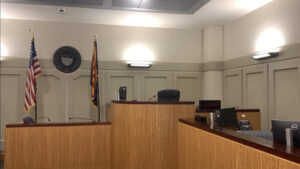
The Phoenix Community Court, which debuted two years ago, is getting more homeless defendants to show up for hearings than traditional courts.

Watch: The Faceoff: Can Andy Biggs win over independent voters? | 29 mins
PHOENIX — A Phoenix specialty court that debuted two years ago is getting more homeless defendants to show up for hearings than traditional courts, according to its presiding judge.
“Nobody really wants to go to court and you really don’t want to be in court, but we have had a tremendous, outstanding success rate,” Phoenix Community Court Presiding Judge James Hernandez told KTAR News 92.3 FM’s Arizona’s Morning News on Tuesday.
Hernandez attributed much of the success to partnerships among city entities, including the Municipal Court, the prosecutor’s office, the public defender’s office and the Office of Homeless Solutions, which includes Community Bridges Inc.
How successful is the Phoenix Community Court?
The specialty court for homeless defendants began hearing cases in 2024 after Councilwoman Ann O’Brien proposed it. The program is designed to connect people with stable housing, substance abuse treatment and mental health care while also reducing recidivism.
Most defendants in community court face misdemeanor charges, like trespassing, obstructing public thoroughfares and shoplifting.
City officials praised the court’s early results at the Public Safety and Justice Subcommittee meeting on April 1.
David Ward, director of Phoenix’s Public Defender’s Office, told the committee that 72% of people experiencing homelessness showed up for community court hearings — a sharp increase from the 5% to 6% attendance rate courts typically see.
Here are some other statistics city leaders shared as of April 1:
- 554 people participated in community court.
- 214 graduated from the program.
- 18 graduates reoffended — an 8% recidivism rate.
- 32 cases were dismissed before graduation.
- 11 people pleaded guilty and received reduced sentences.
- 29 were transferred to other specialty courts.
- 43 returned to regular court for noncompliance.
- 225 opted out of community court and returned to regular court.
Officials said many people opted out because community court requires more participation. Taking part means defendants must be willing to pursue stable housing and work to resolve their cases, officials said.
The court also helped 231 people obtain identification and documents, placed 358 people in shelter or housing, connected 172 with mental health and substance use treatment and provided 98 with employment services.
Phoenix judge says Community Bridges Inc. plays a key role
Hernandez said the workers at Community Bridges Inc. serve as the glue that holds the operation together. CBI is a nonprofit that provides substance use and mental health services.


“Most of the reason that people come to community court is the people at CBI are outstanding. They’re tremendous people,” Hernandez said.
He said CBI staff put themselves in defendants’ shoes, going out into the streets to reach homeless people, many of whom are elsewhere in the city and lack transportation to get to the court in downtown Phoenix.
“CBI will go out and literally give people rides and get them to court and they are more than happy to be there,” Hernandez said.
He said he has seen far more happy faces in community court than in regular court.
“That’s a big reason why we’ve had success. People getting into court and being in court and successfully completing the court,” Hernandez said.
Related
 New Phoenix court helps those experiencing homelessness through the legal system
 Phoenix creates specialty court for people experiencing homelessness
 Maricopa County heat deaths surge past 2025’s pace as officials expand cooling resources
 Circle the City files lawsuit over Phoenix parks ordinance, alleges it directly targets homeless people
 Advocate calls for state of emergency to address family homelessness in Phoenix area
 New homeless data shows increase in shelter population as total remains flat

Comments