
Here’s why the Dragon Bravo Fire containment decreased by half over weekend
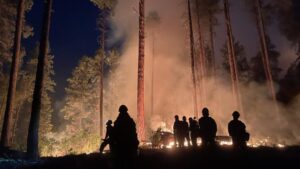
Containment of the Dragon Bravo Fire, a destructive wildfire burning on the North Rim of the Grand Canyon, has decreased by half over the weekend.


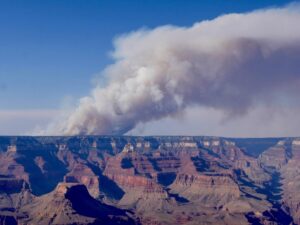
Containment of the Dragon Bravo Fire, a destructive wildfire burning on the North Rim of the Grand Canyon, has decreased by half over the weekend. (Photo by Southwest Area Incident Management Team 4/via Facebook)
(Photo by Southwest Area Incident Management Team 4/via Facebook)
PHOENIX — Containment of the Dragon Bravo Fire, a destructive wildfire burning on the North Rim of the Grand Canyon, has decreased by half over the weekend.
The latest incident report on Monday listed containment at 13%, after it was at 26% on Friday, and more than 55,000 acres burned. That is up from the 28,773 acres the fire had burned at the end of last week.
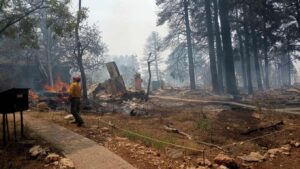
The wildfire was sparked by lightning on Fourth of July and has destroyed over 70 structures on the North Rim of the Grand Canyon, including the historic Grand Canyon Lodge.
Lisa Jennings —a public information officer with the Southwest Area Incident Management Team — told KTAR News 92.3 FM on Monday that the decreased containment is due to improved mapping as well as fire growth.
“The way we calculate containment in an active wildfire is it is a percent of the total fire permitter that is out cold,” Jennings said. “We actually have our firefighters going out there and making sure that those areas are contained, and so that feet of contained line continues to increase, but at the same time, the fire has seen a lot of growth.”
Why else has the Dragon Bravo Fire containment decreased?
Jennings said that firefighting efforts are facing historically dry conditions coupled with high winds and extremely dry fuels.
“That means we’re seeing intense fire behavior that is not usual. It’s really extreme fire behavior, and we don’t use that word lightly,” Jennings said. “So typical containment, we’re able to build lines and hold those lines, but right now we’re seeing embers spark a mile ahead of that fire. And so those traditional methods of fire control aren’t being as effective.”
Currently, the fire is traveling through fuels such as mixed conifer, aspen regeneration and ponderosa pine. Jennings said that firefighters are using multiple containment lines to try to move the fire into fuels that are more receptive to containment.
Jennings added that with the dry conditions, the fire grew 8,000 to 10,000 acres each day over the weekend.
According to the latest incident report, on Sunday the fire pushed three to four miles north and is expected to continue in that direction throughout Monday.
Relative humidity also dropped to 10% over the weekend as winds blew 25 mph over the fire area. The forecast on Monday called for nearly identical conditions.
Jennings said that there is some moisture and monsoon activity expected Thursday into Friday, but that the weather forecast keeps pushing that activity further back and the chances keep decreasing as well.
“We’re still hoping that even if we don’t get rain as part of this event, the humidity will increase and that will reduce the fire behavior,” Jennings said.
She noted that there will be a branch of the incident management team monitoring for any new starts possibly caused by lightning to ensure early response.
Jennings highlighted that the fire has produced a pyrocumulus cloud: a towering column of smoke that, as it rises and cools, forms its own cloud system and even generates its own weather, including winds.
There are 1,000 firefighters working to contain the wildfire as well as around a dozen aircraft. However, Jennings noted that the aircrafts aren’t as effective as the management team would like them to be.
“So the water drops, not all that water is even getting to the ground because it’s getting stuck in the canopy of the trees,” Jennings said. “So the strategy we’re working with right now is using a series of forest roads, it’s in the Kaibab National Forest at this point, to slow the fire progression and push into … where the fuels aren’t as dense, and we can go back to those traditional containment strategies.”
Due to the devastation the wildfire has caused, the North Rim will be closed to visitor access for the rest of the 2025 season. There are also various inner canyon areas that are closed for safety reasons.
KTAR News 92.3 FM’s Serena O’Sullivan contributed to this report.
Related
 Dragon Bravo Fire: Officials give update as extreme dry conditions, gusty winds cause major growth
 Grand Canyon reopens 3 trails that were closed for over a month due to Dragon Bravo Fire
 Historic Grand Canyon lodge destroyed by wildfire, officials say
 Ruben Gallego, Mark Kelly demand answers over devastating Dragon Bravo Fire near Grand Canyon
 National Park Service defends handling of fire that destroyed Grand Canyon Lodge
 Oak Creek reopens Thursday near Sedona after Pocket Fire, with more sites back Oct. 1

Comments
1 Comments
I hate fire season. It's the worst.