
Arizona Gov. Katie Hobbs says GOP lawmakers didn’t act in good faith with election bill
Arizona Gov. Katie Hobbs on Tuesday accused Republican lawmakers of failing to act in good faith with the election bill she vetoed last week.

PHOENIX – Arizona Gov. Katie Hobbs on Tuesday accused Republican lawmakers of failing to act in good faith with the election bill she vetoed last week.
“I agree that we should be able to get election results faster, and I’m willing to have the conversation about how we can do that in a way that doesn’t disenfranchise voters,” the Democratic governor told KTAR News 92.3 FM’s Outspoken with Bruce and Gaydos.
Hobbs said that the majority party in both chambers of the Legislature refused to negotiate with her before passing HB2703/SB1011. The governor vetoed the bill, the first sent to her desk this session.
“And, I might add, they let the chair of the Republican Party, whose main objective is to elect Republicans, be their negotiator on this. So, I don’t think that’s acting in good faith at all,” Hobbs said.
Republicans are now considering bypassing Hobbs and referring the legislation to the ballot through a concurrent resolution, which doesn’t require the governor’s signature. The House already passed HCR2013, which now awaits Senate approval.
“Status quo for our state’s elections is not an option,” Senate President Warren Petersen said after Hobbs vetoed the election bill on Feb. 18. “Arizona should never again be the laughingstock of the nation for its woefully slow election reporting. Our caucus will be discussing a path forward on this issue in the days and weeks ahead.”
However, any reforms enacted through a ballot measure rather than a bill couldn’t go into effect until the 2028 election.
“If they wanted to deal with this and have a solution in place for the next election in 2026, they would sit down at the table and negotiate with me and put a solution in place,” Hobbs said.
What was included in vetoed election bill?
The bill Hobbs vetoed would have changed the deadline for dropping off completed early ballots in person to 7 p.m. the Friday before Election Day instead of 7 p.m. on Election Day.
“They weren’t willing to make any concessions to account for the fact that voters would be disenfranchised with this 7 p.m. Friday ballot turn-in deadline, and I put forward a lot of proposals,” Hobbs said. “I never asked for all or nothing. I asked for consideration and negotiation on them.”
The earlier ballot drop-off deadline would allow most of the state’s votes to be counted by the night of the election. However, the bill also would change the process for early mail voting by requiring voters confirm their addresses on a regular basis.
How would election bill impact early mail voting?
Currently, voters on the Active Early Voting List automatically receive mail ballots for every election without taking action as long as they have voted within the last two federal election cycles.
Under the Republican proposal, voters in counties with more than 500,000 residents would have to confirm their addresses “through an affirmative act on the part of the early mail voter” every election cycle in order to receive an early mail ballot, even if they are on the Active Early Voting List. Maricopa, Pima and Pinal currently have populations above that threshold.
Meanwhile, residents of counties with fewer than 500,000 residents would have to confirm their address every two election cycles (a four-year period).
“That was done with no impact on the election results side of it,” Hobbs said. “And, so, they were using this really as an excuse to gut early voting.”
Related
 Arizona Gov. Katie Hobbs vetoes GOP bill designed to produce faster election results
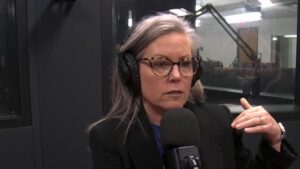 Gov. Katie Hobbs says she's 'very optimistic' about Trump administration's actions on border security
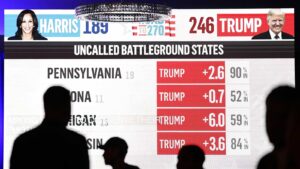 Arizona lawmakers propose multiple plans to speed up election results
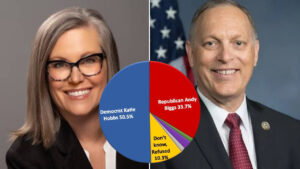 New Arizona poll shows Democrats leading every statewide race
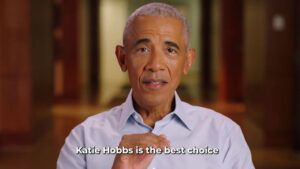 Former President Barack Obama endorses Arizona Gov. Katie Hobbs’ reelection bid
 Jay Feely defends Donald Trump’s economic policies, blames Biden for high prices

Comments
53 Comments
They have very weak minds, hence their need for others to support them.
Neither one of them should’ve ran for office again. Both are walking corpses with Biden getting a slight edge of crazy because incoherent rambling isn’t his normal speech pattern.
Neither one of them should’ve ran for office again. Both are walking corpses with Biden getting a slight edge of crazy because incoherent rambling isn’t his normal speech pattern.