
On the line: Arizona 911 dispatcher jobs turn from silly to serious in seconds
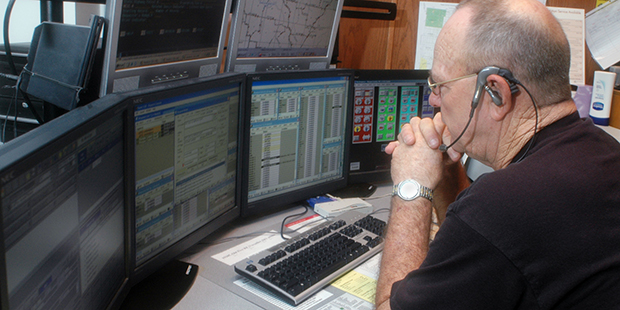
The Phoenix Fire Department invited KTAR into its alarm room to interview a dispatcher and give the world a look at what it really means to answer the call.

(AP Photo/Kelley McCall)
(AP Photo/Kelley McCall)
PHOENIX — In an emergency, most people’s first reaction is to pick up the phone and dial 911, but we rarely think of the dispatcher as a first responder.
We rely on the voice at the other end to get us the help we need as quickly as possible. We also rely on them to be cool, calm and collected in our moments of crisis.
As part of National Public Safety Telecommunications Week, the Phoenix Fire Department invited KTAR into its alarm room to interview a dispatcher and give the world a better look at what it really means to answer the call.
The room handles about 444,000 calls a year, or 1,200 calls per day. It is the main hub for sending emergency services to 26 Phoenix-area cities.
From car accidents to heart attacks, house fires to cats stuck in trees, the people in the room hear it all.
The lead dispatcher, Brant Keeney, said he never knows what will be on the other end of the phone when he answers.
“The next call could be an administrative line … it might be a citizen calling wondering how to get car seats properly installed or it could be a 911 the house is on fire,” he said.
“It takes a strange sense of humor and a lot patience in this job, but along with the stresses there’s a lot of satisfaction, too,” Keeney said. “You really are helping people.”
Keeney said that sense of humor comes into play in two different ways: Helping dispatchers deal with life-changing events on a daily basis and enjoying the lighter side of some calls.
A few of those lighter calls are memorable.
“(A person) called and said she had a strange odor in the house. When I asked her what it smelled like, she said blood,” another dispatcher, Rae Kell, said about a call she received. “She said it can’t be werewolves because we got rid of them last time, so it must be vampires.”
But other calls are tragic. Keeney said every operator dreads hearing the words “child drowning.”
“You can literally hear the room groan, when (that) call comes in,” he said.
“For whatever reason, it always stands out when you hear one of the dispatchers on the phone say, ‘Is he out of the pool,'” Keeney said. “I just get a chill up my back just saying those words.”
Keeney said he has learned over the years to distance himself from situations so he can focus on doing his job.
“That’s not my Uncle Harry that fell of the roof,” he said. “That’s not my father that’s having a heart attack. That’s not my house that’s on fire.”
But despite learning to not get personally connected, Keeney said there are some cases to that stick with every operator.
He recalled one case from when he worked in Colorado. Two women were driving home from a night out with friends. Neither had been drinking.
They were killed by a drunk driver when they were stopped at a red light.
“A good friend of mine was the first captain on the fire truck on the scene, I was the dispatcher,” he recalled. “I could hear in his voice how bad the scene was.”
“They did everything right that night. It was not their fault. And, bam, they were gone and there was nothing I could do about it.”
Keeney said there are people who try to work as dispatchers, but for numerous reasons, just cannot do it.
“It doesn’t make them bad people,” he said. “It just means they’re not cut out to do this type of work.”
KTAR’s Brian Rackham contributed to this report.
Related
 Alex Murdaugh’s defense and prosecutors expect to clash over evidence during pretrial hearing
 Trump will rally Georgia Republicans despite party divisions in battleground state
 Trump wants the midterms to be all about himself. Judging by the ads, Democrats are happy to oblige
 Tempe becomes 1st Arizona city to enact strict ban on Automated License Plate Readers
 Phoenix Art Museum receives $5M gift for Asian art expansion
 Troy Jackson tells Susan Collins to ‘shut up’ during heated Maine Senate debate

Comments
0 Comments