
Arizona Iranian American says he’s torn between two homelands amid war
An Arizona-based Iranian-American describes the horror of watching war unfold, trying to stay in touch with family amid bombed out communication lines.

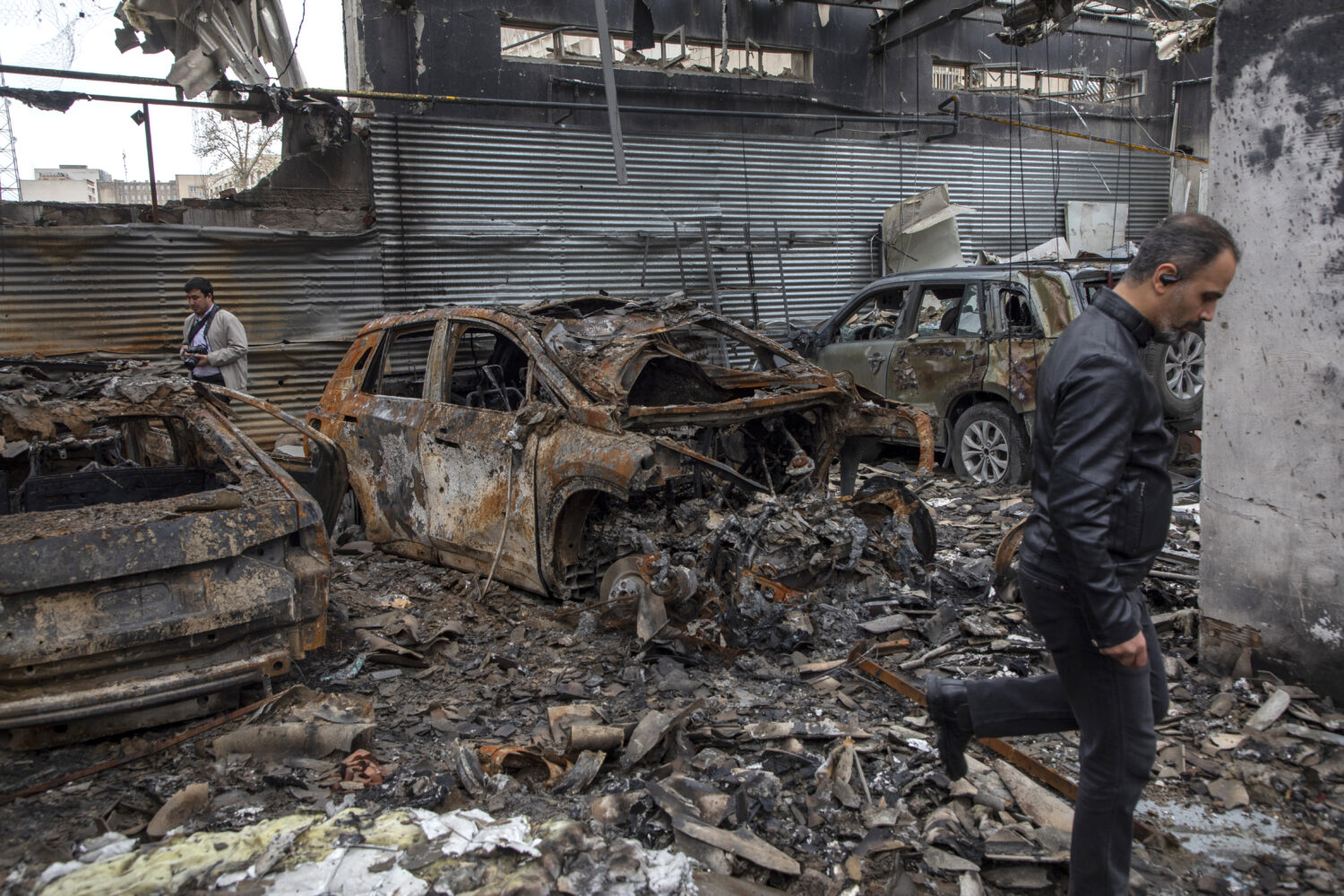
TEHRAN, IRAN - MARCH 28: People walk through the rubble of a foreign car repair workshop that was damaged during a joint U.S. and Israeli attack on March 28, 2026 in Tehran, Iran. The United States and Israel have continued their joint attack on Iran that began on February 28. Iran retaliated by firing waves of missiles and drones at Israel and U.S. allies in the region, while also effectively blockading the Strait of Hormuz, a critical shipping route. (Photo by Majid Saeedi/Getty Images)
(Photo by Majid Saeedi/Getty Images)
PHOENIX — Two Iranian-American men who came to the United States to pursue education and further their careers say they feel stuck between two identities as they watch their homeland ravaged by the nation they’ve long lived in.
Reza Jahani moved to the U.S. from Iran 16 years ago and now lives in Arizona. He told KTAR News 92.3 FM he has experienced feelings of guilt amid the war.
“I feel that I left my family in a very bad situation,” said Jahani. “You feel that you have some contribution without any option. And your contribution is not necessarily a positive contribution to what’s going on.”
Jahani said part of that guilt also comes from knowing his U.S. tax dollars fund the weapons being used against his home country.
Ali Eshraghi, who lives in California, came to the U.S. from Iran in 2013 and works in infrastructure and public policy. He described the past several weeks as a blur.
“The uncertainty, the thing that we don’t know what would happen tomorrow,” he said. “This kind of living in limbo makes life for us and also for the loved ones that we care about very difficult.”
Struggling to reach Iranian family
Both men said communication with family in Iran has been limited by internet blackouts and damage to infrastructure.
Jahani said contact with his parents went from daily to roughly once a week, relayed through younger relatives who could use virtual private networks to get around the outages.
He said he does not fully trust the information he receives.
“You’re waiting for their confirmation that they are healthy or they are still alive, but on the other side, you don’t believe them,” said Jahani.
He explained that his family often doesn’t tell him of nearby bombings and downplays negative impacts from the war.
Eshraghi shared a similar experience, saying he learned through friends that there had been bombardment near his parents’ home.
“They said, ‘Yes, but we didn’t want to tell you, to basically not bother you,'” said Eshraghi.
He said the damage extends beyond immediate violence, pointing to closed schools and destroyed universities.
“The uncertainty is for the kids, for their futures, how they’re going to catch up,” said Eshraghi.
Jahani explained his cousin had decided to freeze her eggs about seven years ago in hopes of having a child at a later time.
“She was worried that if something happened with the electricity, then she’s not going to have a baby at all,” said Jahani. “It seems odd that during a war you’re thinking about having a kid, but I think that’s the instinct in a human. It’s hard to compete with that.”
For now, Jahani said his cousin’s embryos remain preserved, but the fear of losing them remains.
Reacting to Trump’s rhetoric
Both men said President Donald Trump’s threats to send Iran “back to the Stone Ages” and suggestions of the nation’s total annihilation have forced them to question their place in the country they chose.
“The president of the country is threatening to remove your nation — not just the government, not just the military power, the whole nation,” said Jahani. “Is this the United States that I came to 16 years ago? Where are we going?”
As American citizens, the pair said the rhetoric also makes them fear for the future of the United States.
Eshraghi, who said he studied public policy because he believed in the U.S. system of checks and balances, said the administration’s actions have shaken that belief.
“That’s a king, basically,” said Eshraghi, describing Trump’s recent actions.
Jahani also saw historical parallels, drawing a comparison to the 1953 CIA-backed coup in Iran that he said helped fuel the 1979 revolution.
“I’m not saying you’re going to see something similar. But I’m saying the experience of being under the bombardment and being threatened to remove the whole nation, it’s going to come back to the United States at some point, at some time, with lots of cost,” said Jahani.
Pushing back on a media narrative
They also pushed back on what they called a media narrative that Iranian Americans broadly support the war, arguing a vocal pro-war minority dominates the conversation because critics risk being labeled supporters of the Islamic Republic.
“We are against war and we are against the current regime at the same time,” said Jahani.
Both men stressed that the human cost is being lost in the political noise.
“Only on the first day of this war, over 160 schoolgirls were killed. And these are not numbers. When one person is dead, one child is dead, the future for that family is dead,” said Eshraghi.
They argued that the Iranian and American people are not enemies and is heartened by the opposition to the war.
“The same ordinary people in two different places in the world, which by politicians are trying to depict them as their enemies,” said Eshraghi. “It just warms my heart and it makes me more hopeful about the future.”
Related
 Iranian extradited to US to face 2014 smuggling indictment over export of military sonar gearThe Latest: US Navy seizure of Iranian ship casts doubt on fresh ceasefire talks in Pakistan
 The Original Tavern opening in North Phoenix in 2027
 Tempe Police Department introduces new K9 named Cash
 California man arrested in counterfeit currency case in western Arizona
 Arizona Sheriff’s Association expresses concern over Santa Cruz County Sheriff’s actions

Comments
5 Comments
Can someone remind the MENSA member that's crying about KTAR not asking Iranians in Iran how they feel, is because KTAR is primarily a local news source. Also remind the dolt that Trump promised to help these people and now wants to bomb them back to the stone age by targeting key infrastructure.
I'd tell him, but he blocked me.
In the meantime the Iranian government has killed 30,000 + Iranian people for standing up to or speaking out against the Islamic mullahs. The Islamic mullahs have threatened to use their own people as human shields this from the religion of peace. Ktar failed to ask them what they thought about that
They complain about the U.S. threatening to wipe Iran off the face of the earth, but I wonder if they ever complained about Iran threatening to wipe Israel off the face of the earth.