
Deadly E.coli outbreak linked to canal water found in Yuma, officials say
Health officials believe they have narrowed the source of nation’s largest E. coli outbreak in a decade down to canal water, not lettuce.

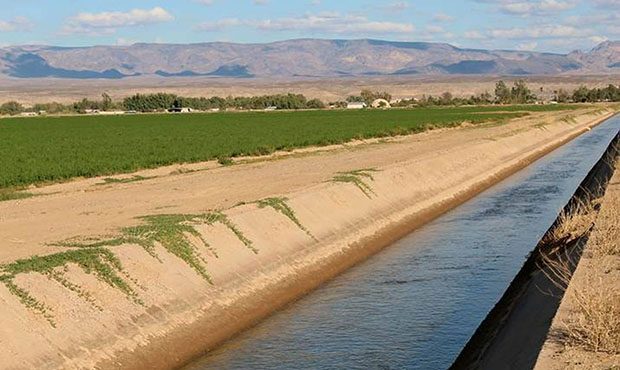
This undated photo shows an irrigation canal on farmland in Mohave Valley, Arizona. (DK McDonald/Mohave Valley Daily News via AP)
(DK McDonald/Mohave Valley Daily News via AP)
PHOENIX — Health officials believe they have narrowed down the source of nation’s largest E. coli outbreak in a decade.
The illnesses were previously traced to romaine lettuce grown in Yuma, Arizona. On Thursday, federal health officials said the same E. coli was found in canal water in the area.
They are still investigating how the bacteria got into the canal and whether there was contamination elsewhere.
They declined to give details about the canal, including its location, until a report can be completed.
“More work needs to be done to determine just how and why this strain of E. coli O157:H7 could have gotten into this body of water and how that led to contamination of romaine lettuce from multiple farms,” said Dr. Scott Gottlieb, commissioner of the U.S. Food and Drug Administration, in a statement.
At least five deaths have been linked to the outbreak, which started in the spring. About 200 more people were sickened.
The deaths have been reported in California, Arkansas, Minnesota and New York.
Earlier, officials tied eight illnesses at a jail in Alaska to whole head romaine lettuce grown at Harrison Farms in Yuma.
But they were unable to find a single farm or packaging or distribution site that could clearly be fingered as the source of contamination for the other cases.
The first illnesses occurred in March, and the most recent began on May 12, according to the Centers for Disease Control and Prevention.
The last large E. coli outbreak like this involved spinach grown in California in 2006. Officials suspect cattle contaminated a nearby stream, and wild pigs roaming the area spread it to fields.
Most E. coli bacteria are not harmful, but some produce toxins that can cause severe illness.
People who get sick from toxin-producing E. coli come down with symptoms about three to four days after swallowing the germ, with many suffering bloody diarrhea, severe stomach cramps and vomiting.
Most people recover within a week, but some illnesses can last longer and be more severe.
The Associated Press contributed to this report.
Related
 Lettuce grown in Arizona could be the source of E. coli outbreak
 More deaths, illnesses linked to E.coli outbreak from Arizona-grown lettuce
 Arizona lettuce growers work on consumer trust after E. coli outbreak
 Man dead following suspected road-rage shooting in Mesa
 Lin’s Grand Buffet opening Gilbert location later this year
 Lawsuit alleges Phoenix police killed father defending his home

Comments
0 Comments