
Arabian oryx calves born at Phoenix Zoo as species continues to rebound
The Phoenix Zoo has been a longtime player in Arabian Oryx conservation, and two calves were born at the facility on Feb. 13.

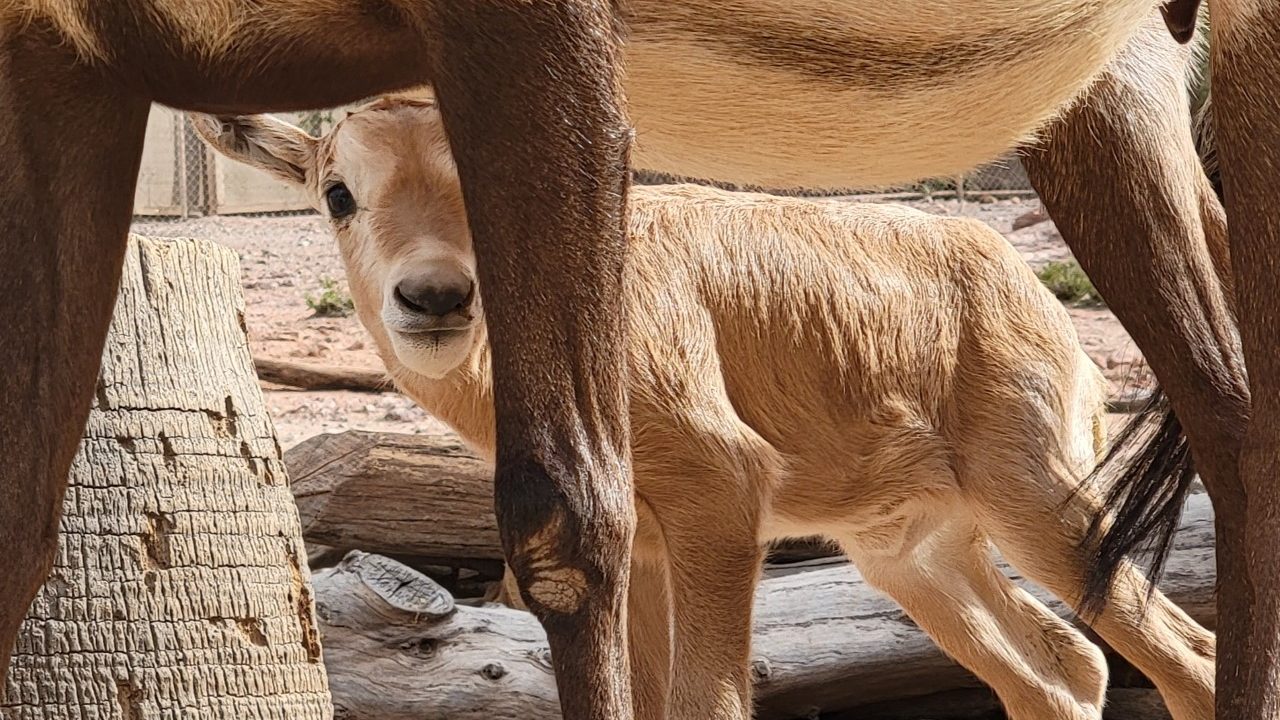
(Phoenix Zoo photo)
(Phoenix Zoo photo)
PHOENIX — The Phoenix Zoo has been a longtime player in Arabian Oryx conservation, and two calves were born at the facility in mid-February.
One of the younglings is visible to the public at the exhibit, while the other lives behind the scenes for the time being.
AWWW!
We’re excited to announce two female Arabian oryx calves were born at the Zoo on February 13. The calf pictured here was born to dam, Debbie, and the other calf was born to dam, Ruby.
📸: Braeden, Keeper II – Hoofstock pic.twitter.com/eprIA1ZyoN
— Phoenix Zoo (@phoenixzoo) March 4, 2023
Arabian oryxes, an antelope native to the Arabian Peninsula and Syrian Desert, went extinct in the wild in 1972 after they were hunted for their hides, meat and horns that can grow taller than two feet.
Operation Oryx was initiated by the Fauna Preservation Society (now Fauna and Flora International) in 1962 with the goal of capturing oryxes for a propagation program and releasing offspring into the wild once numbers picked up.
Three wild animals were sent to a young Phoenix Zoo, but the group wasn’t a herd suitable to start the program.
The Phoenix Zoo gained six more animals by 1964 from the London Zoo, King Saud of Saudi Arabia and a private collection in Kuwait, according to the zoo.
Ten oryxes were introduced to the wild in 1981, and by 2011, the International Union for the Conservation of Nature downlisted the species from endangered to vulnerable. The Arabian oryx became the first species to get upgraded from extinct in the wild to vulnerable.
Once described as the “prototype” of the mystical unicorn, the Arabian oryx is the perfect species to celebrate on #UnicornDay. While the oryx has two horns, they can easily be disguised as one when the animal is viewed from the side, tricking even the keenest observers. pic.twitter.com/nb7mprOO6M
— Joel Sartore (@joelsartore) April 9, 2020
There were 1,200 animals in the wild in 2022 and 6,000-7,000 in captivity, according to the University of Sydney.
The Phoenix Zoo’s calves are light brown and blend into the desert habitat. The zoo said the young antelope will be more active as they get older.
Related
 How to avoid spreading invasive New Zealand mudsnails in Arizona waterways
 Phoenix Zoo's first Roars and Pours happy hour of the year is on tap
 Phoenix Zoo revitalizing facilities, building improved habitats for Arizona's big cats
 3 Phoenix family members plead guilty in COVID fraud case
 Wrongful death lawsuit alleges Arizona ignored 19 abuse reports before killing of 10-year-old
 Rep. Adelita Grijalva responds to ICE detaining Tucson woman outside county courthouse

Comments
0 Comments