
3 federally funded EV charging stations open in Arizona
There will eventually be a total of around 80 statewide locations constructed as part of a nationwide network of fast-charging stations.

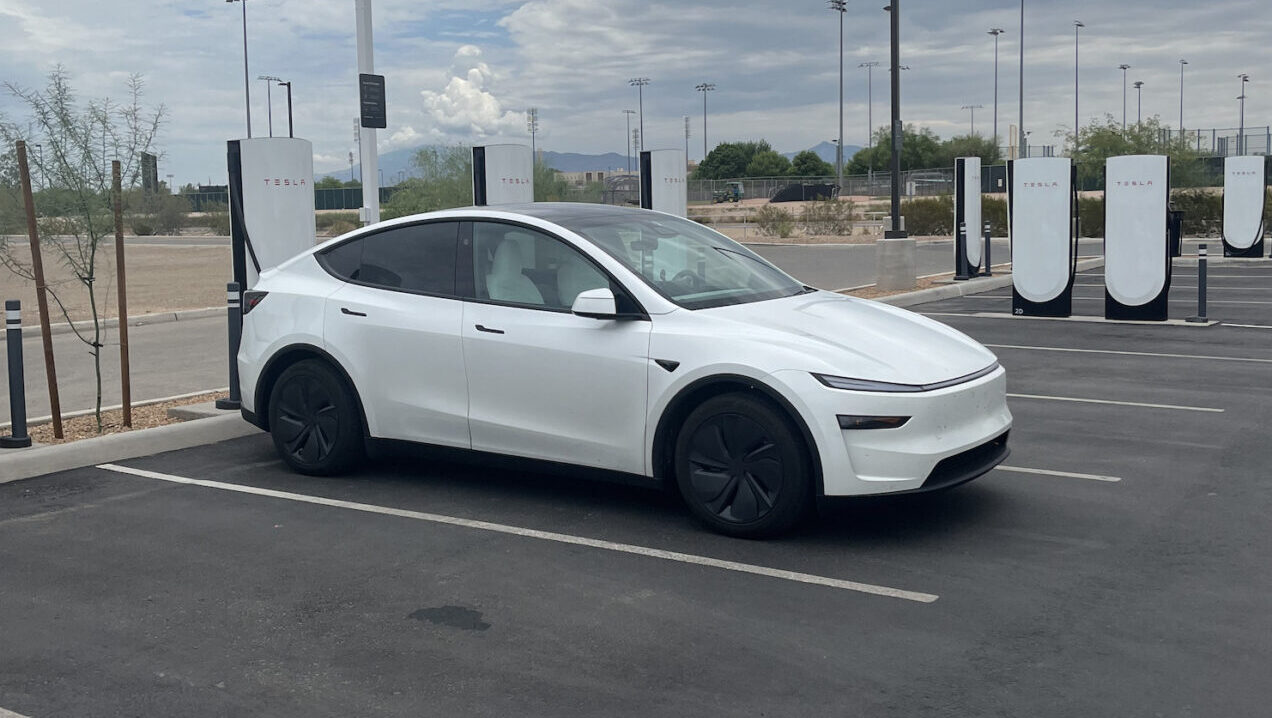
The first three electric vehicle charging stations built as part of a federally funded program in Arizona are now open, the Arizona Department of Transportation announced. (Photo via Arizona Department of Transportation)
(Photo via Arizona Department of Transportation)
The first three electric vehicle (EV) charging stations built as part of a federally funded program in Arizona are now open, the Arizona Department of Transportation announced Wednesday.
There will eventually be a total of around 80 statewide locations constructed as part of a nationwide network of fast-charging stations meant to encourage use of EVs and reduce concerns about battery range.
The three stations are in:
- Tucson at the Rudy’s County Store and Bar-B-Q off Interstate 10 near Kino Parkway
- Green Valley at Verde Valley Center near Interstate 19 and Duval Mine Road
- Wellton at the Chevron near Interstate 8 and Avenue 29 E
Two more locations are expected to open along Interstate 40 in Seligman and Holbrook later this year. There are also 11 other stations that are either currently under construction or being designed.
Additionally, contracts for 14 other projects are expected to be issued by late 2026.
ADOT is administering $76.5 million in federal funding through the National Electric Vehicle Infrastructure Formula Program to build the charging stations.
The traffic authority recently opened bidding for 49 future locations that have an estimated $49 million in federal funding. The bids are the third phase in the network of charging stations, which identifies 31 new locations eligible for EV charging and 18 that weren’t awarded during the first and second phases.
Each station will have at least four 150-kilowatt direct current fast chargers, which are designed to charge an EV in 30 minutes or less. Additionally, most of them will have both the Society of Automotive Engineers North American Charging Standard and the Combined Charging System plugs.
The stations will typically be placed about 90 miles apart and within 3 miles of a highway.
They will be privately owned and operated as federal funds pay for up to 80% of the eligible project costs, while the private developer covers a minimum of 20%.
Proposals for the 49 stations need to be turned in by 2 p.m. on Jan. 15. Construction is then supposed to kick off in 2028 and take around a year to complete.
Related
 Missing 4-year-old found safely in Mesa after Turquoise Alert issued
 Man sentenced to 25 years for sexual assault, harassment and extortion of woman in Mesa
 Arizona distributes $16 million in grants to homeless services providers
 Right lanes blocked on stretch of Interstate 10 in Phoenix due to crash
 Cold Beers & Cheeseburgers announces plans for Carefree location
 Wrong-way crash leaves 2 dead in Tempe

Comments
11 Comments
Hilarious.
I couldn't read your source due to requiring a subscription.
First, Forbes is a left wing EV supporting organization.
Worldwide versus US, big difference.
Many countries have mandated EV sales, that helps sales. We had that but Trump ended that nonsense. US mfg have noted massive losses and declining sales, with some completely ending their EV product lines.
In a free market EV's are dead. The only exception and I've already pointed this out is the hybrid. No charging and unlimited mileage as long as gas is available. Hybrids are the future, not full EV's. Don't get me wrong, there will always be someone willing to buy a full EV.
Not according to an article this week in Forbes:
“Gasoline-only cars lost their global majority for the first time in the first half of 2026, making up 49% of worldwide new-vehicle sales according to Mobility Global data. During this period, global car sales fell by about 5%, but gasoline-only sales dropped by 10% to 20.25 million vehicles. Meanwhile, battery-electric and hybrid car sales grew despite the shrinking market. Battery-electric cars reached 6.87 million sales, and hybrids reached 7.27 million sales. In the European Union, battery-electric sales rose 45% in the first eight months of 2026, matching gasoline cars with a 21.7% market share each. While automakers face financial challenges funding new electric platforms while legacy volumes decline, suppliers of power chips and batteries stand to benefit from the ongoing shift.”
Are you equally concerned about federal tax breaks for oil exploration paid for by EV owners? How about federal subsidies for wheat farmers paid for by gluten-intolerant taxpayers?