
Virtual reality is helping chemistry students at ASU view lessons as real-life situations
Look up "virtual reality ASU" and you'll find a variety of ways Arizona State University is teaching students various subjects, such as chemistry.

Watch: Virtual reality is helping chemistry students at ASU view lessons as real-life situations | 1 min
PHOENIX — Arizona State University is making chemistry classes more engaging by immersing students with visual reality technology.
ASU’s Dreamscape VR program immerses students in realistic scenarios, such as a digitally simulated village with arsenic-contaminated water. Their goal is to design a water filtration system that purifies the supply.
How do virtual reality ASU classes help students?
Lisa Flesher with ASU’s Dreamscape VR program said the VR makes complex lessons more relatable.
“They’re the scientists from day one,” Flesher told KTAR News 92.3 FM. “It’s ownership on their shoulders to be like, ‘I have to figure this out. I need to interpret this data. I need to form hypotheses and conclusions because I don’t want something bad to happen on my watch.'”
Students begin by collecting data in the virtual world, then conduct experiments in the classroom lab. They return to the simulation to test and refine their chemical theories, bridging digital exploration with hands-on science.
ASU has partnered with VR company Dreamscape since 2020. A VR biology course debuted last year, and the university continues expanding its immersive curriculum.


Virtual reality ASU: What students are saying
Flesher said the feedback from that class has been positive, noting that the learning method appeals to students who might not have been interested otherwise.
With an average dropout rate of over 40% in more challenging STEM courses, she emphasized that keeping students engaged is essential.
“Story is something that people remember differently than just studying in a textbook or a lecture,” Flesher said.
“We’re seeing fun results where subsequent semesters they’re remembering things because they’re like, ‘Oh my gosh, there was that creature.'”
Skylar Grayson is a graduate student at ASU who has tried out the experience. She said although VR isn’t going to replace the actual science work, it appeals to more people who may see science in a different way.
“I think that one of the things that people struggle with the science is conceptualizing things that aren’t immediately in front of them,” Grayson said. “When you can visualize the chemical reaction actions that are happening all around you on a scale that you can actually interact with, I think that’s useful.”
Classes begin on Aug. 21.
Funding for this journalism is made possible by the Arizona Local News Foundation.
Related
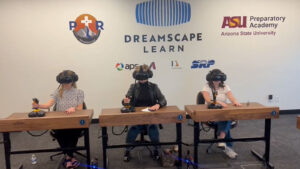 Phoenix school launching immersive classroom program with virtual reality technology
 Honeywell Aerospace in Phoenix develops avionics for autonomous drones, air taxis
 Vice President JD Vance accuses Arizona State, 8 other universities of visa abuse
 What’s on your ballot: Prop 320 would force certain schools to spend more in classrooms
 Here are all the Phoenix-area schools closed since 2024 or scheduled for closure
 Arizona expands aerospace and defense training with new $6.4 million facility

Comments
1 Comments
“It’s ownership on their shoulders to be like I have to figure THIS THIS out''
Which one stutters, the writer or the one being quoted!?!