
President Donald Trump bought up to $5 million of stock in Scottsdale-based Axon
President Donald Trump purchased as much as $5 million in Axon stock just two weeks before ICE solicited a lucrative contract for a type of weapon made by the Scottsdale company.

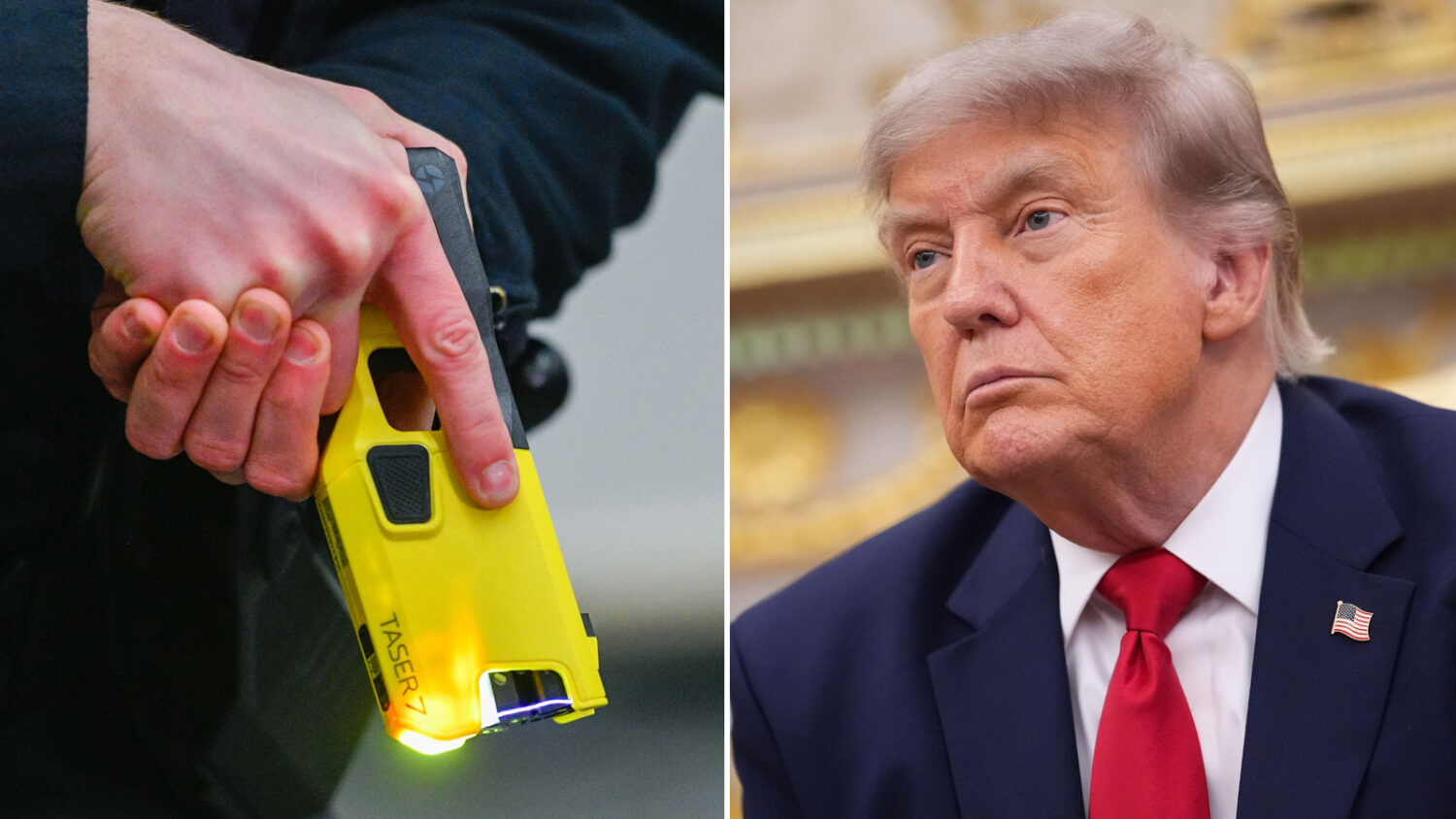
President Donald Trump purchased at least $1 million in Axon stock just two weeks before ICE solicited a lucrative contract for a type of weapon made by the Scottsdale company. (Getty Images file photos)
(Getty Images file photos)
President Donald Trump purchased as much as $5 million in Axon stock just two weeks before Immigration and Customs Enforcement solicited a lucrative contract for a type of weapon made by the Scottsdale-based company, CNBC reported Monday.
“The concern is that [Trump] bought into a company whose business could grow if his own administration expands immigration enforcement,” Jordan Libowitz, vice president of communications at Citizens for Responsibility and Ethics in Washington, told CNBC.
In a statement to the cable news channel, a White House spokesperson denied any conflict of interest. Last month, a spokesperson for the Trump family business told The Associated Press that the president’s portfolio is handled by third parties that have exclusive authority to make investment decisions.
Timing of Trump’s Axon stock purchase and ICE requisition
Trump’s stock disclosure shows price ranges, not specific amounts. He reported a Feb. 10 Axon stock buy of between $1 million and $5 million.
On Feb. 24, ICE published a contract solicitation for 17,800 “conductive energy weapons” for its agents and officers to use as a non-lethal means of subduing hostile individuals. The $220 million requisition includes cartridges and training.
Axon specializes in Taser stun guns that fit the description of what ICE is looking for, and ICE already uses 4,300 Tasers that it wants to upgrade.
CNBC said there are no public records that show what companies responded to the contract posting. There is no indication that Trump is involved in the ICE procurement process.
Still, Deborah Fleischaker, who served as acting chief of staff at ICE during the Biden administration, told CNBC the Axon stock purchase raises “red flags.”
“It is not smart to buy stock in a company that was impacted by the decisions you would be making at the agency,” Fleischaker, a senior advisor for immigration policy and strategy at UnidosUS, told CNBC. “I would have stayed far, far away from actual impropriety, or the appearance of impropriety.”
Related
 Peoria Police Department launches Axon community engagement tool
 Axon housing foes not giving up fight, prepare to sue Scottsdale over deal with Taser-maker
 Chef behind acclaimed LeDu Thai in downtown Phoenix opens supper club in uptown
 Pinal County rezones 4,695 acres of state land for potential massive employment hub
 Arizona TikTok lawsuit alleges app hooks kids, hides risks from families
 True Food Kitchen files for Chapter 11 bankruptcy, closes 12 restaurants

Comments
63 Comments
Multiple bankruptcies and how is Trump university doing these days.
Where's the list of Republicans? You know, like Tommy Tuberville, Roger Marshall, Rand Paul, Rick Scott, Bill Hagerty, Cynthia Lummis, Dan Sullivan, Madison Cawthorn, Pat Fallon, Diana Harshbarger, Blake Moore, Mo Brooks, Lauren Boeberet, Dan Crenshaw, Brian Mast, Kevin Hern, Michael Guest, John Rutherford, Doug Lamborn, Mark Green, Carol Miller, Pete Sessions, Dan Meuser, Maria Elvira Salazar, August Pfluger, Steve Chabot, Victoria Spartz, Rick Allen, Mike Kelly, Chris Jacobs, Austin Scott, Warren Davidson, Lance Gooden, Chuck Fleischmann, Michael Burgess, Jim Banks, Mike Garcia, Rob Wittman, Jim Hagedorn, Roger Williams, and Peter Meijer.
Trump crypto ventures made him $2.3 billion, Trump's crypto investors lost $2.3 billion. That's interesting.