
Phoenix Veterans Day Parade grew from humble beginnings over 30 years
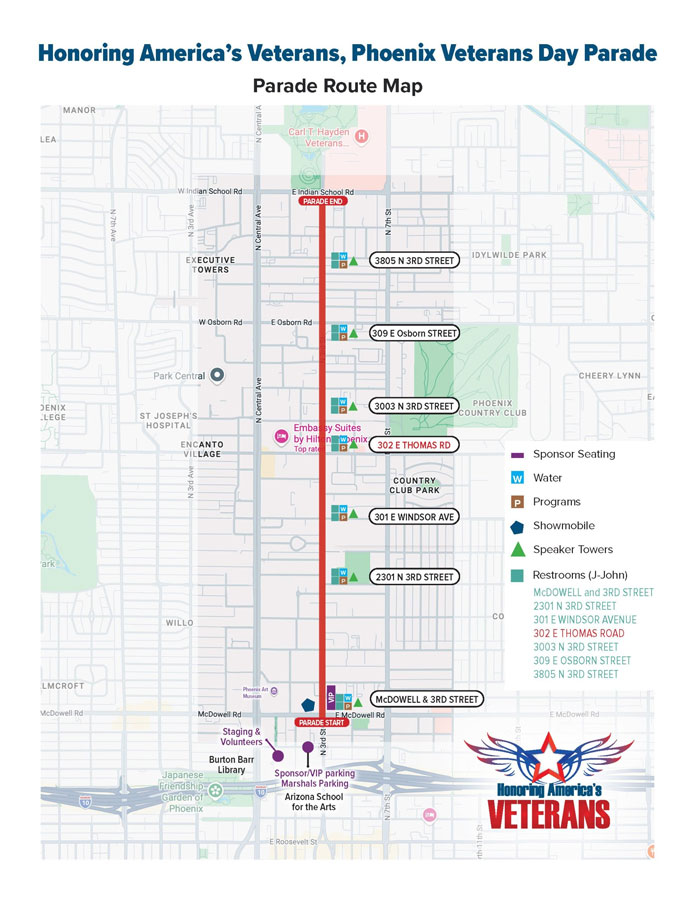
The 2026 version starts at 11 a.m. Wednesday. It has a new route along Third Street from McDowell Road to Indian School Road.

Watch: 100-year-old WWII veteran honored as 2026 Phoenix Veteran's Day Parade grand marshal | 1 min
The annual Phoenix Veterans Day Parade is one of the largest salutes to former military members in the country.
But it did not start that way, according to Paula Pedene, executive director of Honoring America’s Veterans, the group that presents the Phoenix parade.
“It was an initiative [for] a group of veterans in our hospital at the time that wanted to do some community outreach,” Perdene told KTAR News 92.3 FM’s The Mike Broomhead Show on Tuesday.
Pedene, a Navy veteran who was working as a public affairs officer for the Phoenix VA Health Care System at the time, said the first parade in 1997 was not successful.
“It was so poorly attended and so unorganized the very first year, before I got involved, that my boss told me the next week when I met with him, ‘That parade has got to be better.’ And it was one of those things where you just look at him and say, ‘Yes, sir,’” Pedene said.
Pedene said she worked with city officials and other stakeholders to build the event into what it is today.
In its 30th year, Phoenix Veterans Day Parade has new route
The 30th annual Phoenix Veterans Day Parade begins at 11 a.m. Wednesday on a new route along Third Street. It starts at McDowell Road and ends at Indian School Road, not far from the Carl T. Hayden VA Medical Center.
Delmar DeWitt Beard of Glendale, a 100-year-old World War II veteran, is serving as a grand marshal, while two-time Super Bowl champion quarterback Jim McMahon is the celebrity grand marshal.
Pedene said the parade brings the community together and serves as a reminder of the sacrifices made by military members.
“The parade is a visual identifier of what freedom means and what it costs, because not every veteran comes back OK,” she said.
Pedene said 15% of veterans return home with mental health issues, including some who struggle with homelessness.
“The other 85%, though, assimilate into our community and lots of times don’t even talk about their military service,” she said. “So when you get them in the parade, then it makes a difference.”
Related
 Phoenix plans to enter Stage 2 of drought management plan, which includes surcharge for certain customers
 Fugitive wanted for child sex crimes in Arizona captured in Mexico after 9 years on run
 Internal investigation of 2 Buckeye firefighters finds ‘severe and pervasive’ sexual harassment
 Roosevelt Lake rises 22 feet as wet October boosts Salt River Project water supply
 Arizona confirms 6th screwworm case in Cochise County, expands infested area
 Man sentenced to death for sexually assaulting, killing woman at Phoenix gas station in 2020

Comments
0 Comments