
This US House district was once a political battleground. Now it shows why Congress is dysfunctional

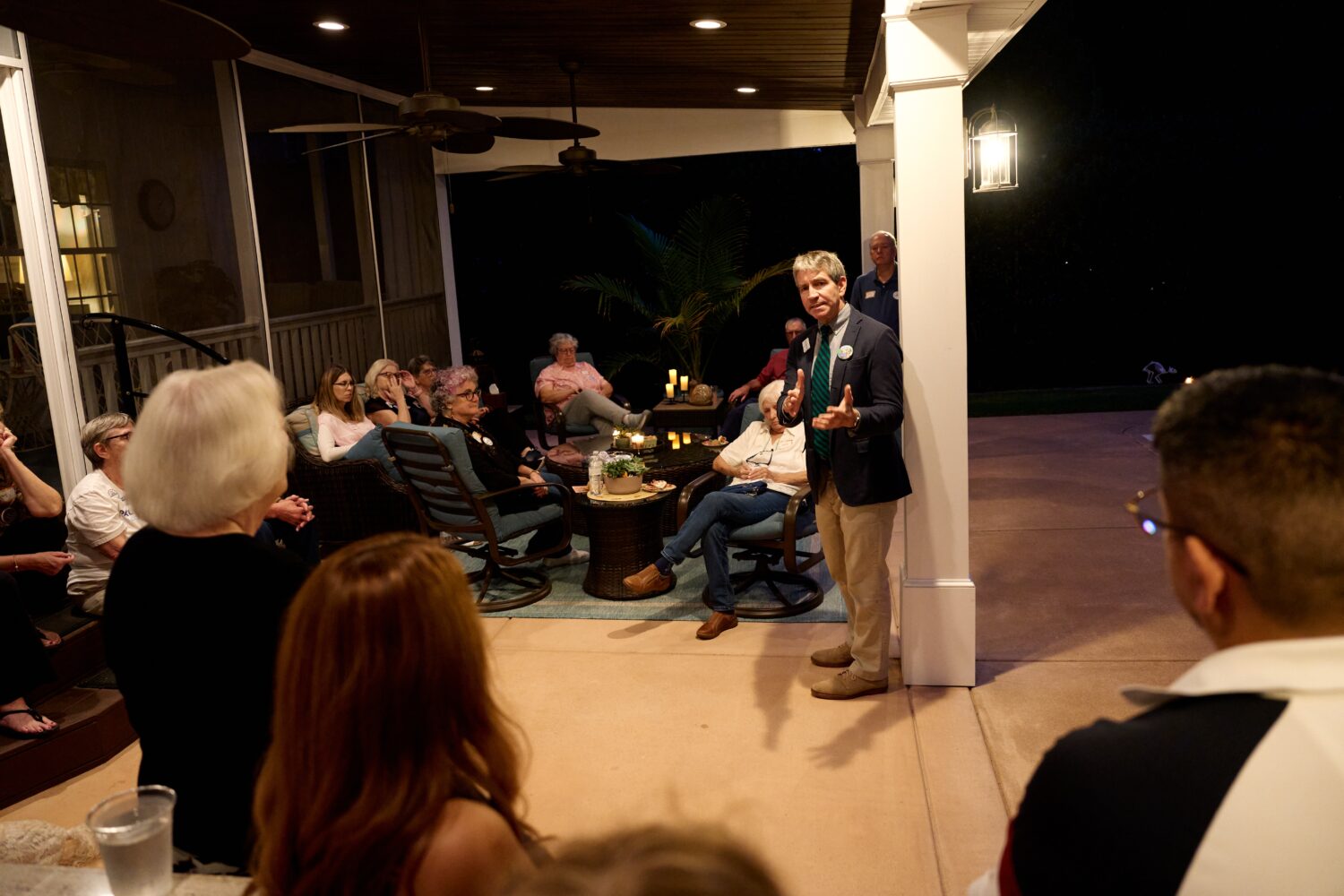
Paul Barringer, the Democratic nominee running for North Carolina's 13th Congressional District, speaks with voters at a campaign event, Oct. 8, 2026, in Garner, N.C. (AP Photo/Matt Ramey)
Credit: AP Photo/Matt Ramey
(AP Photo/Matt Ramey)
RALEIGH, N.C. (AP) — In 2022, Democrat Wiley Nickel ran as a moderate and narrowly won North Carolina’s 13th Congressional District by about 9,000 votes. Two years later, the current congressman, Republican Brad Knott, ran as a conservative and coasted into the U.S. House by more than 70,000 votes.
Voters didn’t change their minds. Politicians changed their voters.
North Carolina’s Republican-controlled legislature redrew its congressional map to transform what was one of the last remaining swing districts in the South to a safe GOP seat. Lawmakers split the rectangular district into an hourglass shape that carved out Democratic voters in Raleigh and replaced them with a swath of rural counties reaching to the Virginia border.
Swing seats, meaning a district a presidential candidate won by 5 percentage points or fewer in the previous election, are disappearing from the national map. For decades after World War II, the number of competitive seats in the House slowly eroded as the nation grew more polarized, voters were less likely to split their ticket and people moved closer to like-minded neighbors, creating Democratic strongholds in urban areas and Republicans ones across rural America.
That decline accelerated the past year since President Donald Trump sparked a partisan redistricting battle. The number of swing districts fell from 45 to 37. There were 96 House seats that fit the modern definition of a swing seat in 1964, according to one count from the 1970s, when the shrinking number of such districts was first noted.
That means the overwhelming majority of House seats are effectively won in primaries, with the support of only a fraction of highly ideological voters. Nickel saw the impact during his term.
“The biggest divide I found in Congress wasn’t Democrat versus Republican, it was safe seats versus competitive seats,” Nickel said. “When your focus is on running a campaign where you talk to every single voter, you look at things differently and your focus is on solving problems.”
Unite America, an organization pushing alternatives to party primaries, calculated that 87% of representatives elected to the House in 2024 were chosen by 7% of the country’s voters.
“Voters don’t have any way of holding Congress responsible, except for a narrow window of swing districts,” Nick Troiano, the group’s executive director, said in an interview. “The least competitive election of our lifetimes will lead to the least accountable and least representative Congress of our lifetimes.”
Republicans are hoping the narrow range of competitive seats limits what Democrats can win on Nov. 3.
“Both sides are fighting over a narrow House battlefield,” said Mike Marinella, a spokesman for the National Republican Congressional Campaign. “It’s a knife fight in a dark alley.”
The alley may be widening this year, but it still is an alley. Democrats have expanded their political targets, with the unpopular Iran war and voters angry about high prices.
There is a long-standing debate among academics as to how much of the decline can be blamed on partisan-motivated redistricting, known as gerrymandering, and how much on Americans’ increasing proclivity to live among like-minded people who vote the same way.
Multiple studieshave found that, without partisan gerrymandering, the House would have about double the number of competitive seats it has now.
Nickel decided not to run for reelection after studying election returns dating to 2016 and finding that no Democratic incumbent had held on in a seat where Trump took 55% or more of the vote. Trump received 58% of the vote in the new district. Nickel eventually ran for district attorney of Wake County, the deeply Democratic county that was largely cut out of the 13th District.
He won his primary and will take office in January. No Republican ran.
That highlights how North Carolina, and the country, have effectively become segregated by political party.
Only 15% of North Carolina’s voting precincts could be classified as politically competitive, according to Michael Bitzer, a political scientist at Catawba College.
“For the average North Carolinian, depending on where they live, if they drive an hour in any direction they will be in a very different North Carolina,” he said.
That certainly is the case traversing from the old 13th District to the new one, anchored in subdivisions and soybean and tobacco farms that stretch away from Raleigh.
Here, few are talking about the congressional race. They see no reason to vote for anyone other than a Republican.
“It’s just what I’ve always been,” said Linda Long, 62, a Republican in the town of Roxboro who works at the local Walmart.
This is what Paul Barringer is up against.
The Democratic nominee against Knott hopes for an upset in a year when even GOP members in safe seats like the 13th District are running scared. Neither Knott’s office nor his campaign responded to a request for an interview.
Barringer, a former healthcare lawyer who returned to the tree farm in the district where he grew up, said he was previously a Republican but switched parties to run, hoping he could attract voters of all stripes.
“I think people are disgruntled about things that are happening,” Barringer said. “They want people who will find ways to work together.”
National Democrats added the seat to a list that could flip in such a favorable environment. But many doubt it.
“They’re blowing smoke,” Linwood Parker, the 78-year-old mayor of Four Oaks, said of Democrats’ hopes they could win the district.
Parker is a lifelong Republican who knows that gerrymandering is a decades-old tradition in North Carolina. Democrats used to do it until they lost power in the 2010 wave. Now Republicans do it.
“Redistricting is just one of the levers that when Republicans, when they are in control, have to touch,” Parker said. “Otherwise it’s like saying, when we play this baseball game, we’re going to have three outs, we’ll give you two.”
Related
 Halloween candy sales are off to a slow start amid high chocolate prices and affordability concerns
 Consumer sentiment slides in Phoenix as gas prices, mortgage rates climb
 Cracking a smile regularly may be good not just for your mood but for your health
 Some US transit systems weigh whether to run trains without a human at the controls
 Sexual harassment rules for Congress are under review after a flurry of ethics cases
 This US House district was once a political battleground. Now it shows why Congress is dysfunctional
Comments
1 Comments
Gerrymandering, by both sides, needs to be made illegal. It leads to “congressmen” like Andy Biggs and Maxine Waters. We deserve better.