
Better water starts with knowing all the information
Water treatment technology is changing and you no longer necessarily need a large kitchen or a cabinet to have treated drinking water at the sink, but before you decide on a system, it helps to know a bit more about Arizona's drinking water.

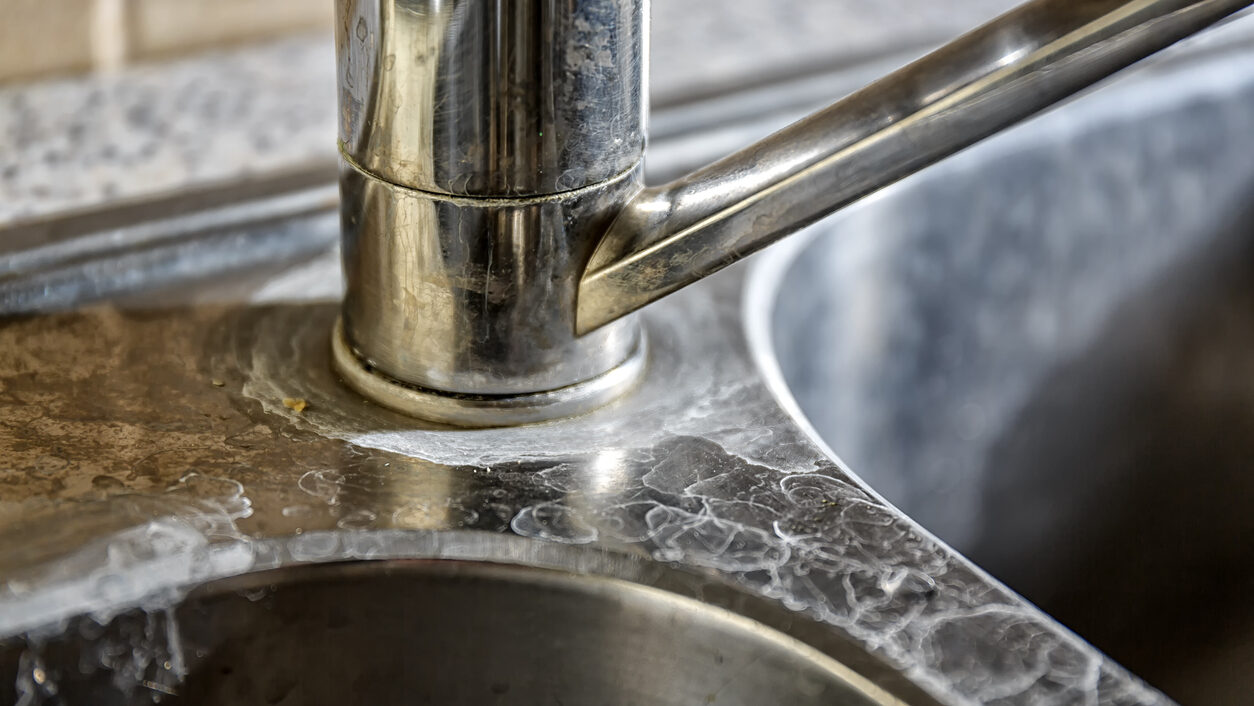
Close-up of a kitchen tap and sink with hard water calcification. (Photo via iStock)
(Photo via iStock)
When most people think about adding a water filtration system to their home, they probably picture a bulky tank beneath the sink, surrounded by tubing, filters, equipment and, of course, the requisite cleaning supplies. If your kitchen already has a deep sink and garbage disposal competing for that space, adding anything can feel like a pain.
Water treatment technology is changing, and according to Jon Owens of AquaZona Kinetico (a Rosie Certified Partner), you no longer necessarily need a large kitchen or a cabinet to have treated drinking water at the sink — but before you decide on a system, it helps to know a bit more about Arizona’s drinking water.
Where does our water come from?
Arizona gets its water from several sources, including the Colorado River through the Central Arizona Project, the Salt and Verde rivers through the Salt River Project and groundwater wells. The city of Phoenix has a new one Advanced Water Purification (AWP), and the public service program is branded as “Pure Water Phoenix.” That is the city of Phoenix’s name for “Toilet to Tap” reuse. No city depends on a single source, so depending on where you live, the water coming out of your faucet could be a combination of those.
As water travels through rivers, aquifers and infrastructure, it picks up naturally occurring minerals like calcium and magnesium. Most contain between 15 and 25 grains of hardness per gallon, which in Arizona is considered “extremely hard.” Basically, lots of dissolved minerals make their way into our homes.
Hard water isn’t necessarily unsafe water. Municipal water suppliers treat their water to meet drinking-water standards, regularly test it and typically publish annual water-quality reports. But meeting safety standards doesn’t mean the water is free of minerals.
What’s in it?
If you’re wondering whether your home needs additional drinking water treatment, start with your water utility company’s Consumer Confidence Report, which provides information about the community’s water source, detected contaminants and compliance with drinking-water standards. You can also do a water audit — a professional assessment that helps homeowners understand water quality and determine the most effective, budget-friendly solution.
During the audit, you can expect a thorough evaluation that includes checking your plumbing, water pressure and all water-using appliances and fixtures.
“After the client has done their homework and research, we go to the home for an on-site test. We start with the pipe size at the point of entry, construction, water pressure and we look at things like the water heater(s), laundry, etc.,” Owens said. “If they have any water quality reports, we integrate those to provide options that are best for that particular application.”
Water softeners and purification systems also have different jobs. A softener is designed for the home’s “working” water: showers, laundry, cleaning, appliances.
By reducing calcium and magnesium, softened water can help minimize buildup, reduce spotting and soap scum, keep laundry softer and help protect plumbing fixtures and appliances from scale. A softener, however, isn’t a purifier.
If you’re concerned about taste, odors or contaminants, look for filtration or purification technology developed to address those concerns. That’s where reverse osmosis (RO) comes in.
Traditional under-sink RO systems use a membrane to separate treated water from a stream carrying impurities away. Conventional systems usually require multiple components, including filters and a storage tank. Think of a traditional RO system as a small reservoir. It treats and stores water so it’s available when you turn on the faucet.
Let’s talk efficiency
Efficiency is another question worth asking when you’re comparing systems. According to the U.S. Environmental Protection Agency, a typical point-of-use RO system can send five to 10 gallons or more to the drain for every gallon of treated water it produces. The actual amount varies by equipment, water conditions and how the system is operated.
That doesn’t mean every RO system performs the same way. When comparing equipment, Owens says you should look beyond the words “water filtration” and ask exactly what a system is designed and certified to reduce.
“The practical benefit is treated water for drinking and food preparation, with improvements in taste, smell and appearance,” Owens said. “Water Quality Association Performance Certification gives you a way to evaluate performance beyond the appearance of the equipment.”
Don’t judge a system by how it looks under your sink. Look for independent performance certifications and understand what the specific system has actually been tested to reduce.
Choosing the right system
Arizona’s hard water is something every resident has to get used to. You don’t have to treat every drop that enters your home, and you don’t necessarily need the same treatment system as your neighbor. Start by learning where your water comes from and what it contains.
Then consider how you use water throughout your home. Softening can address the mineral-related problems that affect laundry, fixtures and plumbing. Filtration or reverse osmosis can target drinking and cooking water.
If your first thought is, “I have zero room under my sink,” don’t worry. Tankless RO technology takes up less room while providing treated water on demand.
“Kinetico’s new HYDRO® ECO Tankless Reverse Osmosis System is designed to bring reverse osmosis drinking water treatment to spaces where a traditional system may not fit. That includes smaller homes, condos, townhomes, apartments, guest houses, ADUs and even some mobile homes, park models and RVs,” Owens said.
The goal here is to understand your water well enough to choose the treatment that makes sense for your home.
Related
 Good flooring starts below the surface
 Garage door warning signs homeowners shouldn’t ignore
 Home batteries can change the way your house uses energy
 Maintenance tips for protecting your home inside, out
 Smart ways for Arizonans to secure their homes
 Window leaks, warning signs every homeowner should watch for
Comments
0 Comments