
NASA spacecraft discovers a huge new crater on the moon

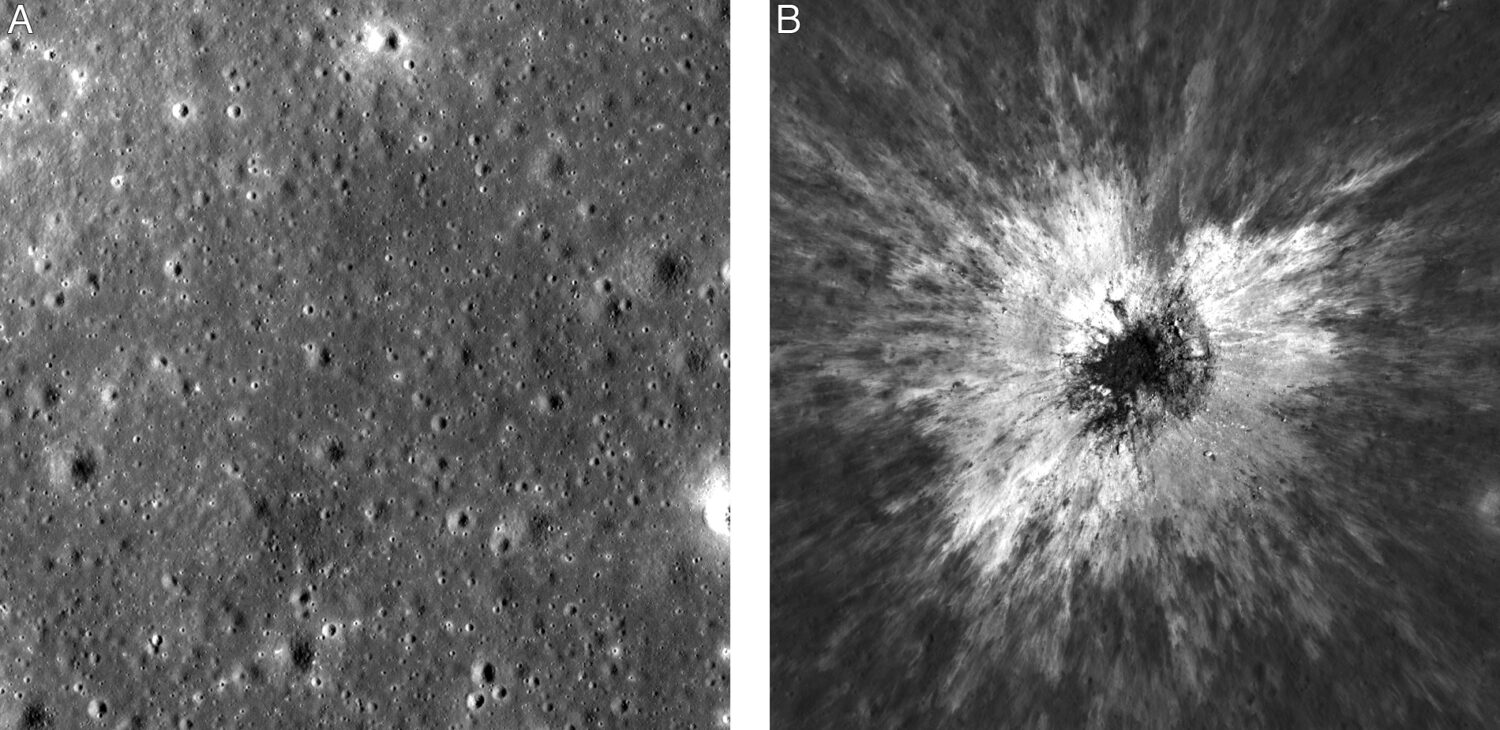
This combination of photos made by NASA's Lunar Reconnaissance Orbiter shows the same area on the surface of the moon before and after a newly-discovered crater in May 2024. (NASA/Goddard Space Flight Center/Intuitive Machines via AP)
Credit: NASA/Goddard Space Flight Center/Intuitive Machines via AP
(NASA/Goddard Space Flight Center/Intuitive Machines via AP)
CAPE CANAVERAL, Fla. (AP) — Scientists have discovered a crater on the moon that’s bigger than the Roman Colosseum and is the result of a powerful impact two years ago that initially went undetected.
The steep-sided hole — about 728 feet (222 meters) across and up to 141 feet (43 meters) deep — is the solar system’s biggest known impact crater carved out in recent times.
Such a large-scale event is estimated to occur only once every 132 years, researchers said, making this a treasure trove of information as NASA prepares to build a base for astronauts on the moon.
“This event constitutes a statistically rare, effectively once-in-a-lifetime observation,” the scientists wrote in one of two studies appearing on the subject Wednesday in the journal Science Advances.
NASA’s Lunar Reconnaissance Orbiter spotted the crater on the moon’s near side in May 2024 soon after it was formed by an incoming fragment of an asteroid or comet. The moon strike escaped real-time detection by telescopes on Earth and in space.
LRO’s wide-angle images were not identified in the crush of data until August 2025. The spacecraft gathered more detailed pictures last fall, followed by confirmation of the discovery early this year.
The crater — named for the late Thomas McGetchin, a former director of Houston’s Lunar and Planetary Institute — is three times bigger than the previous record-holder found by the LRO a decade ago. Pockmarked since ancient times, the moon bears some of the solar system’s largest impact craters, including one that stretches more than 1,500 miles (2,400 kilometers) across.
This latest impact churned the lunar surface for more than 66 miles (100 kilometers). Dust and rocky soil were hurled away at a higher angle than expected, according to Mark Robinson, chief scientist for the LRO’s cameras who works at Intuitive Machines. Robinson was the lead author for one of the studies.
A separate study identified a 4-mile-wide (7-kilometer-wide) cold spot around the new crater, consistent with a loosening of the moon’s top soil. Co-author David Paige of the University of California, Los Angeles, likens it to gardening.
“We’re now thinking of impacts as a way to garden the regolith — churning the sediments and putting stuff above that’s usually below the surface,” Paige said in a statement.
The LRO’s numerous crater discoveries since its launch in 2009 show that the moon’s top inch (2 centimeters) of soil is being overturned by ejected material every 80,000 years, faster than previously thought, according to Robinson.
Contrary to the popular belief that the Apollo moonwalkers’ dusty lunar footprints will last forever, they will “definitely be long gone in that time frame,” Robinson said in an email.
The next step is to calculate the risk of ejected crater material striking NASA’s planned moon base, he added. “That information will help engineers harden structures so one won’t have to worry about damage, or maybe worry less.”
___
The Associated Press’ health and science coverage receives financial support from the AP Fund for Journalism and private foundations. AP is solely responsible for all content. Find AP’s standards for working with philanthropies, a list of supporters and funded coverage areas at AP.org.
Related
 Fed rate hike will likely push borrowing costs on credit cards, mortgages — but benefit savers
 Flash flood warning issued for parts of Gila County and Maricopa County
 KTAR town hall panelists weigh on Prop 144, a ballot measure about elections
 Fencing goes up around the main Kennedy Center building after Trump-aligned board votes to close it
 Upper Verde River on verge of earning state’s highest water quality protection levelJimmy Lai’s son pleads in Washington for his father’s release ahead of Xi’s US visit
Comments
0 Comments