
How did Arizona wind up with a decade-long teacher shortage — with no end in sight?
Arizona has been facing a teacher shortage for years, with educators leaving the profession or state because of low salaries, high workloads and a variety of other factors.

Watch: Arizona's Teacher Shortage Crisis | 1 min
Arizona children are heading back to class for the new school year — but do they have a qualified teacher?
Arizona has been facing a teacher shortage for years, with educators leaving the profession or state because of low salaries, high workloads and a variety of other factors.
Arizona’s public district and charter schools had 59,836 teachers in 2025, about 14% of whom left the classroom during the year, according to state Department of Education data. That’s approximately double the nationwide rate as reported by the Learning Policy Institute.
Superintendent of Public Instruction Tom Horne said that the state is losing double the number of teachers it is gaining.
Low pay cited a major reason for Arizona’s teacher shortage
Peter Boyle, senior director for education at the Center for the Future of Arizona (CFA), said it’s been a decade-long problem in the state. Relatively low teacher pay is a major reason.
According to the National Education Association, the average salary of an Arizona teacher is $64,291. That’s below the state’s minimum living wage — defined as the “income needed for family of one adult and one child to have a modest but adequate standard of living in the most affordable metro area” — of $71,277.
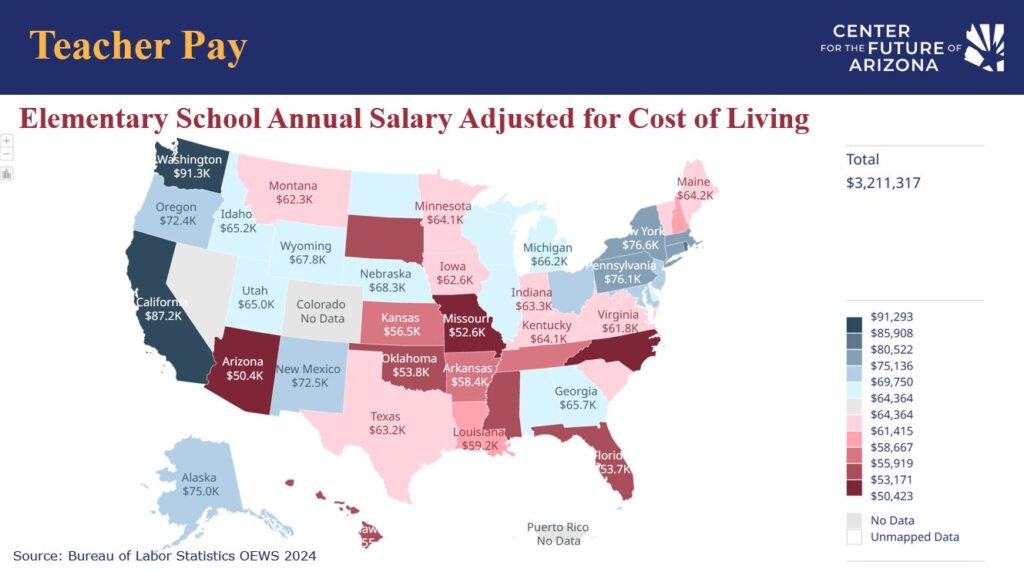
Boyle said the Red for Ed movement in 2018 helped solve part of the problem by pushing then-Gov. Doug Ducey and the Legislature to phase in a 20% pay increase for teachers, but that was not enough to keep the state’s salaries competitive.
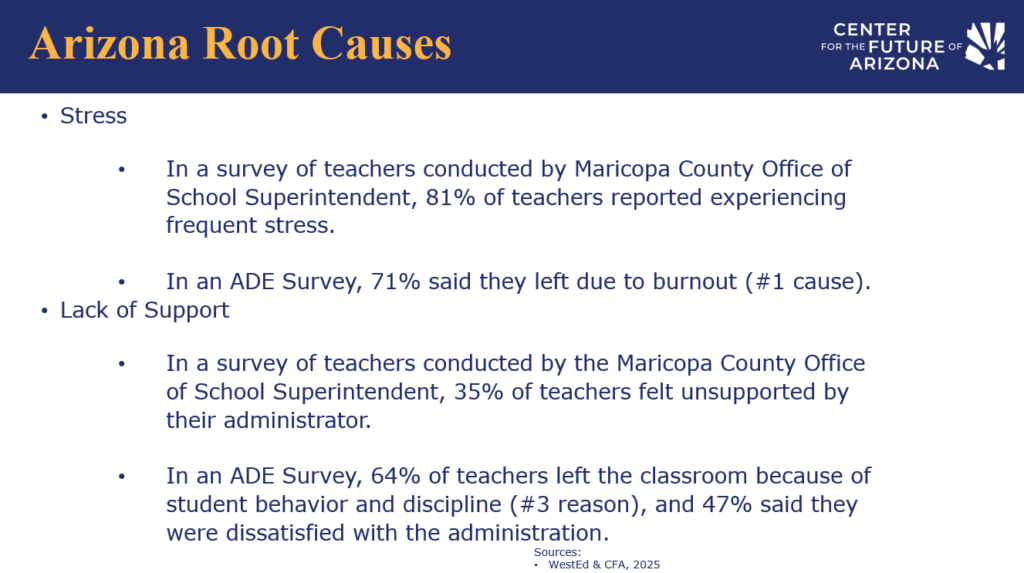
“We were so low that even though in many cases that increase was significant, it moved us from like way, way, way down to way down,” he said. “It addressed one of the particular issues that’s causing an educator retention crisis, which is compensation. But in looking at the data, too, compensation is just one of many factors that are contributing to our education retention issues here in Arizona.”
Arizona teachers share their stories about struggling to make a living
Joshua Murray is a current Buckeye Union High School District English teacher. He said he’s taught for 12 years but took a break from teaching in the middle because of the low wages. He explained that he had to take a second job tutoring and take out loans to get by.
“I think … a lot of teachers’ frustration is that we are professionals, we do get these degrees, but when it comes to the actual salary and surviving in the current economy, it’s very difficult,” he said.
Libby Brauss, a former preschool teacher at the Arizona State Schools for the Deaf and the Blind, said she chose not to renew her contract this summer because of the pay and the amount of work being added to an already full to-do list. She said she had been in a pay freeze for years, with no evidence that it would change soon.
“It became frustrating to know that myself and my colleagues were being asked to do more and more for less and less money and less pay. The stipends for additional work were taken away, but the work that was needing to be done still remained,” she said.
Horne said it’s a bad look for Arizona when teachers are leaving because of money struggles.
“It’s very damaging to the state that we pay our teachers so badly. We’re at the bottom of the pack as far as we pay our teachers. They can make a lot of money by moving to a neighboring state,” he said.
According to the National Education Association, the average teacher salary in Utah, Colorado and Nevada is over $72,000.
Teacher retention is a complex issue
The Arizona Department of Education sent surveys this year to more than 9,000 certified K-12 teachers with questions about why they are or aren’t staying in the classroom. Of the 2,076 responses, 6.8% said they do not plan to return for the new school year.
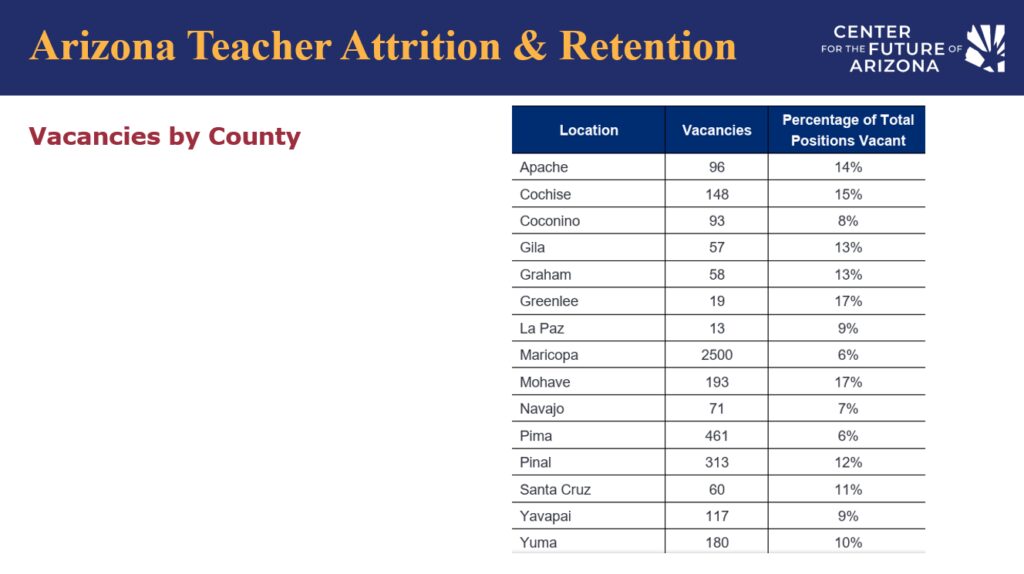
The shortage is worse in rural areas, with Greenlee and Mohave counties seeing 17% of teacher slots remaining vacant. The Maricopa County vacancy rate is 6%, according to CFA data.
Arizona’s education system may be changing in the next decade regardless of teacher salaries, as slowing population growth impacts the number of jobs available. The state had 18,000 more high school seniors than incoming first graders in the 2025-26 school year.
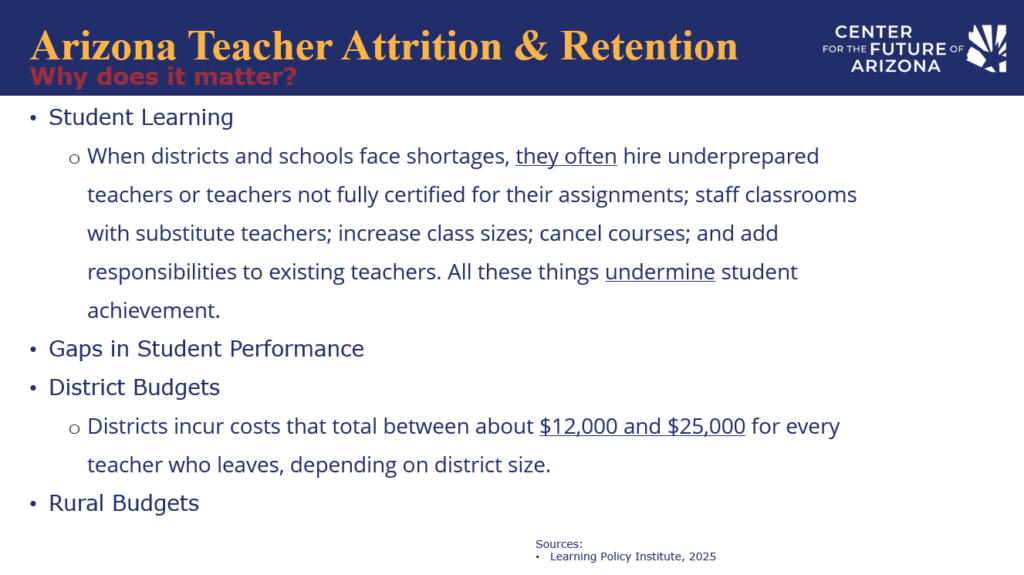
On top of that, each teacher who leaves the classroom costs a district between $12,000 and $25,000. This, in turn, takes away funding that could have gone to other teachers or classroom expenses.
Another factor in Arizona’s teacher shortage is working conditions. Boyle said that with reduced classroom staffing, the remaining teachers can wind up with increased workloads, larger class sizes and extra classes.
When spots are left open, they can be filled in a variety of ways. Schools can hire contracted or nonqualified teachers, create multi-grade classes, collapse classes or recruit current teachers to take over courses.
Boyle said those things can increase the burden for current teachers.
“If you’re a third grade teacher who’s planning on teaching third grade and all of a sudden you’ve got a bunch of fourth graders in your classroom, you’re teaching two sets of standards, preparing for two standardized assessments, dealing with two different levels potentially of developmental needs. And that, again, is sort of an additional tax, if you will, on the educator workload,” he said.
According to the state Department of Education, only 67% of Arizona teachers were certified in 2025-26. That was after 25% of vacancies remained unfilled in 2024, according to the Center for the Future of Arizona.
Can Arizona’s teacher shortage be fixed soon?
The current state of the Arizona education system impacts the future, as well, with students thinking about getting into teaching see a bleak landscape.
Victoria Theisen-Homer, founding director of Arizona Teacher Residency, which trains future teachers using an in-classroom experience, said a large problem for education students is that they are trained how to teach lessons but are not always prepared for other aspects of the job, like angry parents or misbehaving children.
“The future of our society starts in the classroom,” she said. “So, it’s really important that we are providing these candidates with a full holistic experience of what it is to be a teacher before they enter because if they don’t have a full understanding of that whole job, then they’re going to enter and they’re not going to feel like they can float.”
Horne said the education system is a big circle, with students being educated and then going on to become teachers themselves. He said the whole circle in Arizona has issues, and that is making it hard to improve in any area.
“It’s up to us to produce students who are ready to succeed in college, and it’s up to them to train teachers who can prepare the students properly,” the state superintendent said. “And I think in both cases, improvement is needed.”
Brauss, the former preschool teacher, said she was unaware of the struggles teachers face when she first entered the profession. She said she might have reconsidered moving to Arizona for a job if she had a better understanding of how teacher pay and raises worked.
“I didn’t really understand what that meant,” she said. “So now, I do feel this responsibility to have those conversations with preservice teachers.”
With this many factors contributing to the teacher shortage, Boyle predicts it will continue for the next decade.
“It’s one thing to say, ‘Hey, we’ve got a lot of folks leaving,’ but we also have to recognize that we don’t have a ton of new teachers coming into the pipeline. Those numbers are down too,” he said.
Editor’s note: This is the first installment of a two-part KTAR.com series on Arizona’s teacher shortage. The second part looks at solutions. KTAR 92.3 FM also is covering the issue on the air all week as part of a wider effort with 14 newsrooms participating in a collaboration project with the Arizona Local News Foundation.
Funding for this journalism is made possible by the Arizona Local News Foundation.
Subscribe to the KTAR Eyes on Education newsletter to get our top education stories, exclusive guest interviews and more to your email inbox.
Related
 Vice President JD Vance accuses Arizona State, 8 other universities of visa abuse
 What’s on your ballot: Prop 320 would force certain schools to spend more in classrooms
 Here are all the Phoenix-area schools closed since 2024 or scheduled for closure
 Arizona expands aerospace and defense training with new $6.4 million facility
 Scottsdale Unified approves closure of two schools amid declining enrollment
 University of Arizona puts all fraternity chapters on ‘activities suspension’ amid investigations

Comments
6 Comments
Why are the superintendents never held accountable for their lack of leadership, they need to manage their own budget, they are some of the highest paid state employees, there is plenty of money allocated to education, it is managed by incompetent people
I hear the same things from the teachers I know. All this admin, but they don't actually do much to help the students or teachers. Sure they keep busy, but it's more that they make busy work and more burden for the teachers. The teachers still end up doing the real admin work. My friends school makes the teaches do bus duty, recess duty, student and teacher paperwork and forms, build curriculum, get school supplies, plan trips. Seems like a long list of things admin could be doing. Instead they create the busy work projects that no-one wants to do, that just burden the teachers more.
Your point re: "cutting back on the bureaucracy of the administration"
is well taken.
I've known a few teachers, and a common theme when they get together and complain is.. how "Top Heavy" the administration is in the education system, how well administrators are paid, and how little value they actually bring to the table.