
Arizona named Southwest regional hub for semiconductor education
Arizona was named as a hub to organize and support education and pathways for the microelectronics industry across multiple Southwest states.


Arizona was named the new National Network for Microelectronics Education (NNME) Southwest regional node, receiving funding to organize and support education and pathways for the microelectronics industry across multiple states.
The hub will be run by the SEMI Foundation and the Arizona Commerce Authority. It’s funded by the U.S. National Science Foundation Directorate for Technology, Innovation and Partnerships in partnership with the U.S. Department of Commerce.
The Southwest hub will work to serve Arizona, Southern California, Colorado, New Mexico and Utah, receiving $5 million in the first year and up to $20 million over the first five years.
Southwest hub will partner with local semiconductor companies and schools
The hub will partner with more than 45 local semiconductor companies, including Intel, as well as K-12 schools, colleges and universities, career and technical education programs and other workforce development programs. The funding will be distributed among the hub’s partners to support programs.
Kolu Wilson, chief workforce officer with the Arizona Commerce Authority, said 33% of the program’s partners are education organizations.

“They are now able to leverage all of the tools and the resources and the curriculum by other partners that are within our regional node. They don’t have to start from scratch. They are now also connected to all of our partners, including our employer partners semiconductor companies,” she said during a launch event Wednesday at JA BizTown, which is part of Junior Achievement of Arizona.
Shari Liss, vice president of Global Workforce Development & Initiatives at SEMI, said by 2030 there will be a shortage of approximately 150,000 semiconductor and microelectronics workers in the U.S.
“We’re hoping that the NNME will ensure sure that the workforce can keep up with that pace … our partners, our member companies, the companies that need to hire have to be part of this conversation in order to make this work. But so do all of our academic institutions, and so do our K-12 organizations,” she said. “Everybody has to [have] a part.”
Wilson added that the hub could give students the opportunity to learn more about the industry before deciding whether to pursue a career in semiconductors or microelectronics.
“The more we expose the industry to job seekers and students, they may enter coming straight out of high school. They may enter coming out of a community college program. They may enter coming out of a PhD. So, we want to provide the entire education continuum to job seekers and students so they understand where they may enter into the industry,” she said.
Funding for this journalism is made possible by the Arizona Local News Foundation.
Related
 ASU teams up with TSMC Arizona for free semiconductor training program
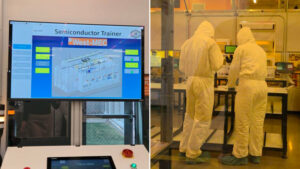 Phoenix trade school opens nation's 1st semiconductor cleanroom for K-12 students
 School board protest halts business in Phoenix district
 Apache Junction offers a la carte public school classes for ESA families
 Red Mountain High School stays open despite flooding, electrical issues
 Arizona superintendent hopefuls debate ESAs, education funding and teacher pay

Comments
1 Comments
Nice to see this. One cannot help but wonder though, with reports of U.S. employees at fab plants in the southwest experiencing a lot of difficulty (cultural issues, safety issues, work environment issues, preference to Asian employees), will these people getting this great training be able to find gainful and fulfilling employment?